

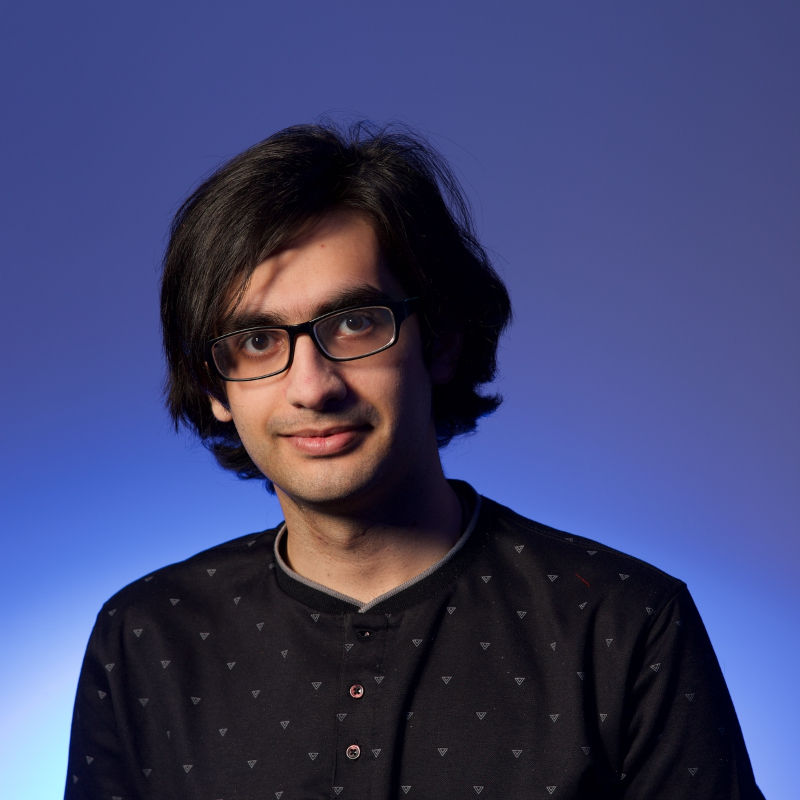
 Shouvanik Chakrabarti
· 3 previous affiliations
- J.P. MorganSince 2022
- Researcher · Since 2022
- University of Maryland, College Park2017–2022
- PhD student · 2017–2022
- Undergrad student · 2013–2017
Research Overview
Shouvanik Chakrabarti focuses on quantum algorithms for convex optimization, machine learning, and theoretical computer science. His early work explored sublinear quantum algorithms and variational quantum circuits for near-term hardware. More recently, his research investigates the theoretical limits of quantum advantage in global optimization, zeroth-order gradient methods, and combinatorial search.
Research Trajectory
Chakrabarti's early research established foundational algorithms for quantum machine learning and optimization. In 2019, he introduced Quantum Wasserstein Generative Adversarial Networks, proposing a quantum analogue to classical WGANs to improve the robustness of adversarial training on noisy quantum hardware. Concurrently, he contributed to the development of Sublinear quantum algorithms for training linear and kernel-based classifiers. This work intersected with the broader research area of The Computational Cost of High Precision and advanced the theoretical understanding of the direction Quantum Query Complexity Lower Bounds. Expanding on the tools required for quantum machine learning, he collaborated on On the principles of differentiable quantum programming languages, which formalized auto-differentiation techniques for variational quantum circuits and imperative quantum programs. In 2020, he formalized the quantum complexity of general convex optimization in Quantum algorithms and lower bounds for convex optimization, providing rigorous bounds for problems beyond semidefinite programming.
Continuing his focus on algorithmic speedups, Chakrabarti developed Sublinear Classical and Quantum Algorithms for General Matrix Games, utilizing a primal-dual framework combined with novel quantum sampling techniques to achieve optimal dimension-dependent runtimes. He also addressed the practical challenges of near-term quantum applications in ICCAD Special Session Paper: Quantum Variational Methods for Quantum Applications, proposing theory-guided principles for training domain-specific variational ansatzes. Applying these variational methods to finance, he led the resource estimation for A Threshold for Quantum Advantage in Derivative Pricing. This study introduced a re-parameterization method that combined pre-trained variational circuits with fault-tolerant computing to reduce the logical qubit requirements for pricing complex derivatives. This foundational period of research culminated in his 2022 dissertation, Quantum Computing for Optimization and Machine Learning, which synthesized his contributions to processing massive datasets with quantum algorithms.
In 2023, Chakrabarti's work expanded into geometric computations and the training dynamics of quantum neural networks. He contributed to Quantum Algorithm for Estimating Volumes of Convex Bodies, which demonstrated a significant reduction in query complexity for volume estimation compared to classical methods. Investigating the theoretical limits of quantum machine learning models, he co-authored Analyzing Convergence in Quantum Neural Networks: Deviations from Neural Tangent Kernels. This paper proved that over-parameterized quantum neural networks suffer from sublinear convergence due to unitarity constraints, contributing to the study of the research area The Barren Plateau Problem in Quantum Neural Networks. Additionally, he participated in a large-scale numerical investigation of the Quantum Approximate Optimization Algorithm (QAOA) in Evidence of Scaling Advantage for the Quantum Approximate Optimization Algorithm on a Classically Intractable Problem, observing favorable scaling against state-of-the-art classical solvers on low autocorrelation binary sequences.
Recent work has focused heavily on advanced optimization frameworks and quantum dynamics. In 2024, he analyzed Generalized Short Path Algorithms: Towards Super-Quadratic Speedup over Markov Chain Search for Combinatorial Optimization, demonstrating that generalized short-path frameworks can outperform classical Markov Chain search methods. In 2025, he established rigorous query complexity bounds for the Quantum Hamiltonian Descent framework in On Speedups for Convex Optimization via Quantum Dynamics, utilizing pseudo-spectral methods to simulate Schrödinger operators. He also oversaw the development of Fast Zeroth-Order Convex Optimization with Quantum Gradient Methods, which achieved an exponential speedup in dimensionality by leveraging the research direction of Estimating Gradients via Quantum Superposition.
Further exploring the intersection of quantum dynamics and optimization, he collaborated on Mechanisms for Quantum Advantage in Global Optimization of Nonconvex Functions, which linked Schrödinger operators to classical Langevin diffusion to show how real-space adiabatic algorithms can navigate complex, nonconvex landscapes. Alongside these theoretical advances, Chakrabarti has continued to analyze classical algorithms, co-authoring A simple analysis of a quantum-inspired algorithm for solving low-rank linear systems, and participated in experimental hardware implementations, such as the generation of certifiably random bits on a trapped-ion system in Certified randomness using a trapped-ion quantum processor.
In 2026, Chakrabarti led the analysis in The Quartic Gap Between Quantum and Dequantized Algorithms for Linear Algebra Is Tight, proving that the near-quartic separation between quantum algorithms and dequantized classical sampling routines for linear systems and related algebraic problems is tight in the worst case. Concurrently, they contributed to classical spin-glass optimization in A Fully Polynomial Approximation Algorithm for the Sherrington-Kirkpatrick Model, developing an incremental approximate message passing algorithm with runtime polynomial in both dimension and precision alongside finite-size guarantees. Chakrabarti also co-authored No Exponential Quantum Advantage for Decoded Quantum Interferometry with Local Quantum Decoders, establishing an information-theoretic barrier that rules out exponential speedups for local decoders in decoded quantum interferometry above the tree reconstruction threshold.
Current Directions
The most recent papers in the evidence indicate a strong focus on the theoretical mechanisms of quantum advantage in complex optimization landscapes. Recent work investigates how quantum dynamics, such as Quantum Hamiltonian Descent and real-space adiabatic algorithms, can provide speedups for both convex and nonconvex global optimization. Additionally, ongoing research addresses zeroth-order optimization techniques that utilize quantum gradient methods to overcome the dimensional scaling bottlenecks inherent in classical approaches.
Profile updated
Loading new papers…
Other researchers whose papers cluster into the same research directions — a proxy for overlapping technical interests and shared intellectual neighborhoods.
See something wrong? Report a mistake