

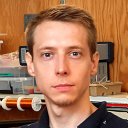
 Mathias Lechner
· 3 previous affiliations
- Current
- Postdoc · 2022–2023
- PhD student · 2018–2022
- TU Wien2012–2017
- MS student · 2016–2017
- Undergrad student · 2012–2016
Research Overview
Mathias Lechner focuses on the safety verification of dynamical systems, continuous-time neural networks, and robust robot learning. His trajectory spans the development of compact, brain-inspired control policies to formal probabilistic certificates for stochastic environments. Most recently, his work investigates adaptive test-time computation for large language models and the application of liquid foundation models to scientific domains.
Research Trajectory
Beginning in 2021, Lechner explored the design of compact, interpretable neural controllers for high-stakes decision-making. He developed architectures combining brain-inspired computation with scalable deep learning, as detailed in Neural Circuit Policies Enabling Auditable Autonomy, which demonstrated that a highly sparse network could effectively map high-dimensional inputs to steering commands for autonomous vehicles. This interest in continuous and biologically inspired dynamics led to a significant contribution in the research direction of Solver-Free Continuous-Time Neural Networks. In Closed-form continuous-time neural networks (2022), he derived a closed-form approximation for the differential equations governing liquid neural networks, capturing the expressive power of neural ordinary differential equations while bypassing the computational overhead of numerical solvers.
Concurrently, Lechner advanced the formal verification of machine learning models, particularly in the area of Neural Certificates for Scalable Safety Verification of Dynamical Systems. He introduced a framework for proving stability in noisy environments in Stability Verification in Stochastic Control Systems via Neural Network Supermartingales (2022), utilizing Ranking Supermartingales to establish formal upper bounds on stabilization time. Building on this foundation, he expanded into the broader areas of Probabilistic Barrier Certificates for Stochastic Safety and Reachability and Probabilistic Safety Certificates for Uncertain Dynamical Systems with Learning Control Policies for Stochastic Systems with Reach-Avoid Guarantees (2023). This work trained neural networks to act as Reach-Avoid Supermartingales, providing infinite-horizon guarantees that a control policy would reach a target while avoiding unsafe regions, contributing to the field of Neural Certificate Co-synthesis for Provably Safe Control. He also applied formal verification techniques to low-precision hardware, introducing Quantization-Aware Interval Bound Propagation to train provably robust models in Quantization-Aware Interval Bound Propagation for Training Certifiably Robust Quantized Neural Networks (2023).
In 2023, Lechner's research broadly investigated the robustness and efficiency of robot learning and closed-loop control. He systematically analyzed the impact of adversarial training on holistic robot performance in Revisiting the Adversarial Robustness-Accuracy Tradeoff in Robot Learning, demonstrating that improved adversarial robustness often inflicts a net loss on overall accuracy in practical applications. Continuing his work on liquid neural networks, he explored their application to out-of-distribution generalization in Robust flight navigation out of distribution with liquid neural networks. To further optimize these models, he demonstrated in Leveraging Low-Rank and Sparse Recurrent Connectivity for Robust Closed-Loop Control that modulating architectural priors in closed-form continuous-time networks yields memory-efficient agents that are highly resilient to environmental shifts.
During this period, Lechner also developed scalable environments and safe planning algorithms. He integrated control theory with generative AI in SafeDiffuser: Safe Planning with Diffusion Probabilistic Models, embedding Control Barrier Functions into the denoising process to ensure formal safety guarantees for robotic tasks like legged locomotion. To address the computational bottlenecks of multi-agent reinforcement learning, he designed Gigastep - One Billion Steps per Second Multi-agent Reinforcement Learning, a fully vectorizable JAX-based environment capable of executing complex 3D dynamics at unprecedented speeds on consumer hardware. Additionally, he collaborated on methods for synthesizing informative training samples, contributing to the research direction of Dataset Distillation for Efficient Model Training through his participation in Dataset Distillation with Convexified Implicit Gradients.
Current Directions
The most recent papers in the evidence, published in 2026, indicate a shift toward optimizing large-scale foundation models for reasoning and scientific discovery. Recent work investigates adaptive test-time computation for large language models. In Zero-Overhead Introspection for Adaptive Test-Time Compute, Lechner collaborated on ZIP-RC, a method that repurposes unused output neurons to allow models to predict their own success and allocate "thinking time" dynamically without additional computational cost.
Alongside this focus on efficient reasoning, he is exploring the application of continuous-time architectures to the sciences. His participation in MMAI Gym for Science: Training Liquid Foundation Models for Drug Discovery addresses the limitations of general-purpose language models in specialized domains, introducing benchmarking recipes and Liquid Foundation Models specifically trained to parse molecular data for practical drug discovery tasks.
Profile updated
Loading new papers…
Other researchers whose papers cluster into the same research directions — a proxy for overlapping technical interests and shared intellectual neighborhoods.
See something wrong? Report a mistake