

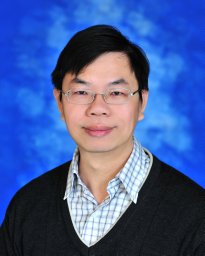
 Chia-Wen Lin
· 8 previous affiliations
- National Tsing Hua UniversitySince 2014
- Distinguished Professor · Since 2024
- Deputy Director · Since 2018
- Professor · Since 2014
- Doctor of Philosophy (Ph.D.), Electrical Engineering · 1993–2000
- National Tsinghua UniversitySince 2007
- Professor · Since 2014
- Associate Professor · 2007–2014
- PhD student · 1993–2000
- MS student · 1990–1992
- Kyoto University2023
- Visiting Professor · 2023
- R&D Director · 2021–2023
- Visiting Professor · 2019
- National Institute of Informatics2015–2016
- Visiting Professor · 2015–2016
- National Chung Cheng University2000–2007
- Associate Professor · 2005–2007
- Assistant Professor · 2000–2005
- Undergrad student · 1982–1987
Research Overview
Chia-Wen Lin focuses on visual content analysis, multimedia processing, and efficient neural network architectures for image restoration and semantic segmentation. His trajectory spans early foundational work in digital video transcoding to contemporary hybrid models that balance local precision with global context. Recently, his research investigates vision-enhanced multi-modal large language models and state space models for high-fidelity visual synthesis.
Research Trajectory
Lin's early trajectory established a foundation in multimedia coding and image processing. A key early contribution was his collaborative work on Digital Video Transcoding, which addressed the adaptation of video streams across diverse network environments. He subsequently expanded into image restoration, developing techniques such as Automatic Single-Image-Based Rain Streaks Removal via Image Decomposition to recover visual fidelity from degraded inputs.
Transitioning into deep learning and generative models, Lin began exploring advanced architectures for facial analysis and synthesis. In SiGAN: Siamese Generative Adversarial Network for Identity-Preserving Face Hallucination, he introduced a framework that reconstructs high-resolution faces from low-resolution inputs while strictly maintaining the subject's identity for verification systems, advancing the broader area of Disentangling Identity from Facial Attributes. This interest in generative synthesis also extended to stylized domains, as seen in his work on AniGAN: Style-Guided Generative Adversarial Networks for Unsupervised Anime Face Generation.
Parallel to his vision work, Lin contributed to theoretical frameworks and specialized industrial applications. He participated in comprehensive reviews of graph-based methods, such as Graph Signal Processing for Geometric Data and Beyond: Theory and Applications, which bridged traditional signal processing with 3D/4D geometric data analysis. In the specialized area of Computational Lithography and Inverse Mask Optimization, his research includes Keeping Deep Lithography Simulators Updated: Global-Local Shape-Based Novelty Detection and Active Learning, applying active learning to maintain the accuracy of semiconductor manufacturing simulators.
A major theme in Lin's recent trajectory is the development of highly efficient neural architectures, particularly in the research direction of Hybrid CNN-Transformer Architectures for Global-Local Vision. To address the computational bottlenecks of standard Vision Transformers in image restoration, his group developed Stripformer: Strip Transformer for Fast Image Deblurring, which utilizes horizontal and vertical strip tokens to capture directional motion blur efficiently. He further advanced this hybrid approach in Attention-Guided Multi-scale Interaction Network for Face Super-Resolution, intelligently fusing local CNN textures with global Transformer structures to restore high-fidelity facial details.
This drive for efficiency and robustness naturally extended to real-time semantic segmentation. In Efficient Semantic Segmentation via Lightweight Multiple-Information Interaction Network, Lin and his collaborators achieved a high-performance balance for resource-constrained hardware, delivering accurate segmentation at high frame rates. To ensure these systems remain reliable in unpredictable environments, he designed the DAWA framework in Towards Robust Online Domain Adaptive Semantic Segmentation under Adverse Weather Conditions, leveraging frequency analysis and large language models to adapt to sudden weather changes on the fly.
Most recently, Lin has integrated state space models and frequency-domain analysis into his architectures to overcome the limitations of encoder downsampling. This is exemplified by WaveSeg: Enhancing Segmentation Precision via High-Frequency Prior and Mamba-Driven Spectrum Decomposition, which combines discrete wavelet transforms with linear-complexity modeling to preserve fine-grained boundaries. A similar philosophy underpins FADPNet: Frequency-Aware Dual-Path Network for Face Super-Resolution, which processes high- and low-frequency facial features separately to achieve superior reconstruction quality with minimal computational overhead. Expanding into multi-modal domains, he has also explored vision-language integration. In Boosting Multi-Modal Large Language Model With Enhanced Visual Features, he proposed architectures to maximize the utility of visual features in large language models. This aligns with his work on Generation and Comprehension Hand-in-Hand: Vision-guided Expression Diffusion for Boosting Referring Expression Generation and Comprehension, which uses diffusion processes to bridge the gap between generating and understanding visual descriptions. Concurrently, he continues to address multimedia security, developing techniques for robust deepfake detection across varying compression rates in UMCL: Unimodal-generated Multimodal Contrastive Learning for Cross-compression-rate Deepfake Detection.
Current Directions
Recent work investigates the integration of advanced visual features into broader multi-modal and generative frameworks. A primary focus is enhancing the visual capabilities of multi-modal large language models (MLLMs), ensuring that visual inputs are fully leveraged for complex understanding and generation tasks. This includes bridging the gap between generating and comprehending object descriptions through vision-guided diffusion processes. Additionally, ongoing research addresses emerging challenges in multimedia security, specifically focusing on robust deepfake detection mechanisms that can maintain accuracy across varying compression rates and adversarial conditions. Finally, the continued exploration of state space models and frequency-domain analysis points toward a sustained interest in developing linear-complexity architectures for high-resolution visual synthesis and segmentation.
Profile updated
Loading new papers…
Other researchers whose papers cluster into the same research directions — a proxy for overlapping technical interests and shared intellectual neighborhoods.
See something wrong? Report a mistake