


TL;DR
SimpleMKKM is a streamlined multiple kernel clustering algorithm that adapts the supervised kernel alignment criterion for unsupervised learning. By reformulating a complex min-max optimization problem into a smooth minimization task solvable via reduced gradient descent, it achieves state-of-the-art clustering performance across diverse datasets without the need for complex hyperparameter tuning.
What Problem Does This Paper Address?
In many real-world scenarios, data comes from multiple sources or "views"—for example, a collection of images might be described by color histograms, texture features, and deep learning embeddings. Multiple Kernel Clustering (MKC) aims to combine these different views (represented as kernel matrices) to improve clustering performance.
The standard approach, Multiple Kernel K-means (MKKM), typically tries to learn kernel weights and cluster assignments simultaneously. However, this often leads to two major issues:
- Optimization Instability: Most methods use "alternating optimization" (fixing one set of variables while updating the other), which is prone to getting stuck in poor local optima.
- Weight Sparsity: These algorithms often produce "sparse" solutions where only one or two kernels are given any weight, effectively ignoring the complementary information in other views. To fix this, researchers often add complex regularization terms, but these introduce new hyperparameters that are notoriously difficult to tune in an unsupervised setting where no "ground truth" labels exist.
Methods
SimpleMKKM introduces a new objective function based on the unsupervised kernel alignment criterion. Instead of the traditional MKKM objective, the authors propose a min-max formulation: $$\min_{\gamma \in \Delta} \max_{H} \text{Tr}(K_{\gamma}HH^\top)$$ Here, $\gamma$ represents the kernel weights, and $H$ is the clustering partition matrix.
The "magic" of SimpleMKKM lies in its optimization strategy. The authors show that the inner maximization—which is essentially a standard kernel k-means problem—defines an optimal value function $\mathcal{J}(\gamma)$ that is actually differentiable. This allows them to reformulate the entire problem as a simple minimization of $\mathcal{J}(\gamma)$ over the simplex of kernel weights.
Instead of alternating between $H$ and $\gamma$, they use a reduced gradient descent algorithm to update the kernel weights directly. This approach naturally handles the constraints (weights must be non-negative and sum to one) and avoids the local-optima traps common in alternating methods.
Datasets
The authors evaluated SimpleMKKM on 11 benchmark datasets representing a wide variety of domains:
- Flowers (Flo17, Flo102): Image datasets of different flower species.
- Protein Fold (PFold): Biological data for protein structure prediction.
- Video (CCV): The Columbia Consumer Video dataset.
- Digits (Digit): Handwritten digit recognition.
- Caltech101 (Cal-5 to Cal-30): Six sub-datasets derived from the Caltech101 image library, varying in the number of object categories.
Key Insights and Ideas
- Bypassing Alternating Optimization: The most significant "aha moment" is proving that the min-max objective can be treated as a smooth minimization problem. This allows the use of gradient-based methods, which are generally more robust and efficient than the block coordinate descent used in previous MKKM variants.
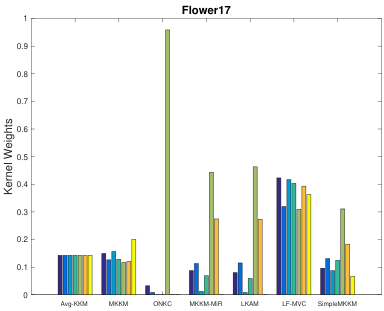
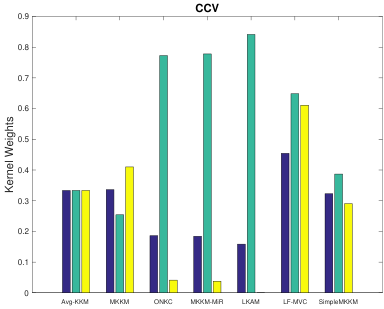
- Natural Non-Sparsity: A surprising finding is that SimpleMKKM produces non-sparse kernel weights without needing explicit $\ell_2$-norm regularization. By utilizing more kernels, the model captures a richer representation of the data. You can see this clearly in the weight distributions across different datasets:
- Parameter-Free Utility: Unlike many state-of-the-art competitors (like MKKM-MiR or LKAM) that require tuning multiple hyperparameters, SimpleMKKM requires none beyond the number of clusters $k$. This makes it much more practical for real-world applications.
Key Results
SimpleMKKM consistently outperformed eight baseline methods across all 11 datasets.
- Accuracy Boost: It exceeded standard MKKM by significant margins, such as a 34.6% improvement in Accuracy (ACC) on the Digit dataset.
- State-of-the-Art Performance: It achieved comparable or superior results to complex, regularized methods like MKKM-MiR and LF-MVC, but with a much simpler, parameter-free implementation.
- Efficiency: Despite the more sophisticated optimization, SimpleMKKM is computationally efficient. It typically converges in fewer than 10 iterations, making its runtime comparable to much simpler algorithms.
Limitations and Future Work
The authors identify a few areas for growth:
- Incomplete Kernels: The current version assumes all views are available for all data points. In practice, some data might have missing views (e.g., an image without a corresponding text description). Extending SimpleMKKM to handle "incomplete kernels" is a primary goal for future work.
- Theoretical Convergence: While they provide a generalization error bound, they suggest that deriving tighter convergence rates using local Rademacher complexity could provide deeper theoretical insights.
Summary updated