


TL;DR
FL-TAC (Federated Learning with Task-specific Adapter Clustering) significantly improves the efficiency of fine-tuning large pre-trained models by training multiple, extremely low-rank adapters for individual tasks on the client side. By clustering these adapters on the server, the framework achieves superior task adaptation and lower communication overhead compared to traditional single-adapter federated learning methods.
What Problem Does This Paper Address?
Fine-tuning large-scale pre-trained models (like LLMs or Vision Transformers) for specific downstream tasks is often hampered by a "data desert"—individual users rarely have enough high-quality data to train a robust model. Federated Learning (FL) solves this by allowing clients to collaborate without sharing raw data. However, FL hits a "communication wall" because these models are massive, making the exchange of model updates prohibitively expensive.
While Parameter-Efficient Fine-Tuning (PEFT) methods like LoRA (Low-Rank Adaptation) reduce this cost by training only small "adapter" matrices, there is a catch: reducing the rank too aggressively to save bandwidth leads to high approximation errors. This is especially true when a single adapter is forced to learn multiple, diverse tasks simultaneously. The authors set out to find a way to slash communication costs without sacrificing the model's ability to adapt to diverse local tasks.
Methods
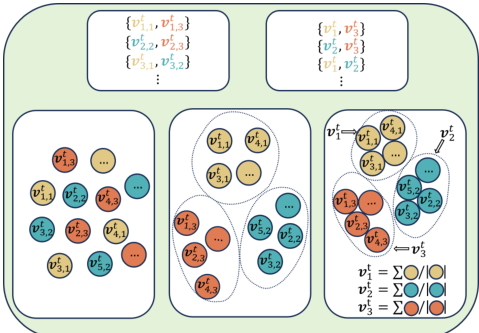
The authors propose a "divide and conquer" strategy called FL-TAC. Instead of one adapter to rule them all, each client trains a unique, extremely low-rank adapter for each of its local tasks.
- Client-Side Training: Each client $i$ performs local fine-tuning on its specific tasks (e.g., one for text classification, one for summarization). Because each adapter only focuses on one task, its rank can be much lower (e.g., rank 1 or 2) than a general-purpose adapter.
- Server-Side Clustering: Clients upload their task-specific adapters. Crucially, the server doesn't need explicit task labels. It uses the K-means algorithm to cluster the received adapters based on their parameter values.
- Task-Specific Aggregation: The server averages the adapters within each cluster to create a set of global task-specific adapters. These are then sent back to the clients for the next round of training.
Datasets
The researchers evaluated FL-TAC across diverse domains:
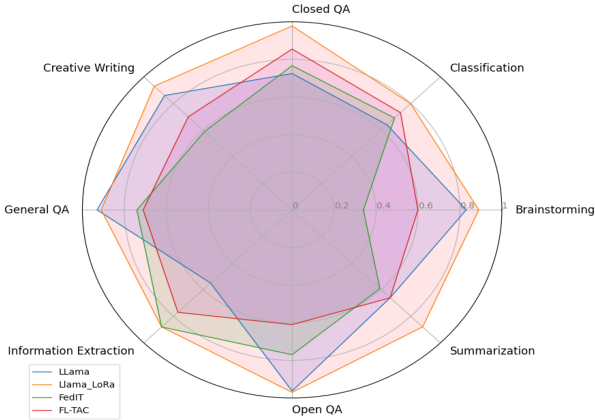
- Text Generation: Databricks-Dolly-15k (8 tasks including Brainstorming, Creative Writing, and QA).
- Text Classification: The GLUE benchmark (SST2, MRPC, QQP, QNLI, RTE).
- Image Classification: CIFAR-10 and CIFAR-100.
To simulate real-world conditions, they used a Dirichlet Partition to create a non-IID (non-independent and identically distributed) data environment, where different clients hold different proportions of task data.
Key Insights and Ideas
- The Rank Trade-off: A key "aha" moment came from a toy simulation showing that training two rank-4 adapters for two distinct tasks consistently yields lower approximation errors than training one rank-8 adapter for both tasks combined. This justifies the overhead of having multiple adapters if they are sufficiently low-rank.
- Parameter Space Evolution: The authors discovered that as training progresses, adapters for the same task naturally drift toward each other in the parameter space. This emergent property allows the server to successfully group them using simple unsupervised clustering (K-means) without needing metadata about what the tasks actually are.
- Knowledge Exchange: By clustering, the system enables "knowledge exchange" between clients working on similar tasks, even if their overall data distributions are different.
Key Results
- Superior Performance: On the Databricks-Dolly-15k dataset, FL-TAC outperformed the FedIT baseline (a single-adapter FL approach) in most categories, including Brainstorming and Classification.
- Communication Efficiency: FL-TAC achieved these results while transmitting fewer parameters. For example, in the Dolly-15k experiments, FL-TAC used roughly half the trainable parameters of the FedIT baseline (4.2M vs 8.5M).
- High Clustering Accuracy: The visualization of clustering results (using UMAP) showed that by epoch 9, task-specific adapters formed distinct, well-separated clusters, proving the robustness of the server-side aggregation.
Limitations and Future Work
The authors acknowledge that while the method is effective, the optimal LoRA rank for a given task might depend heavily on the inherent capabilities of the base pre-trained model. Future research is needed to investigate this correlation. Additionally, while K-means worked well here, more complex clustering scenarios or extremely high numbers of tasks might require more sophisticated grouping techniques.
Summary updated