


TL;DR
Debiased language models implicitly exhibit a structural phenomenon known as "Neural Collapse," where last-layer token representations tightly align with their corresponding word embeddings for fairness-sensitive words. By explicitly enforcing this geometric alignment via a simple, plug-and-play regularization loss, researchers can consistently boost model fairness across various existing debiasing frameworks without sacrificing general language understanding performance.
What Problem Does This Paper Address?
Pretrained language models (PLMs) are notorious for capturing and amplifying societal biases present in their training data, often associating specific demographic groups with stereotypical roles or occupations. While a multitude of debiasing algorithms exist—ranging from counterfactual data augmentation to specialized fine-tuning objectives—they are largely ad-hoc and lack a unified, principled theoretical framework.
The authors of this paper bridge this gap by looking through the lens of Neural Collapse (NC). Originally observed in traditional classification tasks, Neural Collapse describes a geometric phenomenon where, during the terminal phase of training, last-layer features of the same class collapse into a single point (the class mean) and perfectly align with their corresponding classifier weights. Given that next-token prediction in language models is essentially a massive classification problem, the authors ask: Can we understand and improve the fairness of language models by analyzing their underlying geometric collapse?
Methods
The authors first analyze standard Neural Collapse metrics across several popular debiased language models (such as Mabel, ASE, and BEC). They discover a striking consistency: fair models naturally minimize the $\mathcal{NC}_3$ metric, which quantifies the alignment between classifiers (word embeddings) and class means (token representations).
Armed with this insight, they propose a simple auxiliary regularization objective, $\mathcal{L}_{\mathcal{NC}_3}$, to explicitly enforce this collapse during fine-tuning:
$$\mathcal{L}_{\mathcal{NC}_3} = \text{std}\left( \left\langle \frac{w_c}{\|w_c\|_2}, \frac{\mu_c - \mu}{\|\mu_c - \mu\|_2} \right\rangle \right), \quad c \in V_{\text{gender}}$$
This loss minimizes the variance of the alignment between word embeddings ($w_c$) and centered token representations ($\mu_c$) specifically for a vocabulary subset of gender-related words ($V_{\text{gender}}$). This regularization term is simply added to the model's original training loss ($\mathcal{L}_{\text{total}} = \mathcal{L}_{\text{original}} + \alpha \cdot \mathcal{L}_{\mathcal{NC}_3}$), making it entirely agnostic to the underlying debiasing method or data format.
Datasets
The approach was evaluated using several datasets across different stages of training and testing:
- Fine-tuning/Training Baselines: SNLI, MNLI, OntoNotes, TinyStories, and News-Commentary v15.
- Intrinsic Fairness Evaluation: StereoSet (gender domain) and BEC-Pro (evaluating associations between gender words and professions).
- Extrinsic Fairness Evaluation: WinoBias (coreference resolution task) and Bias-in-Bios (predicting occupations from biographies).
- General Capabilities: The GLUE benchmark was used to verify that the debiasing process does not degrade standard natural language understanding.
Key Insights and Ideas
- Fairness Has a Geometric Signature: Debiasing a language model naturally forces the representations of gender-sensitive words to become more structurally uniform and aligned with their static embeddings.
- Collapse is Localized, Not Global: This increased neural collapse occurs exclusively within fairness-sensitive vocabularies ($V_{\text{gender}}$). When evaluating NC metrics across the entire vocabulary, the differences between biased and debiased models disappear (as shown in the paper's vocabulary ablation studies).
- Universal Orthogonality: Because the proposed regularization targets a fundamental geometric property of the network's final layer, it is completely orthogonal to existing debiasing techniques. It can be seamlessly integrated into data-based, fine-tuning-based, or prompt-based fairness algorithms as a "plug-and-play" booster.
Key Results
The explicit $\mathcal{NC}_3$ regularization consistently improved both intrinsic and extrinsic fairness metrics across all tested baselines:
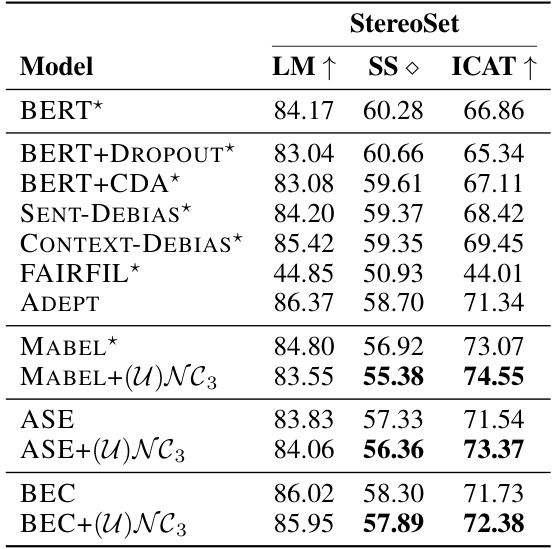
- StereoSet: Adding the regularization to the Mabel baseline reduced its Stereotype Score (SS) closer to the ideal mark of 50 (dropping from 56.92 to 55.38) and boosted the overall ICAT score to 74.55 (see Table 4).
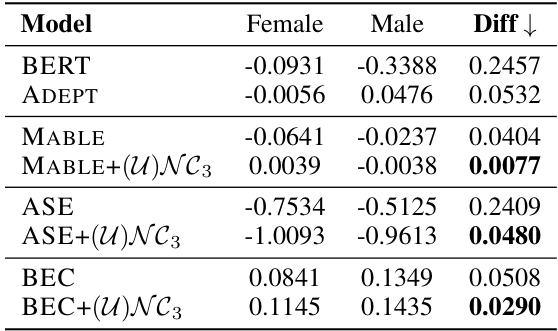
- BEC-Pro: The difference ("Diff") between female and male profession association scores saw massive reductions. For instance, Mabel combined with the new regularization saw an order-of-magnitude fairness improvement, dropping the score difference from 0.0404 to 0.0077 (see Table 5).
- WinoBias & Bias-in-Bios: The models exhibited significant drops in True Positive Rate (TPR) disparities across demographic groups.
- Performance Preservation: Crucially, testing on the GLUE benchmark demonstrated that models maintained their general language processing capabilities, avoiding the common pitfall of "catastrophic forgetting" during debiasing.
Limitations and Future Work
While highly effective, the authors note that the fairness improvements were relatively limited in rare-class classification scenarios, such as the Bias-NLI evaluation. Additionally, the empirical validation in this work primarily focused on gender bias and medium-sized models (BERT and RoBERTa backbones). Exploring how this geometric inductive bias scales to larger generative Large Language Models (LLMs) and broader dimensions of social bias (e.g., race, age, religion) remains an open and promising direction.
Summary updated