


TL;DR
Distilling large video models into fast, few-step versions usually forces a trade-off: you get speed, but you lose the creative "soul" and diversity of the original model. This paper introduces two clever guidance tricks—anti-drifting and motion-aware guidance—that allow small, autoregressive video models to generate high-quality, diverse videos in just 4 steps, successfully matching the performance of models ten times their size.
What Problem Does This Paper Address?
Autoregressive (AR) video models are the "gold standard" for interactive applications because they generate video chunk-by-chunk, allowing for streaming and real-time response. However, they are painfully slow, often requiring hundreds of denoising steps per chunk.
To speed them up, researchers use distillation, where a small "student" model tries to mimic a big "teacher." Currently, most people use Distribution Matching Distillation (DMD). While DMD is fast, it has two major flaws:
- Mode Collapse: The student becomes "boring," losing the sample diversity of the teacher.
- The Bidirectional Requirement: It often requires a massive, non-autoregressive teacher to supervise the student, which breaks the causal nature of AR generation.
A better alternative is FlowMap distillation, which teaches the student to follow the teacher's exact "path" (denoising trajectory). But FlowMap distillation has historically failed for AR video because of rollout drift (errors accumulate over time until the video turns into mush) and the sheer mathematical complexity of learning fast-moving objects in just a few steps.
Methods
The authors propose two complementary mechanisms to fix FlowMap distillation:
1. Anti-Drifting Guidance
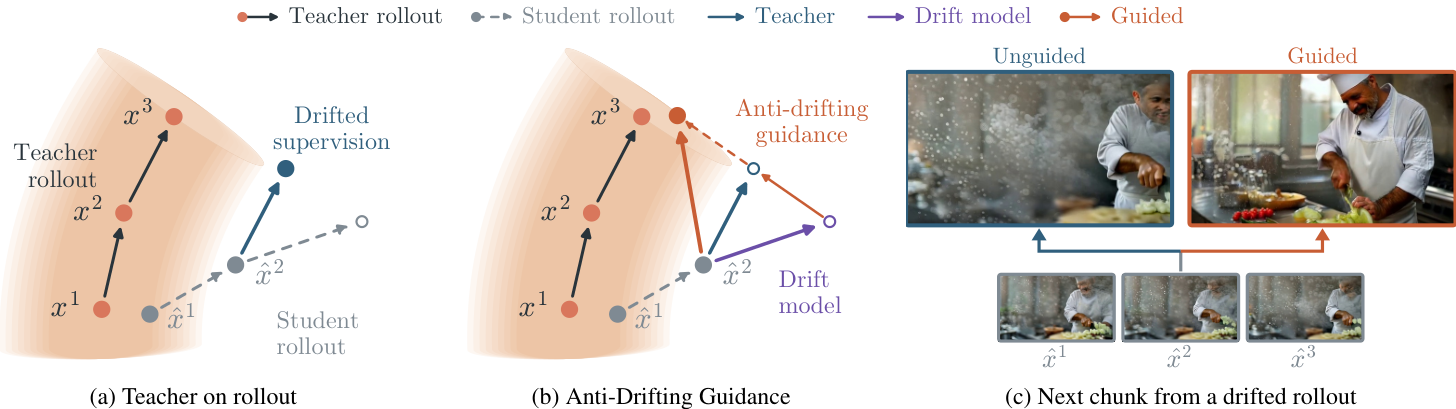
When a student model makes a tiny mistake in frame 1, that mistake becomes part of the "history" for frame 2. Because the teacher was only ever trained on "perfect" history, it doesn't know how to correct the student; it just continues the error.
The fix? They train a small auxiliary "drift model" to mimic the student's mistakes. During training, they use this drift model as a "negative" signal. They tell the teacher: "Look at what the student is doing, look at the drift model, and then push your prediction away from that error." This steers the student back toward the correct distribution.
2. Motion-Aware Guidance
Static backgrounds are easy to learn, but moving objects have a "complex velocity field"—mathematically, they are very "wiggly" (high Lipschitz constant). This makes them nearly impossible for a student to learn in just 4 steps.
The authors added an uncertainty head to the model. This head identifies which parts of the frame are "uncertain" (usually the moving parts). They then apply skip-layer guidance (SLG) specifically to those patches. This effectively "smooths out" the math for the moving parts, making the teacher's trajectory easier for the student to follow.
Datasets
The researchers used several high-end benchmarks and models:
- Teachers: 1.3B parameter AR video models (Causal-rCM and Causal Forcing), which were themselves distilled from a massive 14B Wan2.1-T2V model.
- Training Data: Synthetic videos from Wan2.1-T2V-14B and prompts from the VidProM dataset.
- Evaluation: VBench (for quality), V-JEPA 2 and VideoMAE V2 (for diversity), and MovieGen prompts (for long 30-second rollouts).
Key Insights and Ideas
- The "Exposure Bias" Trap: AR teachers can't fix a drifted history because they've never seen one. By explicitly modeling the "drift," we can turn a weakness into a corrective signal.
- Smoothing the Path: You don't need to guide the whole image. By focusing guidance on high-uncertainty motion patches, you can simplify the "velocity field" exactly where the student is struggling most.
- Diversity is Free: Unlike DMD, which optimizes for a final distribution, FlowMap distillation preserves the "coupling" between noise and output. This means if the teacher can imagine a thousand different ways a cat can jump, the student can too.
Key Results
- Matching the Giants: Their 4-step student (distilled from a 1.3B teacher) matched the performance of DMD students distilled from 14B teachers on VBench.
- Long-Term Stability: On 30-second video rollouts, their method significantly reduced quality drift compared to standard baselines.
- Diversity Preserved: Quantitative metrics (V-JEPA 2) confirmed that their students maintained the high sample diversity of the original AR teachers, whereas DMD-based models showed significant "mode collapse."
Limitations and Future Work
- Inherited Flaws: The student is only as good as the teacher. If the 1.3B teacher has lower semantic scores (understanding of complex prompts) than a 14B model, the student will inherit that limitation.
- Drift isn't Zero: While anti-drifting guidance helps immensely, it doesn't completely eliminate drift over very long horizons.
- Training Overhead: Maintaining an online "drift model" during Stage 2 training requires extra computational steps.
The authors suggest that combining this approach with even stronger teachers or longer-horizon supervision could be the next frontier for real-time, high-fidelity video generation.
Summary updated