

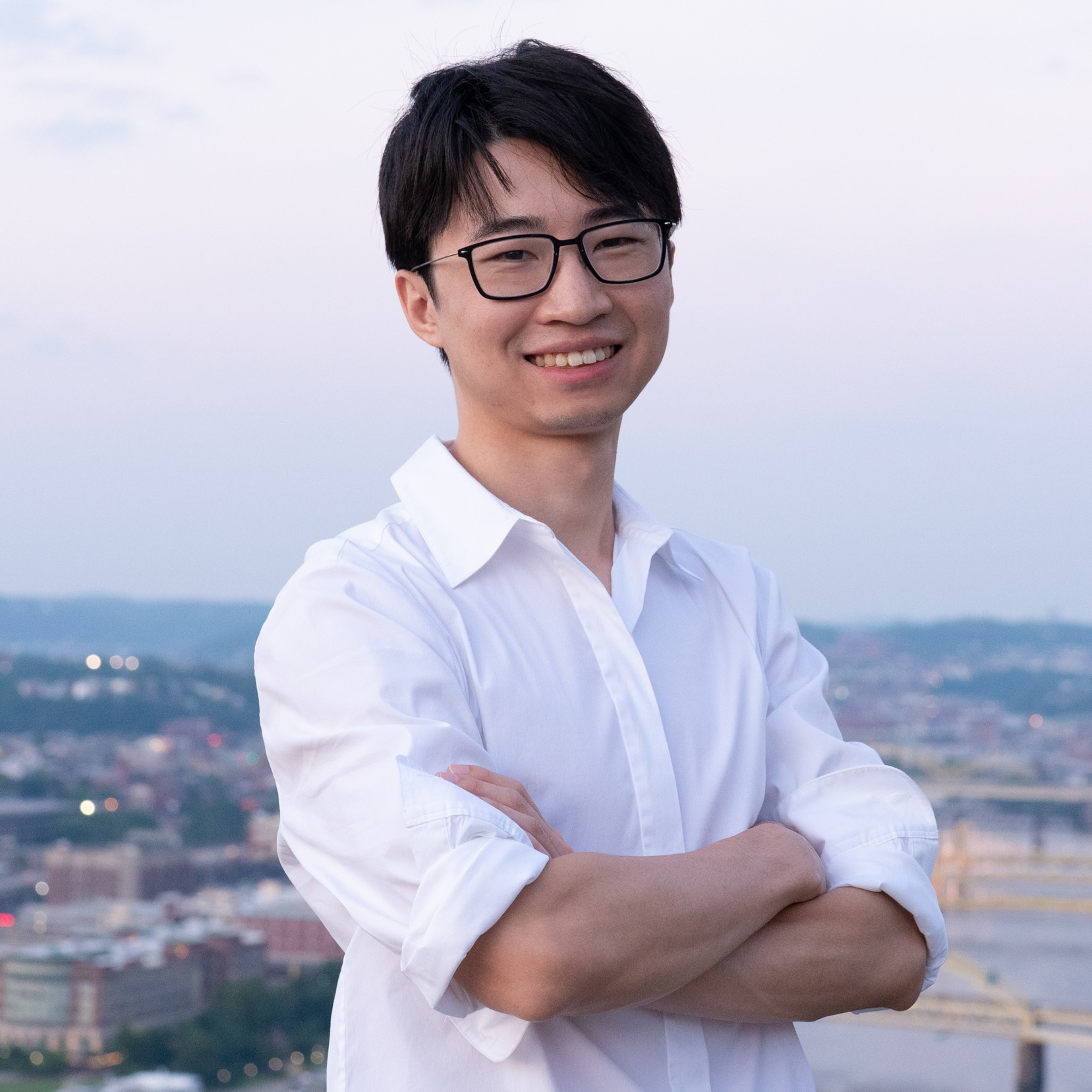
 Xun Huang
· 4 previous affiliations
- Adobe Systems (United States)Since 2024
- Researcher · Since 2024
- RobloxCurrent
- Current
- Nvidia (United States)2020–2024
- Researcher · 2020–2024
- Cornell Tech2016–2020
- PhD · 2016–2020
1 other author named Xun Huang: Xun Huang (Nanyang Technological University · Nanjing University of Science and Technology · 1 paper)
Research Overview
Xun Huang focuses on generative modeling, video synthesis, and real-time visual computing. His early work advanced image-to-image translation and style transfer through novel neural architectures. More recently, his research addresses the challenges of interactive video generation and world models, developing autoregressive diffusion techniques and state-space architectures to enable consistent, high-framerate spatiotemporal synthesis.
Research Trajectory
Huang's early research explored visual attention and the semantic gap in computer vision. In the area of High-Level Semantic Integration for Visual Saliency, he introduced SALICON: Reducing the Semantic Gap in Saliency Prediction by Adapting Deep Neural Networks. This work leveraged the representational power of deep neural networks to better predict human eye fixations, advancing the broader field of Object Centric Human Gaze Prediction.
Transitioning into generative modeling, he proposed Stacked Generative Adversarial Networks, a novel architecture that inverted the hierarchical representations of discriminative networks to guide image generation. Shortly after, he developed Arbitrary Style Transfer in Real-Time with Adaptive Instance Normalization, introducing the AdaIN layer to align feature statistics between content and style images, enabling flexible, feed-forward artistic stylization. Expanding on image synthesis, he presented the MUNIT framework in Multimodal Unsupervised Image-to-Image Translation, which modeled conditional distributions to generate diverse outputs from a single source image rather than relying on deterministic mappings. During this period, he also collaborated on Controllable Video Generation With Sparse Trajectories, exploring ways to explicitly control synthesized motion using user-specified trajectories.
After co-authoring a comprehensive survey, Generative Adversarial Networks for Image and Video Synthesis: Algorithms and Applications, his focus expanded to accommodate the rise of diffusion models and 3D generation. He contributed to eDiff-I: Text-to-Image Diffusion Models with an Ensemble of Expert Denoisers, a project that improved text alignment and visual quality by specializing denoisers for different stages of the diffusion process, advancing techniques in the research direction of Multimodal Feature Fusion for Joint Representation Learning. He also participated in the development of Magic3D: High-Resolution Text-to-3D Content Creation, which addressed the slow optimization and low-resolution bottlenecks of earlier text-to-3D methods by utilizing a two-stage framework with a sparse 3D hash grid.
In recent years, Huang has concentrated heavily on interactive and real-time video synthesis. Addressing the research direction of Bridging the Training and Inference Gap in Sequence Generation, he investigated exposure bias in Self Forcing: Bridging the Train-Test Gap in Autoregressive Video Diffusion. To tackle the memory and consistency limitations of interactive simulations, he directed work on Long-Context State-Space Video World Models, replacing traditional Transformers with state-space models to achieve near-infinite temporal memory. He further oversaw the development of From Slow Bidirectional to Fast Autoregressive Video Diffusion Models, which adapted pretrained bidirectional transformers into fast, on-the-fly generators using distribution matching distillation.
This trajectory culminated in MotionStream: Real-Time Video Generation with Interactive Motion Controls, a framework enabling high-framerate generation with user-guided camera and trajectory controls. This work significantly advanced the areas of Real-Time Causal Video Diffusion and Visual Anchoring for Consistent Long Video Generation. Concurrently, he guided research on Learning an Image Editing Model without Image Editing Pairs, introducing the NP-Edit paradigm to train editing models using differentiable feedback from vision-language models rather than curated before-and-after datasets.
Continuing to optimize causal and real-time synthesis, Huang contributed to Analyzing and Improving FlowMap Distillation of Autoregressive Video Models, introducing anti-drifting and motion-aware guidance to enable few-step autoregressive video generation without sacrificing sample diversity. In MonarchRT: Efficient Attention for Real-Time Video Generation, they participated in developing structured attention factorized with Monarch matrices, achieving high sparsity and real-time generation on commodity hardware. Additionally, Huang led the development of PixVid in Back to Pixels: Lifting Latent Video Diffusion into Pixel Space, lifting latent diffusion back to framewise pixel generation to enhance spatial resolution and enable frame-by-frame interactivity.
Current Directions
Recent work investigates the architecture and training paradigms necessary for real-time, interactive video generation and world models. A primary focus is overcoming the latency and memory bottlenecks of traditional diffusion models by transitioning from bidirectional attention to autoregressive and state-space architectures. This includes developing distillation techniques and structured attention approximations to compress multi-step diffusion processes into fast, causal generators capable of running at high framerates, as well as lifting latent video models into pixel space for fine-grained per-frame interactivity. Additionally, current research addresses fundamental training challenges in sequence generation, such as mitigating exposure bias in autoregressive models and leveraging differentiable feedback from vision-language models to train generative systems without relying on paired datasets.
Profile updated
Loading new papers…
Other researchers whose papers cluster into the same research directions — a proxy for overlapping technical interests and shared intellectual neighborhoods.
See something wrong? Report a mistake