

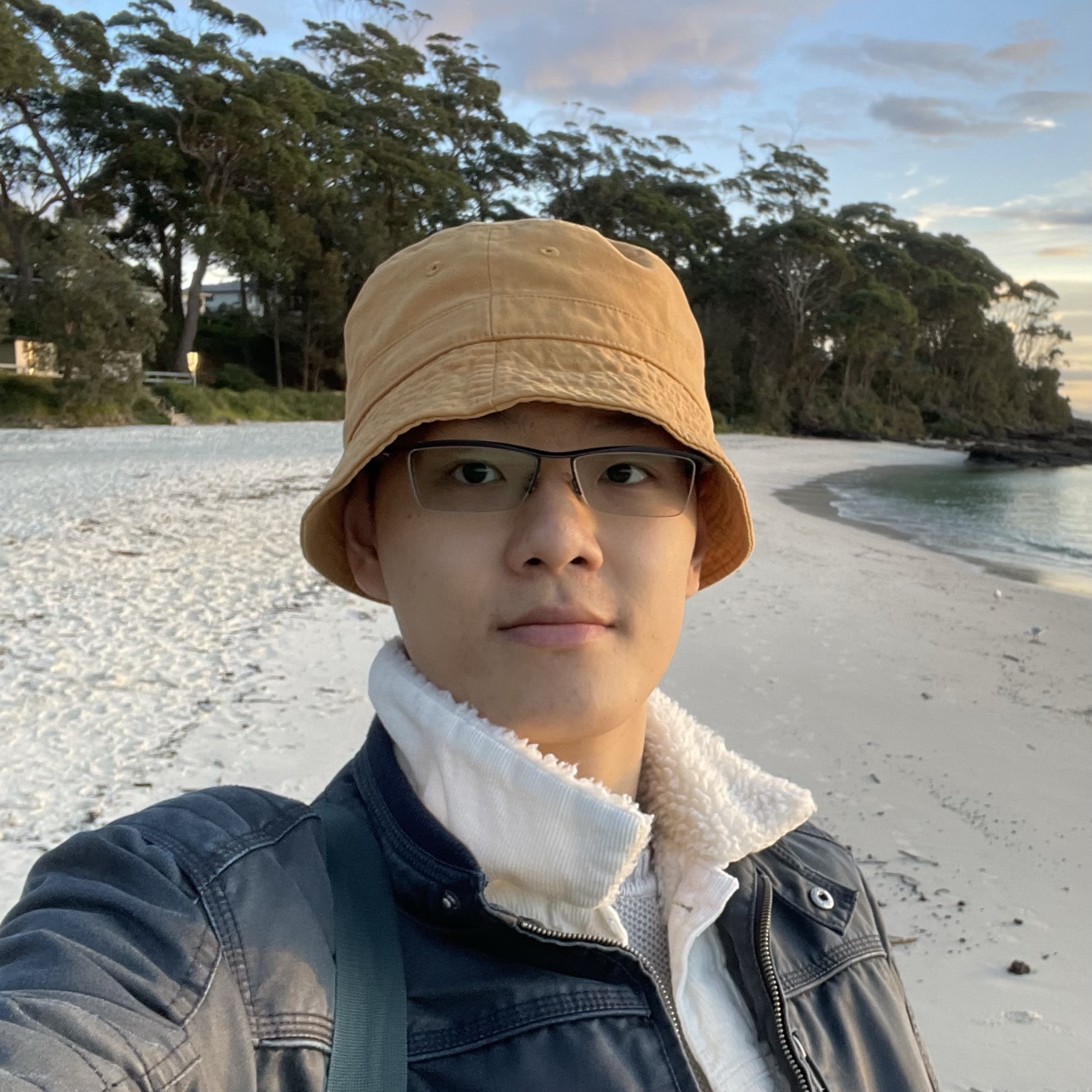
 Yunzhong Hou
· 4 previous affiliations
- Australian National UniversitySince 2019
- Research Fellow · Since 2023
- Postdoc · 2023–2025
- Doctor of Philosophy - PhD, Computer Science · 2019–2023
- Beijing Institute of TechnologySince 2026
- Full Professor · Since 2026
- Applied Scientist Intern · 2022
- Tsinghua University2014–2018
- Bachelor of Engineering - BE, Electrical and Electronics Engineering · 2014–2018
Research Overview
Yunzhong Hou focuses on computer vision, multi-view system optimization, and spatial reasoning in multimodal models. His trajectory spans from image compression and semi-supervised segmentation to reinforcement learning for active camera view selection. Most recently, his work investigates minimal sufficiency in 3D spatial reasoning and end-to-end tuning for latent diffusion models.
Research Trajectory
Yunzhong Hou’s early research explored foundational problems in computer vision, particularly how neural networks process visual information under constrained conditions. In 2022, he investigated the intersection of image compression and explainable AI in Learning to Structure an Image with Few Colors and Beyond. This work contributes to the broader area of Semantic Hallucination for Extreme Low Bitrate Compression by isolating the structural features necessary for object recognition when color information is drastically reduced. To achieve this, he and his collaborators proposed ColorCNN, a color quantization network that learns to preserve critical image structures in limited color spaces by minimizing classification loss.
During the same period, Hou addressed the challenge of label efficiency in dense visual tasks. In Multi-View Correlation Consistency for Semi-Supervised Semantic Segmentation, he introduced a framework that bridges the gap between consistency learning and contrastive learning. By extracting rich pairwise relationships within self-correlation matrices and matching them across augmented views, the proposed Multi-View Correlation Consistency (MVCC) method provides robust supervision signals, allowing models to achieve highly competitive segmentation performance using only a small fraction of annotated data.
Between 2023 and 2024, Hou’s focus shifted toward the optimization and control of multi-view camera systems, treating camera configuration and view selection as dynamic, learnable processes. He developed automated approaches to spatial layouts in Optimizing Camera Configurations for Multi-View Pedestrian Detection. Utilizing a novel interactive simulation environment called CarlaX, this research combined a transformer-based configuration generator with reinforcement learning to design camera setups that outperform traditional coverage-based heuristics and human-expert designs.
Building on the need for efficiency in multi-camera environments, Hou tackled the computational bottleneck of processing redundant video feeds. In Learning to Select Camera Views: Efficient Multiview Understanding at Few Glances, he advanced the research direction of Active View Selection via Reinforcement Learning. The paper introduced MVSelect, a reinforcement learning module that sequentially identifies and processes only the most informative camera angles. By relying on just two or three "glances" rather than the entire suite of available views, the system drastically reduces computational overhead while maintaining high accuracy in tasks like 3D object classification and pedestrian detection.
Expanding this control paradigm to dynamic, moving cameras, Hou explored autonomous cinematography in Learning Camera Movement Control from Real-World Drone Videos. Rather than relying on rigid manual rules or simplified simulations, he and his co-authors developed DVGFormer, an AI agent trained on nearly 100,000 professional videos. The transformer-based model learns to predict smooth, aesthetically pleasing 3D drone trajectories directly from visual cues and historical movement data.
In 2025 and 2026, Hou’s research evolved to address complex reasoning in multimodal and generative AI systems. He led the development of the Minimal Sufficient Spatial Reasoner (MSSR) in Pursuing Minimal Sufficiency in Spatial Reasoning. This work engages with the emerging fields of 3D Spatial Grounding for Vision-Language Models and Decoupling Perception and Reasoning in Multimodal Models. The MSSR framework utilizes a dual-agent cognitive strategy that iteratively curates a "Minimal Sufficient Set" of information—pruning irrelevant visual details while actively requesting missing spatial context. This approach allows the system to outperform monolithic large language models on challenging 3D spatial reasoning benchmarks. Concurrently, Hou participated in advancing generative architectures, contributing to REPA-E: Unlocking VAE for End-to-End Tuning with Latent Diffusion Transformers.. This research introduces a representation alignment loss that enables the joint optimization of variational autoencoders and diffusion transformers, significantly accelerating training times and improving generation quality.
Current Directions
The most recent papers in the evidence indicate a strong focus on the intersection of spatial reasoning, multimodal large language models (MLLMs), and efficient generative architectures. A primary theme is the pursuit of "minimal sufficiency" in AI cognition—designing systems that can intelligently filter out noise and actively seek out only the information necessary to solve complex 3D spatial tasks. This involves decoupling raw visual perception from higher-order logical reasoning, allowing multi-agent frameworks to mimic human-like iterative problem-solving. Additionally, current work investigates the end-to-end optimization of latent diffusion models, exploring novel loss functions and alignment strategies to tightly integrate representation learning with generative diffusion processes for faster, higher-fidelity image synthesis.
Profile updated
Loading new papers…
Other researchers whose papers cluster into the same research directions — a proxy for overlapping technical interests and shared intellectual neighborhoods.
See something wrong? Report a mistake