

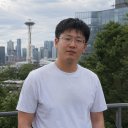
 Xander Zhang
· 5 previous affiliations
- National University of SingaporeSince 2026
- Researcher · Since 2026
- Carnegie Mellon University2024–2026
- Postdoc · 2024–2026
- Sensetime (China)2023–2024
- Researcher · 2023–2024
- Tsinghua University2017–2022
- PhD student · 2017–2022
- Wuhan University2013–2017
- Undergrad student · 2013–2017
Research Overview
Xander Zhang focuses on geometric deep learning, large language model alignment, and the application of neural networks to physical and scientific systems. His trajectory spans early work in distributed systems and medical imaging to foundational contributions in equivariant neural networks and partial differential equations. Most recently, his research addresses multi-domain fine-tuning, multimodal alignment, and proactive language agents.
Research Trajectory
Zhang’s early research spanned applied algorithms for medical imaging and scalable distributed systems. In 2004, he contributed to the evaluation and enhancement of surgical guidance tools in Assessing Spline-Based Multi-resolution 2D-3D Image Registration for Practical Use in Surgical Guidance, proposing a least-squares normalized pattern intensity measure to improve registration accuracy. Concurrently, he explored parallel computing architectures, participating in the development of a cluster middleware framework for scientific data analysis in Scaling and Parallelizing a Scientific Feature Mining Application Using a Cluster Middleware. This interest in scalable infrastructure continued into data center networking; he was part of the team that designed BCube: a high performance, server-centric network architecture for modular data centers in 2009, which utilized servers as relay nodes to support bandwidth-intensive applications and ensure graceful degradation during hardware failures.
Following this early systems work, Zhang’s focus shifted toward geometric deep learning and the representation of complex 3D structures. He introduced a novel approach to modeling 3D rotation groups in Quaternion Product Units for Deep Learning on 3D Rotation Groups (2020), leveraging quaternion algebra to disentangle rotation-invariant and rotation-equivariant features. This foundational work in geometric representations naturally extended to molecular modeling. In 2022, he collaborated on Spherical Message Passing for 3D Molecular Graphs, which utilized spherical coordinate systems to efficiently identify 3D graph structures. This work contributed significantly to the research direction of Bridging the Molecular Geometric Representation Gap, alongside broader efforts in chirality-sensitive and invariant geometric deep learning. Continuing in the geometric and physical domain, Zhang explored symmetry-aware neural networks for physical simulations. He co-authored Group Equivariant Fourier Neural Operators for Partial Differential Equations (2023), bringing geometric deep learning into the frequency domain to solve PDEs, thereby advancing the area of parameter-efficient neural operators via spectral weight sharing.
In 2024, Zhang’s research expanded across optimization, numerical methods, and diverse applied machine learning domains. Addressing decentralized optimization, he proposed a single-loop algorithm in Jointly Improving the Sample and Communication Complexities in Decentralized Stochastic Minimax Optimization, achieving optimal oracle and communication complexities through variance reduction. His work on numerical solvers included A τ Matrix Based Approximate Inverse Preconditioning for Tempered Fractional Diffusion Equations, which developed an efficient preconditioner to accelerate iterative solutions for fractional diffusion systems using spectral clustering techniques. He also continued his investigation into physical modeling with SineNet: Learning Temporal Dynamics in Time-Dependent Partial Differential Equations.
Simultaneously, Zhang applied neural architectures to practical surveillance and synthesis tasks. He led research on infodemic tracking in Predicting viral rumors and vulnerable users with graph-based neural multi-task learning for infodemic surveillance, leveraging multi-task synergy for robust feature learning to simultaneously predict rumor virality and user vulnerability. In the domain of generative models, his group developed CFA-GAN: Cross fusion attention and frequency loss for image style transfer, addressing inference speed and local detail retention. He also oversaw applied environmental research, establishing generic retrieval models for inland water monitoring in Satellite retrievals of water quality for diverse inland waters from Sentinel-2 images: An example from Zhejiang Province, China.
Most recently, Zhang has focused on the alignment, fine-tuning, and proactive capabilities of large language models and multimodal systems. In 2024, he introduced a benchmark and framework for language agents in Ask-before-Plan: Proactive Language Agents for Real-World Planning, enabling models to predict clarification needs and invoke external tools before executing plans. Moving into 2025, his work addresses the complexities of model adaptation. He guided the development of Synergy over Discrepancy: A Partition-Based Approach to Multi-Domain LLM Fine-Tuning, a framework that mitigates inter-domain interference by strategically partitioning training data. To tackle subjective human annotations, he oversaw Whose Instructions Count? Resolving Preference Bias in Instruction Fine-Tuning, proposing a self-supervised method for modular adaptation and parameter-efficient model debiasing that dynamically corrects stylistic conflicts across transformer layers. Finally, he contributed to the area of boundary-aware learning for efficient classification with Aligning by Misaligning: Boundary-aware Curriculum Learning for Multimodal Alignment, utilizing ambiguous negative samples and a differentiable curriculum sampler to improve multimodal alignment across image, video, and audio domains.
Current Directions
The most recent papers in the evidence indicate a strong focus on the alignment and robust fine-tuning of large language models and multimodal systems. Recent work investigates how to manage conflicting human preferences during instruction fine-tuning and how to prevent negative transfer when adapting models across multiple diverse domains. Additionally, Zhang is exploring the design of proactive language agents capable of recognizing ambiguity and seeking clarification before executing complex real-world plans. This encompasses broader efforts in boundary-aware contrastive learning and curriculum scheduling to improve the precision of multimodal representations.
Profile updated
Loading new papers…
Other researchers whose papers cluster into the same research directions — a proxy for overlapping technical interests and shared intellectual neighborhoods.
See something wrong? Report a mistake