

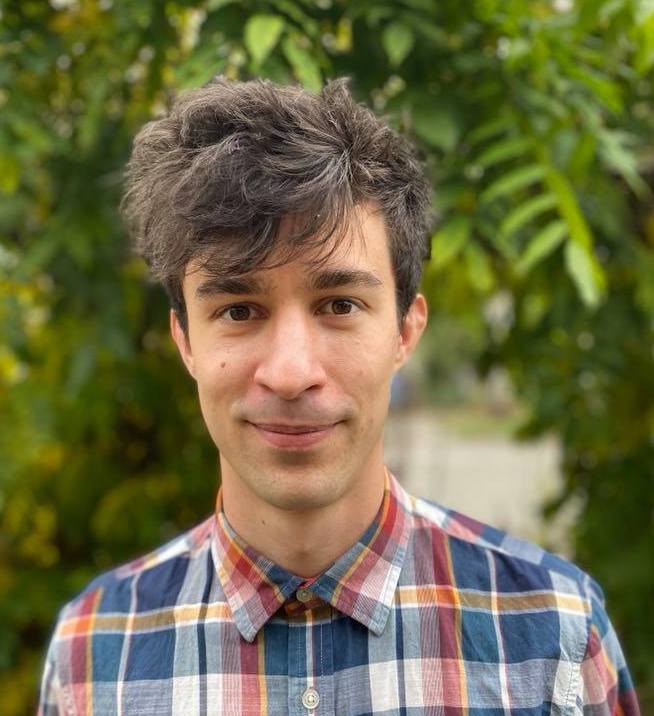
 Vincent Roulet
· 8 previous affiliations
- Google (United States)Since 2022
- Researcher · Since 2022
- Current
- University of Washington2018–2022
- Acting Assistant Professor · 2021–2022
- Acting Instructor · 2020–2021
- Postdoc · 2018–2021
- Postdoctoral Research Associate · 2018–2020
- PHD Student in Machine Learning · 2014–2017
- École Normale Supérieure - PSL2013–2017
- PhD student · 2014–2017
- Master 2 (M2) Mathematics, Computer Vision, Machine Learning · 2013–2014
- Bloom speaker2015–2016
- Entrepreneur · 2015–2016
- École Polytechnique2010–2014
- MS student · 2010–2014
- Diplôme d'ingénieur, Electrical, Electronics and Communications Engineering · 2010–2013
- Research Intern in Machine Learning · 2013
Research Overview
Vincent Roulet focuses on the design and analysis of optimization algorithms, differentiable programming, and the mathematical foundations of machine learning. His trajectory spans from establishing convergence guarantees for non-convex optimization to developing scalable, curvature-aware methods for deep neural networks. Most recently, his work addresses the theoretical structures underlying autoregressive models and the utilization of per-example gradient statistics to improve optimizer performance.
Research Trajectory
Vincent Roulet’s early research began with investigations into structured machine learning and optimization. In 2015, he participated in research on integrating clustering constraints directly into supervised learning with Supervised Clustering in the Data Cube, exploring ways to improve model interpretability and predictive performance in high-dimensional settings. His focus soon shifted deeply into the mathematical foundations of optimization. Engaging with the research direction of Local Geometry and Convergence Rates in Nonconvex Optimization, he demonstrated in Sharpness, Restart and Acceleration (2017) that optimal restart strategies are robust and can generically accelerate accelerated methods by leveraging Hölderian error bounds. Continuing in this domain, he contributed to A Smoother Way to Train Structured Prediction Models (2018), which developed a primal incremental algorithm utilizing techniques from the area of Variance Reduction in Stochastic Optimization to overcome the non-smoothness inherent in maximum margin objectives. In 2019, he examined gradient-based algorithms for nonlinear control through the lens of first-order optimization complexity in Iterative Linearized Control: Stable Algorithms and Complexity Guarantees.
By 2023, his work increasingly addressed the specific optimization challenges posed by modern deep learning architectures and complex risk objectives. He proposed a mathematically grounded alternative to standard backpropagation for recurrent networks in Target Propagation via Regularized Inversion for Recurrent Neural Networks, replacing it with regularized analytical inversions to improve performance on long sequences. He also advanced the area of Spectral Risk Measures for Tail-Sensitive Decision Making with Stochastic Optimization for Spectral Risk Measures. This work introduced the LSVRG algorithm to optimize L-risks, interpolating between average-case and worst-case performance while addressing the biased subgradient estimates that hinder standard approaches.
Investigating the training dynamics of neural networks, he analyzed how stepsize-tuners interact with the Hessian's largest eigenvalue in On the Interplay Between Stepsize Tuning and Progressive Sharpening, explaining the poor performance of classical Armijo linesearch in deep learning. Concurrently, he contributed to the broader area of Scalable Second-Order Optimization for Neural Networks by introducing a matrix-free algorithm in Dual Gauss-Newton Directions for Deep Learning. By solving the optimization subproblem in its dual form, this approach shifted the computational focus from the massive number of model parameters to the smaller number of network outputs, improving robustness to learning rate settings.
In 2024, building on his prior stepsize research, he introduced Curvature Dynamics Aware Tuning (CDAT) in Stepping on the Edge: Curvature Aware Learning Rate Tuners, a method designed to maintain optimization at the edge of stability and naturally induce beneficial behaviors like automatic warm-up. As a Research Scientist at Google DeepMind, he formalized a unified mathematical paradigm for differentiating through complex control flows and nested optimization loops in The Elements of Differentiable Programming. He also collaborated on Prospect, a stochastic algorithm for distributionally robust optimization, in Distributionally Robust Optimization with Bias and Variance Reduction, which achieved significant convergence speedups across fairness and distribution shift benchmarks.
His most recent work continues to bridge theoretical insights with practical deep learning methodologies. In 2025, he developed a framework generalizing the logistic loss using f-divergences in Loss Functions and Operators Generated by f-Divergences, demonstrating that specific variants consistently outperform standard cross-entropy. In 2026, he oversaw research revealing a mathematical bijection between next-token predictors and sequence-level energy-based models in Autoregressive Language Models are Secretly Energy-Based Models: Insights into the Lookahead Capabilities of Next-Token Prediction. Finally, he opened new investigations in the area of Optimization with Per-Example Gradient Statistics with Per-example Gradients: a New Frontier for Understanding and Improving Optimizers, demonstrating that accessing individual gradients is computationally feasible and can fundamentally improve the mechanics of standard optimizers like Adam.
Current Directions
The most recent papers in the evidence point to a dual focus on the foundational properties of generative models and the fine-grained mechanics of neural network optimization. Recent work investigates the theoretical underpinnings of autoregressive language models, establishing explicit mathematical links to energy-based models to show that next-token prediction functions as a form of implicit planning analogous to reinforcement learning. Alongside this, current research explores the utility of per-example gradient statistics—moving beyond the traditional reliance on mini-batch averages—to better understand and refine the behavior of adaptive optimizers. Additionally, ongoing work addresses the design of novel loss functions and probability operators derived from information geometry, utilizing f-divergences to create more effective and computationally efficient alternatives to standard cross-entropy for classification and language modeling tasks.
Profile updated
Loading new papers…
Other researchers whose papers cluster into the same research directions — a proxy for overlapping technical interests and shared intellectual neighborhoods.
See something wrong? Report a mistake