

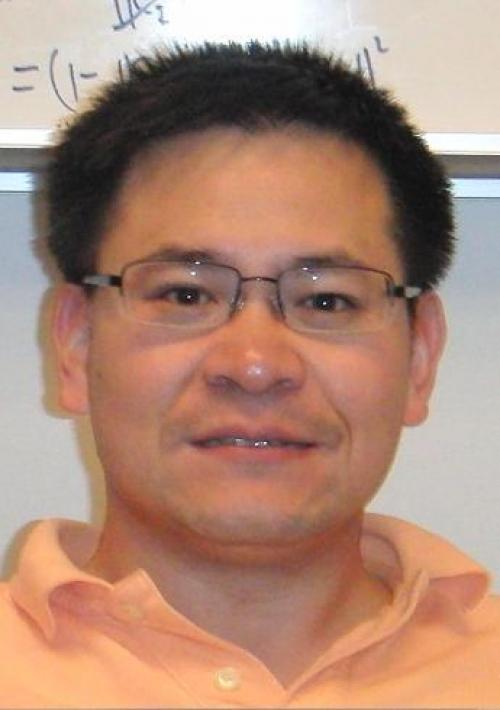
 Zhaosong Lu
· 1 previous affiliation
- University of MinnesotaSince 2019
- Full Professor · Since 2019
1 other author named Zhaosong Lu: Zhaosong Lu (1 paper)
Research Overview
Zhaosong Lu focuses on the theoretical foundations and algorithmic development of hierarchical, distributed, robust, and stochastic optimization. His trajectory spans from large-scale semidefinite programming and sparse recovery methods to randomized block coordinate descent and non-convex optimization. Currently, his work addresses distributionally robust optimization and single-loop stochastic algorithms for complex machine learning applications.
Research Trajectory
Lu's early research established foundational algorithms for complex programming challenges. In 2005, he explored Algorithm Design and Analysis for Large-Scale Semidefinite Programming and Nonlinear Programming. He subsequently applied smooth optimization techniques to statistical problems, detailing a Smooth Optimization Approach for Sparse Covariance Selection in 2009.
Moving into the 2010s, Lu focused heavily on non-convex and potentially non-smooth optimization landscapes. He introduced a rigorous mathematical framework in Sequential Convex Programming Methods for A Class of Structured Nonlinear Programming, contributing to the research direction of Successive Surrogate Minimization for Nonconvex Nonsmooth Optimization and the broader area of Adaptive Optimization without Global Lipschitz Constants. With collaborators, he developed the General Iterative Shrinkage and Thresholding (GIST) framework in A General Iterative Shrinkage and Thresholding Algorithm for Non-convex Regularized Optimization Problems, a method for solving optimization problems that use non-convex penalties to induce sparsity.
Continuing this theme of sparsity, he explored iterative hard thresholding algorithms for $l_0$-regularized convex cone programming in Iterative hard thresholding methods for l0 regularized convex cone programming, improving convergence guarantees for compressed sensing applications. He also proposed novel approximations for $l_p$ norms in Iterative reweighted minimization methods for lp regularized unconstrained nonlinear programming, leading to more stable algorithms for sparse solutions.
A major theme in Lu's mid-2010s work is the development of scalable algorithms for high-dimensional problems, particularly through the area of Randomized Block Coordinate Methods for Large Scale Optimization. To address the computational bottleneck of evaluating full gradients in machine learning and signal processing, he introduced block coordinate descent techniques in Randomized Block Coordinate Non-Monotone Gradient Method for a Class of Nonlinear Programming, advancing the research direction of Scaling Optimization by Avoiding Full Gradient Calculations. He refined the theoretical underpinnings of these methods in On the complexity analysis of randomized block-coordinate descent methods, achieving sharper convergence rates and improved iteration complexity bounds for composite minimization problems.
During this period, he also addressed matrix completion through the research direction of Greedy Rank-Increasing Strategies for Low-Rank Optimization, as seen in Orthogonal Rank-One Matrix Pursuit for Low Rank Matrix Completion. He further expanded coordinate gradient techniques in An Accelerated Randomized Proximal Coordinate Gradient Method and its Application to Regularized Empirical Risk Minimization. Bridging second-order accuracy with randomized efficiency, he developed the Randomized Block Proximal Damped Newton (RBPDN) method in Randomized block proximal damped Newton method for composite self-concordant minimization, demonstrating significant speedups and global linear convergence properties for classical damped Newton methods.
In recent years, Lu has tackled increasingly complex optimization landscapes found in modern machine learning. He established a framework for $\alpha$-symmetric generalized-smoothness in Generalized-Smooth Nonconvex Optimization is As Efficient As Smooth Nonconvex Optimization, proving that complex functions like high-order polynomials and exponentials can be optimized with optimal complexity bounds, a key contribution to the area of Convergence Analysis for Hölder Smooth Functions.
His recent collaborative work addresses stochastic optimization for complex structures. He participated in the development of the Stochastic Moreau envelope Approximate Gradient (SMAG) method in Single-Loop Stochastic Algorithms for Difference of Max-Structured Weakly Convex Functions, providing a single-loop algorithm that avoids the hyperparameter tuning challenges of double-loop alternatives. Finally, his research has advanced Distributionally Robust Optimization (DRO) to protect models against data shifts. He formalized algorithms for this in A Stochastic Algorithm for Sinkhorn Distance-Regularized Distributionally Robust Optimization and further expanded on nested stochastic programming approaches in Nested Stochastic Gradient Descent for (Generalized) Sinkhorn Distance-Regularized Distributionally Robust Optimization, providing convergence guarantees for non-convex and potentially unbounded loss functions.
Current Directions
The most recent papers in the evidence address the intersection of optimization and robust machine learning, particularly focusing on Distributionally Robust Optimization (DRO). Recent work investigates how to protect models against data distribution shifts using Sinkhorn distance regularization, formulating these challenges as nested stochastic programming problems. Additionally, current directions include the design of single-loop stochastic algorithms for complex, weakly convex functions, aiming to achieve optimal convergence rates while eliminating the need for cumbersome hyperparameter tuning associated with traditional double-loop methods. This focus reflects a broader commitment to developing theoretically grounded, scalable algorithms for non-convex and stochastic environments.
Profile updated
Loading new papers…
Other researchers whose papers cluster into the same research directions — a proxy for overlapping technical interests and shared intellectual neighborhoods.
See something wrong? Report a mistake