

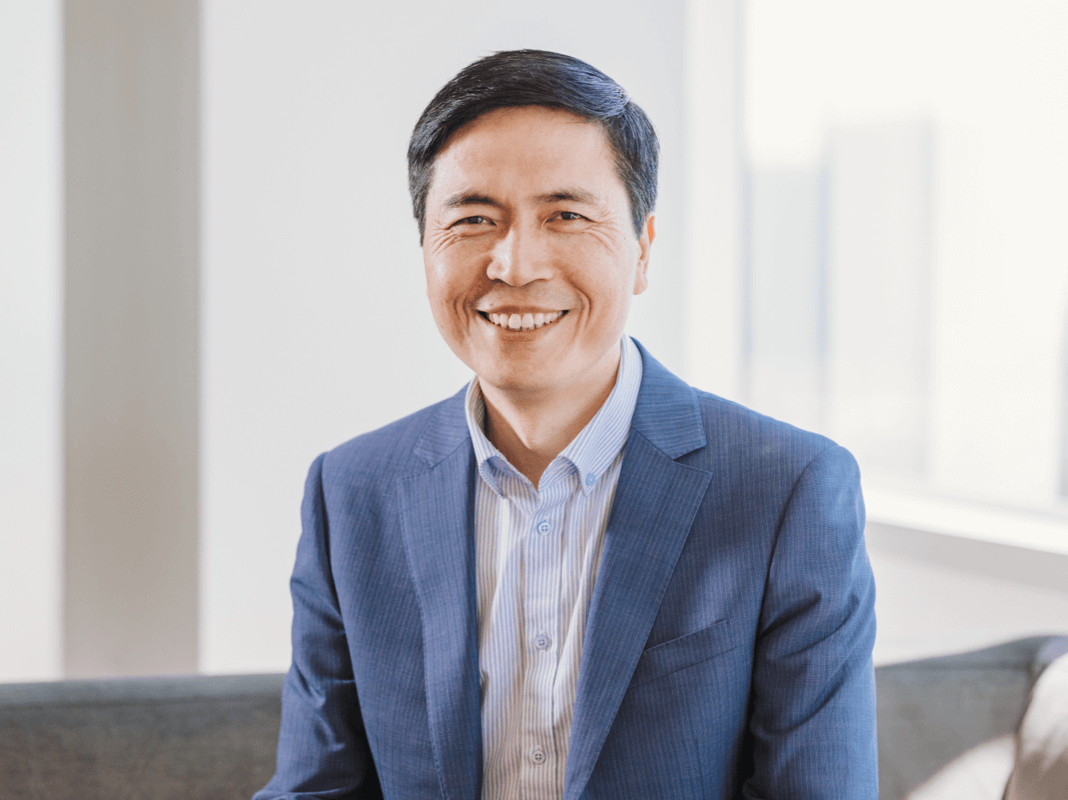
 Song-Chun Zhu
· 3 previous affiliations
- Principal Researcher · 2020–2050
- Peking UniversitySince 2020
- Full Professor · 2020–2050
- Discover2002–2020
- Full Professor · 2002–2020
Research Overview
Song-Chun Zhu focuses on computer vision, statistical modeling, and cognitive artificial intelligence. His foundational work established unifying mathematical frameworks for image parsing, texture modeling, and spatial representation using stochastic grammars and energy-based models. Currently, his research addresses artificial general intelligence, emphasizing embodied robotic autonomy, social reasoning, and the integration of human-like memory into multimodal systems.
Research Trajectory
Early research established rigorous statistical foundations for computer vision. He introduced the FRAME: Filters, Random fields, and Minimax Entropy - Towards a Unified Theory for Texture Modeling model, which combined multi-channel filtering with Markov random fields via a minimax entropy principle to create a unified theory of texture modeling. Concurrently, he developed Region Competition: Unifying Snakes, Region Growing, and Bayes/MDL for Multiband Image Segmentation., a variational approach that minimized a generalized Bayes/minimum description length criterion to synthesize snakes and region-growing algorithms.
This statistical approach evolved into comprehensive frameworks for visual parsing in the early 2000s. Work on Image Segmentation by Data-Driven Markov Chain Monte Carlo advanced probabilistic inference in vision, leading to the synthesis presented in Image Parsing: Unifying Segmentation, Detection, and Recognition. He formalized these compositional structures in A Stochastic Grammar of Images, establishing a paradigm for representing complex visual scenes through hierarchical, generative rules.
By the late 2010s, his research expanded to encompass cognitive and spatial representations, including contributions to the research direction of The Geometric Optimality of Hexagonal Spatial Representations. In this area, he participated in developing Learning Grid Cells as Vector Representation of Self-Position Coupled with Matrix Representation of Self-Motion, which modeled 2D self-position and motion through vector-matrix multiplication to explain the magnified local isometry of grid cells.
More recently, the trajectory has shifted toward complex decision-making, social reasoning, and cognitive architectures. He oversaw the development of CivRealm: A Learning and Reasoning Odyssey in Civilization for Decision-Making Agents, a high-complexity environment based on the game Civilization designed to test the long-term strategic and diplomatic capabilities of reinforcement learning and large language models. Extending this focus to human dynamics, his group introduced SIV-Bench: A Video Benchmark for Social Interaction Understanding and Reasoning to evaluate multimodal models on their ability to infer unobservable mental states and social relationships. He also led a comprehensive synthesis of memory mechanisms in modern AI systems in The AI Hippocampus: How Far are We From Human Memory?, categorizing implicit, explicit, and agentic memory paradigms.
The foundational work on stochastic grammars has also been adapted to new domains. In music, he guided the creation of MusicAOG: an Energy-Based Model for Learning and Sampling a Hierarchical Representation of Symbolic Music, which uses an and-or graph representation to encapsulate musical structures, textures, and harmonies. This compositional approach extends to visual aesthetics, contributing to the broader area of Hierarchical And-Or Graphs for Visual Composition through Learning AND–OR Templates for Compositional Representation in Art and Design, which seeks to explain image quality by teaching machines the underlying grammar of art.
In the domain of embodied AI and robotics, his recent work addresses adaptive manipulation. He directed research on the F-TAC Hand, detailed in Embedding high-resolution touch across robotic hands enables adaptive human-like grasping, which integrates distributed tactile sensing for nuanced robotic dexterity. Complementing this hardware advancement, he developed algorithmic approaches for robotic control, such as Learning Virtual Grasp with Failed Demonstrations via Bayesian Inverse Reinforcement Learning, which incorporates previously ignored failed demonstrations into policy learning. Finally, he has participated in advancing generative vision models, contributing to G4Splat: Geometry-Guided Gaussian Splatting with Generative Prior for multi-view consistent 3D scene completion, and MILR: Improving Multimodal Image Generation via Test-Time Latent Reasoning, which enables image generation models to iteratively refine outputs at inference time using policy gradients. Expanding this focus, Zhu contributed to DecomVoxel: Harnessing 3D-Native Priors with Guided In-situ Denoising Optimization for Decompositional Scene Reconstruction, which integrates 3D-native priors and adaptive spatial guidance for decompositional reconstruction under occlusion. In language reasoning, they participated in developing Seek in the Dark: Reasoning via Test-Time Instance-Level Policy Gradient in Latent Space, optimizing latent trajectories on a per-instance basis with self-generated rewards, while also contributing to multimodal social intelligence benchmarks through v-HUB: A Benchmark for Video Humor Understanding from Vision and Sound.
Current Directions
The most recent papers in the evidence point to three primary research directions centered on artificial general intelligence and cognitive modeling. First, current work investigates cognitive architectures and social reasoning in foundation models. This includes developing benchmarks to evaluate how multimodal systems infer unobservable mental states during human interactions, as well as formalizing memory mechanisms—spanning implicit, explicit, and agentic paradigms—to enable continual learning and personalized inference.
Second, research in embodied AI and robotic autonomy focuses on closing the gap between human and machine dexterity. Recent projects explore the integration of high-resolution, distributed tactile sensing into biomimetic robotic hands, alongside inverse reinforcement learning frameworks that leverage failed demonstrations to improve continuous control policies for grasping.
Finally, ongoing work addresses generative reasoning and compositional representation. This involves advancing test-time latent reasoning to allow multimodal models to iteratively refine outputs without additional training, utilizing geometric priors for 3D scene completion, and applying hierarchical and-or graph templates to interpret and generate complex structures in both visual art and symbolic music.
Profile updated
Loading new papers…
Other researchers whose papers cluster into the same research directions — a proxy for overlapping technical interests and shared intellectual neighborhoods.
See something wrong? Report a mistake