

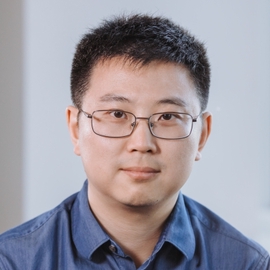
 Yixin Zhu
· 2 previous affiliations
- Peking UniversitySince 2021
- Assistant Professor · Since 2021
- Discover2012–2021
- Postdoc · 2018–2021
- PhD student · 2015–2018
- MS student · 2012–2013
Research Overview
Yixin Zhu focuses on interactive artificial intelligence, cognitive reasoning, and robotic manipulation. His work integrates high-level common sense—such as functionality, affordance, and physics—with raw sensory inputs to enable richer representations of objects, scenes, and agents. Recently, his research emphasizes embodied AI, visuotactile perception, and bridging the simulation-to-reality gap for humanoid robots.
Research Trajectory
Zhu's early research established a foundation in understanding object affordances and physical interactions from visual data. He introduced a generative spatio-temporal framework for task-oriented object modeling in Understanding tools: Task-oriented object modeling, learning and recognition (2015), which represented tools through their functional basis, imagined actions, and underlying physical concepts. Building on this physics-based approach, he subsequently developed methods to infer forces and pressures acting on human body parts during interactions, as detailed in Inferring Forces and Learning Human Utilities from Videos (2016), framing affordance around human utilities rather than mere geometric compatibility.
Moving toward higher-level cognitive tasks, Zhu contributed to the broader area of Decoupling Visual Perception from Structural Reasoning. With collaborators, he helped introduce RAVEN: A Dataset for Relational and Analogical Visual REasoNing (2019), a benchmark designed to test fluid intelligence and structural analogies in vision systems. He expanded on this by addressing the generation of answers in spatial-temporal logic tasks in Abstract Spatial-Temporal Reasoning via Probabilistic Abduction and Execution (2021). Concurrently, his work explored the research direction of Multimodal Grounding for Deictic Reference Resolution. This is exemplified by his participation in the development of YouRefIt: Embodied Reference Understanding with Language and Gesture (2021), a dataset capturing how agents use both language and physical gestures to refer to objects in shared environments.
In 2023, Zhu's research investigated how agents acquire knowledge and reason in complex, open-ended environments. He oversaw the development of the MEWL benchmark in MEWL: Few-shot multimodal word learning with referential uncertainty, evaluating the ability of multimodal models to resolve referential ambiguity during fast mapping. He also led work on Active Reasoning in an Open-World Environment, introducing an interactive setting where agents must actively gather evidence to solve mysteries, highlighting the limitations of passive question-answering models. To address reproducibility and activity understanding in specialized domains, his group curated ProBio: A Protocol-guided Multimodal Dataset for Molecular Biology Lab. Returning to object affordances, he contributed to the area of Functional Part Representations for Generalizable Robotic Manipulation with PartAfford: Part-level Affordance Discovery, proposing a framework that decomposes 3D shapes into parts to predict affordances using sparse supervision.
Zhu's focus on physical reasoning evolved to encompass dynamic, interactive scenarios. He directed research on I-PHYRE: Interactive Physical Reasoning (2024), shifting the paradigm from static predictions to continuous, timing-dependent physical interventions. In parallel, he advanced the research direction of Integrating Neural Perception with Symbolic Logic and the related area of Automated Rule Induction for Neuro-Symbolic AI. This is demonstrated in Neural-Symbolic Recursive Machine for Systematic Generalization (2024), where he and his co-authors developed a modular framework utilizing deduction-abduction training to ground symbols and induce functional programs, achieving robust systematic generalization.
A significant portion of Zhu's recent trajectory centers on embodied AI and robotic manipulation. He led efforts to overcome the simulation-to-reality gap in humanoid robotics with Bridging the Sim-to-Real Gap in Humanoid Dynamics via Learned Nonlinear Operators (2025), introducing a DeepONet-based reinforcement learning framework. His work in the area of Visuotactile Fusion for Dexterous Robotic Manipulation includes contributions to Embedding high-resolution touch across robotic hands enables adaptive human-like grasping (2025), which details a biomimetic hand equipped with distributed tactile sensing. To improve robotic planning and coordination, his lab developed AutoMoMa, detailed in A Scalable Whole-body Trajectory Generator for Coordinated Mobile Manipulation (2025), and introduced an optimization framework for manipulator mounting in B$^{*}$: Efficient and Optimal Base Placement for Fixed-Base Manipulators (2025). He also explored automated curriculum learning through zero-sum teacher-student dynamics in Heterogeneous Adversarial Play in Interactive Environments (2025). Additionally, he participated in the development of UniAct: Unified Motion Generation and Action Streaming for Humanoid Robots (2025), a framework translating multimodal instructions into real-time humanoid actions.
Most recently, Zhu's research continues to push the boundaries of intuitive physics. He led the development of Neural Force Field: Few-shot Learning of Generalized Physical Reasoning (2026), a framework that models object interactions as continuous force fields, enabling AI systems to learn physical dynamics from minimal examples and generalize to out-of-distribution scenarios.
Current Directions
The most recent papers in the evidence indicate a strong focus on scaling embodied AI for complex robotic systems, particularly humanoid robots and dexterous manipulators. Recent work investigates methods for bridging the sim-to-real gap in humanoid dynamics and generating coordinated, whole-body trajectories for mobile manipulation. Another major theme is the integration of high-resolution tactile sensing to enable adaptive, human-like grasping. Furthermore, ongoing research addresses generalized physical reasoning, exploring how continuous neural representations—such as neural force fields—can allow agents to learn intuitive physics from minimal examples and perform goal-directed planning in novel environments.
Profile updated
Loading new papers…
Other researchers whose papers cluster into the same research directions — a proxy for overlapping technical interests and shared intellectual neighborhoods.
See something wrong? Report a mistake