

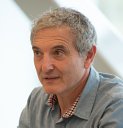
 Shlomo Dubnov
· 6 previous affiliations
- University of California San DiegoSince 2003
- Professor, Music and CSE · Since 2003
- Director · Since 2010
- Ben-Gurion University of the Negev1998–2003
- Senior Lecturer · 1998–2003
- NexAudio2001–2003
- Founder · 2001–2003
- Hebrew University of Jerusalem1992–1996
- Doctor of Philosophy (Ph.D.), Computer Science · 1992–1996
- The Jerusalem Academy of Music and Dance1988–1991
- Bachelor's degree, Music Theory and Composition · 1988–1991
Research Overview
Shlomo Dubnov focuses on computer audition, machine improvisation, and the computational modeling of musical style. His early work established statistical and machine learning methods for analyzing sound textures and generating musical sequences. More recently, his research investigates fine-grained controllability in generative music models, cross-cultural music analysis, and universal audio source separation using weakly labeled data.
Research Trajectory
Dubnov’s early research focused on the statistical characterization and synthesis of complex auditory phenomena. In the late 1990s, he explored sound classification methods for stationary, non-musical sounds and machine noises, introducing an efficient decorrelated matched filter approach in Analysis of sound textures in musical and machine sounds by means of higher order statistical features. Building on this granular view of sonic analysis, he subsequently developed statistical learning algorithms for generating new random instances of natural sounds, detailed in Synthesizing Sound Textures through Wavelet Tree Learning. This foundational work in audio textures naturally extended into the symbolic domain. In Using Machine-Learning Methods for Musical Style Modeling, he investigated how stochastic rules could be derived directly from musical examples to construct mathematical models of musical style, enabling new applications in computer-aided composition.
Throughout the mid-2000s, Dubnov concentrated on real-time machine improvisation and the rapid learning of audio structures. With collaborators, he adapted string-matching data structures to musical sequences in Using Factor Oracles for Machine Improvisation, demonstrating how variable Markov models could be utilized in live performance contexts. He helped formalize the broader academic context of these techniques by publishing Computer audition: an introduction and research survey. Continuing to refine structural learning algorithms, he introduced Audio Oracle: a New Algorithm for Fast Learning of audio Structures, which provided a robust mechanism for capturing and reproducing the temporal organization of audio signals.
As deep learning transformed audio research, Dubnov’s lab integrated neural architectures with established musicological and information-theoretic frameworks. His group contributed to the research direction of Fine-Grained Controllability in Generative Music Models through the development of Music SketchNet: Controllable Music Generation via Factorized Representations of Pitch and Rhythm. By combining Variational Autoencoders with Variable Markov Oracles, he also proposed quantitative methods to distinguish the aesthetic priorities of different musical traditions in Towards Cross-Cultural Analysis using Music Information Dynamics, advancing work in the area of The Cross-Cultural Generalization Gap in Music Models.
In recent years, Dubnov has overseen extensive work in computational auditory scene analysis, source separation, and multimodal representation learning. To address the challenge of generalizing to unseen audio sources, his team developed a transformer-based pipeline in Zero-Shot Audio Source Separation through Query-Based Learning from Weakly-Labeled Data. In the domain of melody extraction, he guided research on Towards Improving Harmonic Sensitivity and Prediction Stability for Singing Melody Extraction, which modified input representations and training objectives to better capture trailing harmonics and stabilize melody contours. Expanding into large-scale multimodal learning, his lab released the LAION-Audio-630K dataset and proposed a feature fusion mechanism in Large-Scale Contrastive Language-Audio Pretraining with Feature Fusion and Keyword-to-Caption Augmentation.
Dubnov’s recent trajectory reflects a continued emphasis on generative modeling, evaluation metrics, and complex structural representations. He led efforts to improve hybrid remixing pipelines using deep filters in Music Enhancement with Deep Filters: A Technical Report for The ICASSP 2024 Cadenza Challenge. To tackle data limitations and copyright concerns in cross-modal generation, his group adapted Stable Diffusion architectures for the audio domain in MusicLDM: Enhancing Novelty in text-to-music Generation Using Beat-Synchronous mixup Strategies. Concurrently, he sought to objectively measure human-AI musical interaction, introducing an entropy-based metric in Evaluating Co-Creativity using Total Information Flow.
In 2025, his research output has included significant contributions to both symbolic and acoustic analysis. He participated in the development of BACHI: Boundary-Aware Symbolic Chord Recognition Through Masked Iterative Decoding on Pop and Classical Music, a model that mimics human ear-training alongside a newly corrected MIDI dataset. He also continued to scale auditory scene analysis in Universal Source Separation With Weakly Labelled Data for Computational Auditory Scene Analysis, addressing the limitations of conditional systems that struggle with large numbers of sound classes. Finally, his collaborative work on Deriving Representative Structure from Music Corpora introduced the Structural Temporal Graph to calculate structural distances between songs, contributing to the broader area of Long Form Structural Coherence in Musical Audio Generation.
Current Directions
Dubnov’s most recent work investigates the scalability of computational auditory scene analysis and the hierarchical modeling of musical structure. A major focus is universal audio source separation, specifically developing systems capable of automatically detecting and separating hundreds of sound classes using only weakly labeled training data. In parallel, his research addresses the symbolic and structural dimensions of music, utilizing masked iterative decoding for chord recognition and developing unified data structures, such as the Structural Temporal Graph, to capture the multi-layered architectural DNA of entire music corpora. Additionally, his lab continues to refine generative audio models, exploring beat-synchronous data augmentation strategies and information-theoretic metrics to evaluate co-creativity between human musicians and AI agents.
Profile updated
Loading new papers…
Other researchers whose papers cluster into the same research directions — a proxy for overlapping technical interests and shared intellectual neighborhoods.
See something wrong? Report a mistake