

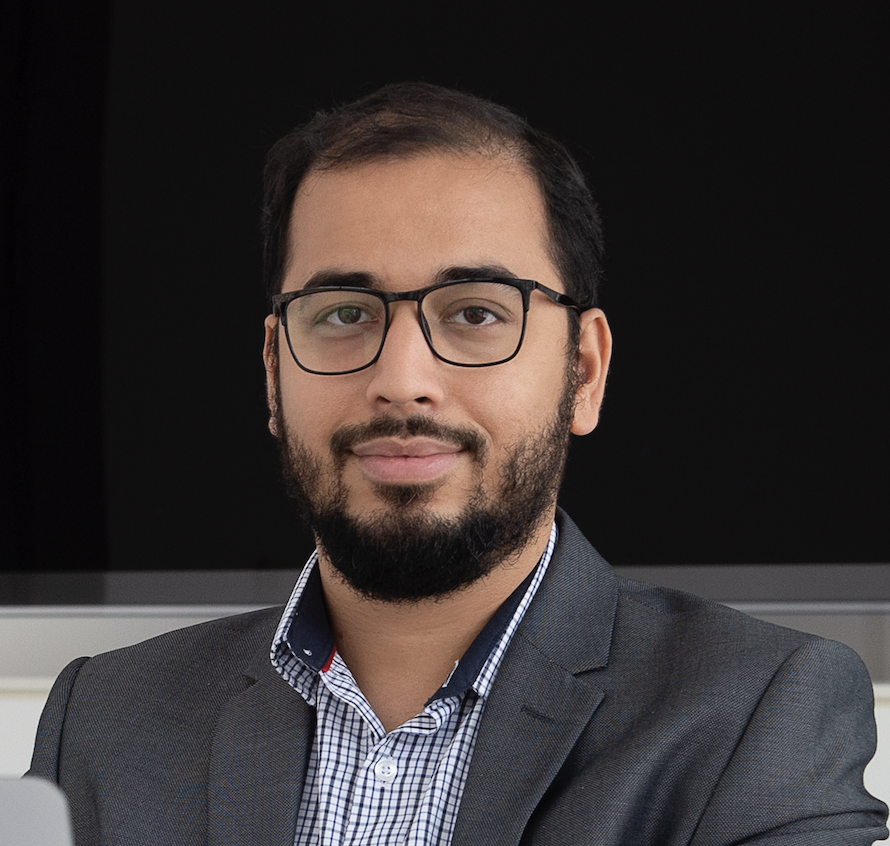
 Salman Khan
· 5 previous affiliations
- Australian National UniversitySince 2016
- Lecturer · Since 2016
- Associate Professor · Since 2021
- Assistant Professor · 2020–2021
- Senior Scientist · 2018–2020
- Research Scientist · 2016–2018
- The University of Western Australia2012–2016
- PhD student · 2012–2016
3 other authors named Salman Khan: Salman Khan (Elm Europe · Astek International · Elm Company · Oxford Brookes University · 11 papers), Salman Khan (STMicroelectronics (Italy) · 1 paper), Salman Khan (Oxford Brookes University · 0 papers)
Research Overview
Salman Khan focuses on computer vision, multi-modal learning, and model generalization, with an emphasis on building robust systems that can learn from limited data. His trajectory spans early work in scene understanding and adversarial robustness to the development of vision-language models and prompt adaptation techniques. Recently, his research has expanded into large multimodal agents and the application of foundation models to Earth observation and climate science.
Research Trajectory
His early research addressed fundamental challenges in indoor scene understanding. He introduced a joint framework for estimating spatial layouts and identifying clutter in RGBD images in Separating objects and clutter in indoor scenes, utilizing a conditional random field model to incorporate geometric features and interactions between scene elements. Following this, his focus shifted toward the robustness of deep neural networks, specifically exploring the research direction of Transferable Adversarial Attacks via Feature Representation Distortion. He developed the Neural Representation Distortion (NRD) attack in Distorting Neural Representations to Generate Highly Transferable Adversarial Examples, demonstrating that maximizing disruptions in a network's internal feature space generates adversarial examples that successfully transfer across different architectures and tasks. Expanding on this in the broader area of Cross-Task Transferability of Adversarial Perturbations, he introduced a generative network trained with a relativistic loss to create perturbations capable of transferring across entirely different image domains in Cross-Domain Transferability of Adversarial Perturbations.
Concurrently, he addressed the challenge of recognizing unseen categories. In Improved Visual-Semantic Alignment for Zero-Shot Object Detection, he proposed a novel loss function and refined semantic word embeddings to bridge visual perception and linguistic understanding, contributing to the research area of Resolving Background Ambiguity in Open Vocabulary Object Detection. He then collaborated on Towards Open World Object Detection, participating in the development of ORE, a detector that uses contrastive clustering and energy-based identification to detect unknown objects and incrementally learn them. Returning to adversarial robustness, he developed Transferable Targeted Perturbations (TTP) in On Generating Transferable Targeted Perturbations, matching feature distributions to a target class to fool unknown models into specific predictions.
As the field transitioned toward attention-based architectures, he led a comprehensive review of this shift in Transformers in Vision: A Survey, detailing how global dependency modeling allowed Transformers to scale effectively in computer vision. This architectural evolution naturally led to work in the research direction of Test-Time Adaptation for Vision-Language Models. He participated in the development of multi-modal prompt learning for CLIP in MaPLe: Multi-modal Prompt Learning, which dynamically adjusted both vision and language representation spaces. As a senior author, he subsequently directed the development of PromptAlign in Align Your Prompts: Test-Time Prompting with Distribution Alignment for Zero-Shot Generalization, a test-time adaptation strategy that aligns the feature statistics of a single test sample with proxy training data to handle distribution shifts. During this period, he also led community evaluation efforts in image enhancement, organizing the NTIRE 2023 Challenge on Efficient Super-Resolution: Methods and Results.
His subsequent work increasingly integrated large language models with visual inputs. He introduced Video-ChatGPT: Towards Detailed Video Understanding via Large Vision and Language Models, bridging a video-adapted visual encoder with an LLM to enable coherent conversations about video content. In parallel, his lab advanced low-level vision tasks, proposing an all-in-one image restoration framework in EvoIR: Towards All-in-One Image Restoration via Evolutionary Frequency Modulation that separates high and low frequencies and uses an evolutionary algorithm to dynamically balance multiple degradation targets like noise, haze, and rain.
Most recently, he has directed significant efforts toward applying foundation models to climate science and remote sensing. He oversaw the development of AirCast: Improving Air Pollution Forecasting Through Multi-Variable Data Alignment, a Vision Transformer-based model that integrates weather and air quality data to predict extreme pollution events. He also led the creation of GeoPixel: Pixel Grounding Large Multimodal Model in Remote Sensing, an end-to-end LMM capable of complex dialogue and precise segmentation mask generation for satellite imagery, contributing to the area of Dynamic Aspect Ratio Tiling for High Resolution Multimodal Models. Expanding on planetary-scale data, his team introduced TerraFM: A Scalable Foundation Model for Unified Multisensor Earth Observation to process heterogeneous radar and optical imagery, and Recovering Cloud Microstructures with Cascaded Diffusion Inversion, a two-stage diffusion framework for super-resolving satellite cloud imagery. Beyond Earth observation, he recently directed the creation of Agent-X: Evaluating Deep Multimodal Reasoning in Vision-Centric Agentic Tasks, a large-scale benchmark designed to stress-test the multi-step reasoning and tool-use capabilities of advanced LMMs. Continuing to explore deep network architectures and safety diagnostics, Khan oversaw FlexPooling with Simple Auxiliary Classifiers in Deep Networks as well as Regime-Aware Physics-Guided Early Warning of Lithium-Ion Battery Thermal Runaway Using Thermo-Mechanical Signals. Khan also collaborated on multi-robot systems in Seeing Together, Acting Apart: Shared Environmental Understanding for Multi-Robot Navigation, introducing an upstream policy-agnostic representation layer that aggregates multi-view observations to enable decentralized embodied collaboration.
Current Directions
The most recent papers in the evidence indicate a strong focus on two primary areas: the application of large multimodal models to Earth observation, and the evaluation of vision-centric agentic reasoning. In the climate and remote sensing domain, recent work investigates scalable foundation models capable of unifying multisensor satellite data, improving air pollution forecasting, and performing pixel-level grounding in high-resolution aerial imagery. Concurrently, his research addresses the limitations of current large multimodal models when deployed as autonomous agents, developing comprehensive benchmarks to evaluate their capacity for multi-step reasoning and tool invocation in complex visual environments.
Profile updated
Loading new papers…
Other researchers whose papers cluster into the same research directions — a proxy for overlapping technical interests and shared intellectual neighborhoods.
See something wrong? Report a mistake