

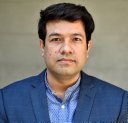
 Rao Muhammad Anwer
· 4 previous affiliations
- Assistant Professor · Since 2020
- Research Scientist · 2018–2020
- Aalto University2014–2020
- Postdoc · 2014–2020
- Universitat Autònoma de Barcelona2008–2013
- PhD student · 2008–2013
Research Overview
Rao Muhammad Anwer focuses on computer vision, multimodal reasoning, and the multilingual evaluation of large language models. His early work addressed foundational problems in object detection and instance segmentation before expanding into 3D perception and spatial-temporal modeling. More recently, his research investigates the integration of visual grounding with large multimodal models and the development of culturally aware benchmarks for diverse linguistic domains.
Research Trajectory
Anwer's early research addressed foundational challenges in computer vision, particularly in feature representation and efficient object parsing. In Color attributes for object detection (2012), he and his collaborators demonstrated that explicitly modeling color attributes alongside traditional shape features could significantly improve detection accuracy for categories where color is a discriminative cue. During this period, his broader interests also encompassed the area of Unsupervised Part Discovery for Fine-Grained Recognition. Building on these efforts to balance precision and computational efficiency, he later introduced SipMask: Spatial Information Preservation for Fast Image and Video Instance Segmentation (2020). This architecture preserved spatial details within a single-stage framework, bridging the gap between the high accuracy of slower two-stage models and the speed required for real-time video processing.
As the field shifted toward foundation models, Anwer's focus expanded to integrate dense visual grounding with natural language generation. He contributed to the development of GLaMM: Pixel Grounding Large Multimodal Model (2024), which enables models to generate text responses seamlessly tied to pixel-level object segmentation masks. This work aligns with his broader engagement in the research direction of Reasoning Segmentation with Multimodal Large Language Models. He further advanced this paradigm in OpenSeg-R: Improving Open-Vocabulary Segmentation via Step-by-Step Visual Reasoning (2025), a framework that leverages hierarchical visual cues to resolve semantic confusion among visually similar categories.
Simultaneously, Anwer extended open-vocabulary perception into three-dimensional spaces, a key theme in the area of Open-Vocabulary 3D Perception via 2D Foundation Models. With Open-YOLO 3D: Towards Fast and Accurate Open-Vocabulary 3D Instance Segmentation (2025), he participated in designing a high-speed framework that utilizes 2D bounding boxes and multi-view voting to process 3D scenes efficiently. He also guided the development of All in One: Visual-Description-Guided Unified Point Cloud Segmentation (2025), which enhances 3D point cloud segmentation by incorporating external knowledge from large language models and reference images.
A major parallel arc in Anwer's recent trajectory involves evaluating and adapting large multimodal models for diverse linguistic and cultural contexts. He contributed to PALO: A Polyglot Large Multimodal Model for 5B People (2024), which utilized semi-automated translation to extend high-quality visual reasoning to ten major languages, reflecting his work in the research area of Human in the Loop Translation Refinement. Recognizing the limitations of general-purpose models in non-Western contexts, Anwer has led several initiatives to create rigorous, culturally aware evaluation frameworks, contributing to the broader area of Culturally Grounded Benchmarks for Multilingual Evaluation. In CAMEL-Bench: A Comprehensive Arabic LMM Benchmark (2025), his team introduced a large-scale evaluation suite spanning diverse domains to measure multimodal capabilities specifically in Arabic. He also oversaw Fann or Flop: A Multigenre, Multiera Benchmark for Arabic Poetry Understanding in LLMs (2025), which exposed the "classical gap" in modern models' ability to parse historical poetic forms, a challenge central to the direction of Modeling the Linguistic Gap Between Formal and Dialectal Speech. Expanding beyond language, he directed the creation of Time Travel: A Comprehensive Benchmark to Evaluate LMMs on Historical and Cultural Artifacts (2025), testing how well AI systems comprehend the temporal and cultural nuances of human history.
Anwer's recent work also adapts foundation models to specialized domains and complex spatial-temporal tasks. In agriculture, he guided the development of AgroGPT : Efficient Agricultural Vision-Language Model with Expert Tuning (2025), a vision-language model fine-tuned on conversational data to provide expert-level diagnostics. In the medical domain, he led the design of a lightweight spatial-temporal transformer for Real-time Breast Lesion Detection in Videos via Spatial-temporal Feature Aggregation (2025), addressing the computational bottlenecks of processing ultrasound videos. His research increasingly tackles dynamic and multi-sensor environments. He oversaw Tracking Meets Large Multimodal Models for Driving Scenario Understanding (2025), which integrates 3D object tracking data directly into LMMs to capture complex spatiotemporal dynamics for autonomous driving. Moving to planetary scales, he collaborated on TerraFM: A Scalable Foundation Model for Unified Multisensor Earth Observation (2026), aiming to unify the processing of heterogeneous satellite imagery. He also contributed to TAViS: Text-bridged Audio-Visual Segmentation with Foundation Models (2026), which uses natural language as an intermediary to align audio and visual modalities. Finally, to rigorously test the limits of these advanced systems, he participated in developing Agent-X: Evaluating Deep Multimodal Reasoning in Vision-Centric Agentic Tasks (2026), a benchmark assessing the capacity of LMMs to execute multi-step reasoning and tool use in complex visual scenarios.
Current Directions
Based on his most recent papers, Anwer's current work focuses on scaling multimodal reasoning to complex, dynamic, and specialized environments. A primary theme is the integration of temporal and spatial dynamics into foundation models, enabling them to process continuous streams of data such as autonomous driving trajectories, medical ultrasound videos, and multi-sensor earth observation imagery. Additionally, he is actively investigating the agentic capabilities of large multimodal models, developing frameworks to evaluate how well these systems can execute multi-step reasoning and utilize tools in vision-centric tasks. Finally, his ongoing efforts in multilingual and cultural benchmarking highlight a sustained commitment to ensuring that advanced AI systems are robust, culturally grounded, and accessible across diverse global populations.
Profile updated
Loading new papers…
Other researchers whose papers cluster into the same research directions — a proxy for overlapping technical interests and shared intellectual neighborhoods.
See something wrong? Report a mistake