

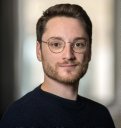
 Ruben Ohana
· 8 previous affiliations
- Nvidia (United States)Since 2025
- Researcher · Since 2025
- Simons Foundation2022–2025
- Research Fellow, Center for Computational Mathematics, Flatiron Institute · 2022–2025
- Flatiron Institute2022–2025
- Postdoc · 2022–2025
- École Normale Supérieure - PSL2019–2022
- PhD candidate · 2019–2022
- Research Internship in Machine Learning · 2019
- Criteo (France)2021–2022
- PhD Internship in Machine Learning · 2021–2022
- LightOn2019–2022
- PhD student · 2019–2022
- Sorbonne Université2018–2019
- Master 2 (M2), Mathématiques et statistiques · 2018–2019
- LIP62018
- Research Internship in Quantum Information · 2018
Research Overview
Ruben Ohana focuses on foundation models for scientific data, machine learning algorithms for optical processing units, and adaptive optimization techniques. His early work explored the integration of analog photonic hardware with biologically plausible learning rules to improve computational efficiency and privacy. Recently, his research has shifted toward developing large-scale datasets, generative models, and flexible emulators for complex physical simulations.
Research Trajectory
During his doctoral studies and his concurrent time as a research scientist at the startup LightOn, Ohana’s work centered on leveraging physical randomness and analog hardware to accelerate machine learning. In 2020, he explored the theoretical and practical aspects of random projections and recurrent architectures. He introduced Structured Reservoir Computing in Reservoir Computing meets Recurrent Kernels and Structured Transforms, connecting reservoir computing to recurrent kernels in the infinite-width limit to improve memory efficiency and speed for chaotic time-series prediction. That same year, he addressed the computational bottlenecks of large-scale random features in Kernel Computations from Large-Scale Random Features Obtained by Optical Processing Units. By utilizing analog Optical Processing Units (OPUs), this work demonstrated fast, energy-efficient computations in the analog domain, contributing to the broader area of Scaling Random Projections Beyond the Silicon Memory Wall and the domain of Photonic Accelerators for High Dimensional Random Projections.
In 2021, Ohana expanded his focus to biologically plausible learning rules and privacy. He participated in analyzing the theoretical framework of Direct Feedback Alignment (DFA) in Align, then memorise: the dynamics of learning with feedback alignment. This research revealed that DFA operates through a two-step process of alignment and memorization, advancing the research direction of Structural Constraints in Direct Feedback Alignment. Building on this, he combined OPUs and DFA to develop a differentially private training mechanism in Photonic Differential Privacy with Direct Feedback Alignment, leveraging the intrinsic noise of optical random projections to achieve provable privacy without significant computational overhead. He further utilized OPUs for security in Adversarial Robustness by Design Through Analog Computing And Synthetic Gradients (2022), physically obfuscating network parameters to defend against adversarial attacks. This early phase of his career culminated in his thesis, Leveraging (Physical) Randomness in Machine Learning Algorithms, which synthesized his findings on using physical hardware noise for computational and security benefits.
Moving into 2023, Ohana’s trajectory broadened to include statistical learning theory and optimization. He bridged optimal transport and PAC-Bayesian theory in Shedding a PAC-Bayesian Light on Adaptive Sliced-Wasserstein Distances, providing formal generalization bounds for adaptive Sliced-Wasserstein distances. This method allowed for the learning of highly discriminative slice distributions, situating his work within the domain of Dimension Independent Statistical Convergence for Probability Distances. In the area of Bounding Adaptive Step Sizes for Stable Optimization, he developed MoMo: Momentum Models for Adaptive Learning Rates. MoMo introduced a new class of adaptive learning rates that model the loss function using momentum, significantly reducing the need for manual tuning across various architectures.
In 2024 and beyond, particularly during his involvement with the Polymathic AI collaboration and as a Research Fellow at the Flatiron Institute, his focus shifted heavily toward scientific machine learning and generative AI. He led the development of The Well: a Large-Scale Collection of Diverse Physics Simulations for Machine Learning, a massive 15TB dataset spanning biological systems, fluid dynamics, and astrophysics designed to evaluate surrogate models. This represented a key contribution to the field of Foundation Models for Scientific Machine Learning.
His subsequent work has explored advanced control mechanisms and architectural improvements for generative models. In 2025, he introduced TC-LoRA: Temporally Modulated Conditional LoRA for Adaptive Diffusion Control, shifting controllable image generation to weight-space conditioning by dynamically generating LoRA adapters at each denoising step. Continuing his work on physical simulations in 2026, he collaborated on On the Value of Tokeniser Pretraining in Physics Foundation Models, investigating how strategic pretraining of tokenizers improves the accuracy and efficiency of physics emulators. Concurrently, he co-developed Overtone: Cyclic Patch Modulation for Clean, Efficient, and Flexible Physics Emulators, a framework for Transformer-based emulators that eliminates grid artifacts through dynamic patch modulation during inference.
Current Directions
Recent work investigates the architecture, training dynamics, and control mechanisms of foundation models for physical simulations and generative AI. The most recent papers in the evidence address the efficiency and flexibility of physics emulators, exploring techniques like strategic tokenizer pretraining to improve downstream accuracy on physical systems. Additionally, ongoing research examines structural improvements to Transformer-based emulators, such as dynamic, cyclic patch modulation to eliminate grid artifacts and allow for flexible speed-accuracy trade-offs during inference. In the broader generative space, current efforts also focus on adaptive control in diffusion models, utilizing hypernetworks to dynamically generate weight-space conditioning at each denoising step for more precise and parameter-efficient image generation.
Profile updated
Loading new papers…
Other researchers whose papers cluster into the same research directions — a proxy for overlapping technical interests and shared intellectual neighborhoods.
See something wrong? Report a mistake