

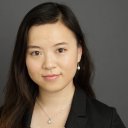
 Rose Yu
· 4 previous affiliations
- University of California San DiegoSince 2020
- Associate Professor · Since 2020
- Northeastern University2018–2020
- Assistant Professor · 2018–2020
- California Institute of Technology2017–2018
- Postdoc · 2017–2018
- University of Southern California2012–2017
- PhD student · 2012–2017
Research Overview
Rose Yu focuses on physics-guided machine learning, spatiotemporal forecasting, and the discovery of symmetries in dynamical systems. Her early work developed foundational graph and tensor methods for modeling complex temporal data. More recently, her research emphasizes integrating physical laws into deep learning architectures and building probabilistic AI models for large-scale weather prediction.
Research Trajectory
Yu's early research addressed the challenges of multivariate spatiotemporal forecasting. In 2014, she introduced a unified framework in Fast Multivariate Spatio-temporal Analysis via Low Rank Tensor Learning, combining global low-rank constraints with local Laplacian regularization to improve the accuracy and computational speed of data interpolation and forecasting. In 2018, she modeled traffic flow as a diffusion process on directed graphs, developing the Diffusion Convolutional Recurrent Neural Network in Diffusion Convolutional Recurrent Neural Network: Data-Driven Traffic Forecasting to capture both complex spatial dependencies and nonlinear temporal dynamics.
Transitioning toward physical systems and control, she participated in 2019 research on robust nonlinear control for multi-rotor drones. This work, detailed in Neural Lander: Stable Drone Landing Control Using Learned Dynamics, combined nominal dynamics models with deep neural networks constrained by spectral normalization to manage complex aerodynamic interactions near the ground. By 2020, her focus expanded into the broader area of Enforcing Physical Consistency in Data-Driven Models. She guided the development of the AutoODE framework in Bridging Physics-based and Data-driven modeling for Learning Dynamical Systems, demonstrating that mechanistic models tuned via automatic differentiation are significantly more robust to distribution shifts than purely data-driven neural networks.
This interest in physical consistency naturally led to a sustained focus on symmetry and equivariance. In 2021, she explored incorporating symmetries into convolutional networks to improve generalization under distributional shifts in Incorporating Symmetry into Deep Dynamics Models for Improved Generalization. Recognizing that strict symmetry often fails in real-world fluid dynamics due to boundary conditions or noise, her group advanced the research direction of Soft and Adaptive Equivariance for Imperfect Symmetries. This concept was formalized in Approximately Equivariant Networks for Imperfectly Symmetric Dynamics (2022), which relaxed rigid symmetry constraints to model complex physical systems more accurately.
In parallel, she addressed computational challenges in continuous-time event modeling. In 2023, she introduced Auto-NPP in Automatic Integration for Fast and Interpretable Neural Point Processes, contributing to the area of Overcoming the Integration Bottleneck in Neural Point Processes by replacing slow numerical integration with exact, highly expressive automatic integration.
Returning to dynamical systems, her work evolved toward the automated discovery of governing laws. In 2024, she contributed to the research areas of Automated Symmetry Discovery and Generalized Equivariance and Discovering Non-Linear Symmetries from Data with Latent Space Symmetry Discovery. This paper introduced Latent LieGAN, a generative framework that maps high-dimensional observations into a latent space to automatically discover complex, nonlinear symmetries without prior knowledge. She also synthesized this growing field in a comprehensive 2024 overview, Learning dynamical systems from data: An introduction to physics-guided deep learning.
In 2025, she further advanced equation discovery by integrating symmetry invariants to constrain the vast search space of symbolic differential equations in Discovering Symbolic Differential Equations with Symmetry Invariants. She also extended her earlier work on imperfect symmetries with Governing Equation Discovery with Relaxed Symmetry Constraints, proposing a two-stage approach to identify a symmetric backbone before refining it to capture symmetry-breaking terms.
Current Directions
The most recent papers in the evidence address large-scale probabilistic weather forecasting, efficient generative modeling for physical simulations, and the reasoning capabilities of large language models.
A major current focus is developing highly efficient and agentic approaches to atmospheric science. This includes Elucidated Rolling Diffusion Models for Probabilistic Weather Forecasting and U-Cast: A Surprisingly Simple and Efficient Frontier Probabilistic AI Weather Forecaster, which aim to democratize AI weather prediction by achieving robust probabilistic forecasting without the massive computational overhead of complex graph networks or iterative diffusion processes. Furthermore, she recently introduced Zephyrus: An Agentic Framework for Weather Science, which equips language models with specialized Python environments and meteorological tools to reason about atmospheric phenomena and perform simulations autonomously.
Her recent work also investigates accelerated generative frameworks for high-fidelity simulation, such as Recursive Flow Matching, which enforces self-consistency across trajectory scales to drastically speed up physics simulations. Finally, she is exploring trajectory-aware interventions for language models, as seen in Manifold-Guided Attention Steering, a method that projects internal activations onto a learned correctness manifold to correct reasoning errors in real-time during inference.
Profile updated
Loading new papers…
Other researchers whose papers cluster into the same research directions — a proxy for overlapping technical interests and shared intellectual neighborhoods.
See something wrong? Report a mistake