

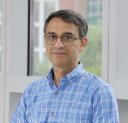
 Rizwan Ahmad
· 1 previous affiliation
- The Ohio State UniversitySince 2001
- Associate Professor · Since 2022
- Assistant Professor · 2017–2022
- Assistant Professor · 2015–2017
- Researcher · 2008–2015
- Postdoc · 2007–2008
- PhD student · 2001–2007
Research Overview
Rizwan Ahmad focuses on cardiovascular magnetic resonance imaging, inverse problems, and digital signal processing. His work spans the development of accelerated data acquisition techniques and advanced image reconstruction algorithms, evolving from early research in electron paramagnetic resonance to modern deep learning frameworks. Currently, he investigates physics-informed generative models and self-supervised learning to improve the diagnostic accuracy of dynamic medical imaging.
Research Trajectory
Ahmad’s early research centered on optimizing data acquisition for electron paramagnetic resonance (EPR) imaging. In Data acquisition and reconstruction techniques for improved electron paramagnetic resonance (EPR) imaging (2007), he modeled spatial and spectral-spatial acquisition processes using the Radon transform to significantly reduce scan times without compromising image quality. He subsequently co-authored a comprehensive review of the field’s methodologies in Theory, Instrumentation, and Applications of Electron Paramagnetic Resonance Oximetry (2010).
Transitioning his focus to cardiovascular magnetic resonance imaging (MRI), Ahmad began addressing the inherent slowness of MRI data acquisition through compressed sensing and novel sampling strategies. He developed Variable density incoherent spatiotemporal acquisition (VISTA) for highly accelerated cardiac MRI (2014), a technique that generates highly uniform and incoherent sampling patterns to maintain temporal resolution at high acceleration rates. To reconstruct these undersampled signals, he introduced adaptive algorithms in Iteratively Reweighted ℓ1 Approaches to Sparse Composite Regularization (2015), which automatically adjusted regularization weights for signals sparse across multiple dictionaries. Applying these principles to blood flow quantification, he proposed A Bayesian model for highly accelerated phase-contrast MRI (2015), demonstrating accurate recovery from highly undersampled data and contributing to the broader research area of Multi-directional Volumetric Hemodynamic Mapping.
As his work progressed, Ahmad increasingly focused on mitigating patient motion and automating the reconstruction pipeline. He participated in the development of Patient specific prospective respiratory motion correction for efficient, free‐breathing cardiovascular MRI (2019), which limited residual motion in single-shot imaging while maintaining full acquisition efficiency. To streamline image recovery, he advanced the area of Automated Regularization Tuning for Inverse Problems by introducing Autotuning Plug-and-Play Algorithms for MRI (2020). This algorithm utilized Morozov’s discrepancy principle to eliminate manual parameter tuning, achieving optimal performance with faster convergence. He further detailed these frameworks in Plug-and-Play Methods for Magnetic Resonance Imaging: Using Denoisers for Image Recovery (2020).
In recent years, Ahmad’s group has integrated deep learning and generative models into dynamic MRI. His lab introduced flexible sampling toolkits in Technical Report (v1.0)--Pseudo-random Cartesian Sampling for Dynamic MRI (2022), supporting the broader research direction of Learned Inverse Solvers for Real-Time Image Reconstruction. To address the need for uncertainty quantification in medical imaging, he developed A Regularized Conditional GAN for Posterior Sampling in Inverse Problems (2022), enabling the rapid generation of multiple plausible image reconstructions. He expanded on this by applying conformal prediction in Task-Driven Uncertainty Quantification in Inverse Problems via Conformal Prediction (2024), creating a framework that stops scanning once diagnostic uncertainty for a specific downstream task is sufficiently low.
A major theme of Ahmad’s recent trajectory involves robust imaging during physical stress and irregular motion. His group developed techniques to capture high-quality cardiac cine and flow images while patients actively pedal inside the scanner, detailed in Accelerated Real-time Cine and Flow under In-magnet Staged Exercise (2024) and Coil Reweighting to Suppress Motion Artifacts in Real-Time Exercise Cine Imaging (2024). To handle complex volumetric motion without breath-holds, he oversaw the creation of EMORe: Motion-Robust 5D MRI Reconstruction via Expectation-Maximization-Guided Binning Correction and Outlier Rejection (2025).
Simultaneously, Ahmad has pushed the boundaries of unsupervised learning, advancing the area of Physics Informed Deep Learning for Accelerated MRI Reconstruction. His lab developed MRI recovery with self-calibrated denoisers without fully-sampled data (2024), a self-supervised method that trains denoisers directly on undersampled data. He also collaborated on Solving Inverse Problems using Diffusion with Fast Iterative Renoising (2025), which improves the accuracy and speed of pre-trained diffusion models. Further contributing to the field of Physics-Driven Generative Reconstruction for Undersampled Medical Imaging, his group introduced An unsupervised method for MRI recovery: deep image prior with structured sparsity (2025), which discovers underlying motion patterns without pre-defined models or fully sampled training sets. Most recently, these innovations have been translated to more accessible hardware, as demonstrated in Feasibility of Golden Angle Spiral Real-Time Phase Contrast MRI at 0.55T: A Single-Center Prospective Study (2026), aligning with his overarching goal of enabling Eliminating Breath-Hold Constraints in Dynamic MRI.
Current Directions
The most recent papers in the evidence indicate a strong focus on self-supervised and unsupervised deep learning for medical image reconstruction. By leveraging techniques like deep image priors, structured sparsity, and self-calibrated denoisers, Ahmad’s current work seeks to eliminate the reliance on fully sampled ground-truth data, which is often impossible to acquire in dynamic clinical scenarios.
Additionally, his research addresses the practical challenges of imaging uncooperative or physically stressed patients. Recent frameworks emphasize extreme motion robustness, enabling high-fidelity 5D cardiac imaging and real-time exercise MRI without requiring breath-holds or electrocardiogram gating. This methodological work is increasingly being adapted for lower-cost, mid-field (0.55T) MRI scanners, suggesting a parallel focus on improving the clinical accessibility and patient tolerance of advanced cardiovascular imaging.
Profile updated
Loading new papers…
Other researchers whose papers cluster into the same research directions — a proxy for overlapping technical interests and shared intellectual neighborhoods.
See something wrong? Report a mistake