

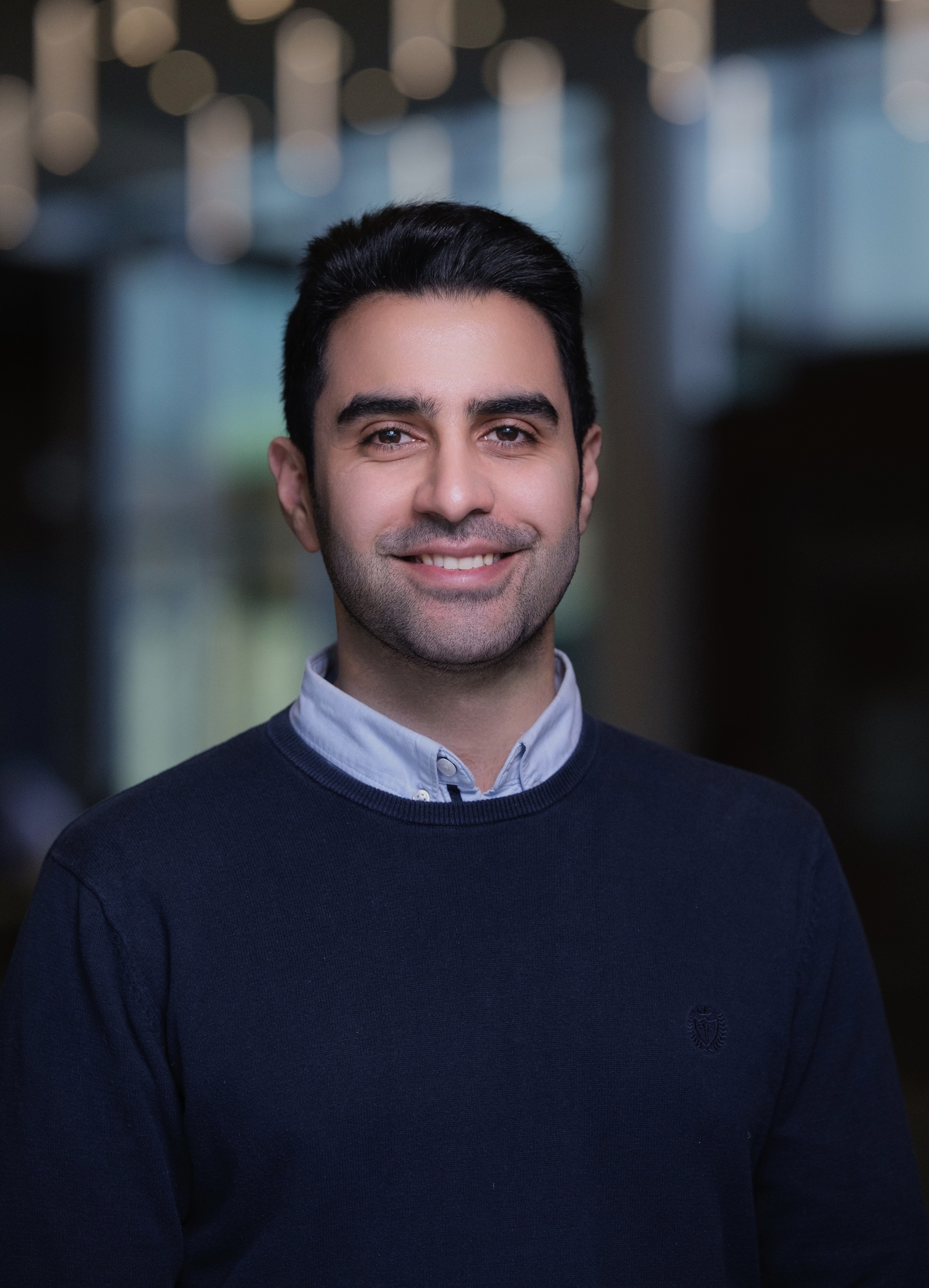
 Reza Shirkavand
· 3 previous affiliations
- University of Maryland, College ParkSince 2023
- PhD student · Since 2023
- University of Pittsburgh2022–2023
- MS student · 2022–2023
- Sharif University of Technology2015–2020
- Undergrad student · 2015–2020
Research Overview
Reza Shirkavand focuses on efficient and adaptive deep learning, with an emphasis on parameter-efficient fine-tuning, model compression, and generative recommendation systems. His trajectory spans from optimizing graph transformers to developing memory-efficient adaptation techniques for large language and vision models. His current work investigates dynamic routing and structural pruning to deploy massive architectures in resource-constrained environments.
Research Trajectory
Shirkavand's early research addressed the parameter-efficient adaptation of frozen foundation models. In Deep Prompt Tuning for Graph Transformers, he introduced DeepGPT, a method that freezes a pre-trained backbone and trains only a minimal set of task-specific prompt tokens. By injecting these tokens at the input and across transformer layers, the approach achieved performance competitive with full fine-tuning while updating less than 0.5% of the model's parameters.
The focus on efficiency naturally extended to the computationally demanding domain of generative AI and multimodal systems. To address the massive architectures of text-to-image models, he collaborated on Not All Prompts Are Made Equal: Prompt-based Pruning of Text-to-Image Diffusion Models, exploring how prompt characteristics can guide the pruning of diffusion backbones. This work intersects with the broader research direction of Difficulty-Adaptive Test-Time Scaling for Reasoning Models. Recognizing that model compression can inadvertently preserve or amplify undesirable behaviors, he subsequently developed Efficient Fine-Tuning and Concept Suppression for Pruned Diffusion Models. This research provided a mechanism to suppress the generation of copyrighted or unsafe content that persists after pruning and knowledge distillation. Concurrently, he investigated the reliability of multimodal systems in ARGUS: Hallucination and Omission Evaluation in Video-LLMs. By implementing a dense, sentence-level entailment analysis, this evaluation framework revealed that even advanced models frequently hallucinate or omit key events during freeform video captioning.
Returning to core language model efficiency, Shirkavand advanced the area of Zeroth Order Optimization for Memory Efficient Large Model Fine-Tuning. In Bilevel ZOFO: Efficient LLM Fine-Tuning and Meta-Training, he proposed an optimization framework nesting a fast parameter-efficient inner loop within a full-model zeroth-order outer loop, yielding faster training and higher accuracy than prior memory-efficient techniques. To optimize inference costs, he introduced Cost-Aware Contrastive Routing for LLMs. This lightweight framework embeds user prompts and models into a shared metric space, enabling microsecond-latency model selection that significantly improves the accuracy-cost tradeoff without requiring retraining.
Most recently, his trajectory has incorporated dynamic routing and structural pruning into recommendation systems and Mixture-of-Experts (MoE) architectures. He participated in the design of Semantics Meet Signals: Dual Codebook Representationl Learning for Generative Recommendation, which dynamically allocates representational capacity based on item popularity. Building on the intersection of LLMs and recommendation, he developed Catalog-Native LLM: Speaking Item-ID dialect with Less Entanglement for Recommendation. This novel IDIOMoE architecture separates collaborative filtering signals from semantic text processing using dedicated experts, maintaining recommendation accuracy while preserving the model's language reasoning capabilities. Further advancing MoE methodologies, he contributed to ToMoE: Converting Dense Large Language Models to Mixture-of-Experts through Dynamic Structural Pruning, a technique that transforms dense LLMs into sparse MoE models without requiring weight updates to the original architecture.
Current Directions
The most recent papers in the evidence indicate a strong focus on bridging large language models with specialized, resource-efficient architectures. Recent work investigates the transformation of dense models into sparse Mixture-of-Experts configurations through dynamic structural pruning and specialized routing mechanisms. Additionally, ongoing research addresses the integration of generative LLMs into large-scale recommendation systems, exploring how to decouple collaborative filtering signals from natural language processing to maintain reasoning capabilities while optimizing for domain-specific tasks.
Profile updated
Loading new papers…
Other researchers whose papers cluster into the same research directions — a proxy for overlapping technical interests and shared intellectual neighborhoods.
See something wrong? Report a mistake