

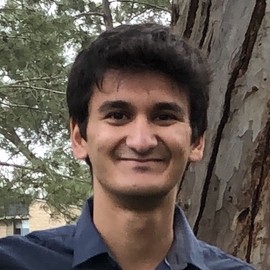
 Raghav Kansal
· 5 previous affiliations
- Bexorg, IncSince 2025
- Researcher · Since 2025
- Current
- Schmidt AI Fellow · 2024–2025
- University of California San Diego2015–2024
- PhD student · 2019–2024
- BS, Physics and Computer Engineering · 2015–2019
- LPC Graduate Scholar · 2023–2024
- LPC Artificial Intelligence Fellow · 2021–2022
- PhD student · 2020–2024
Research Overview
Raghav Kansal focuses on the intersection of machine learning and high-energy physics, developing generative models, graph neural networks, and equivariant architectures for scientific simulation and data analysis. His trajectory spans the creation of physics-informed neural networks for particle collision data to the establishment of unified data standards for scientific research. Most recently, his work investigates continuous generative modeling and optimal transport for physical systems.
Research Trajectory
Beginning in 2020, Kansal's research addressed the computational bottlenecks of high-energy physics (HEP) simulations by leveraging machine learning. He introduced a novel architecture in Graph Generative Adversarial Networks for Sparse Data Generation in High Energy Physics, utilizing message-passing neural networks to generate the sparse, irregular data characteristic of particle jets. Expanding on this approach, he developed message-passing GANs specifically for particle clouds in Particle Cloud Generation with Message Passing Generative Adversarial Networks. This work established new benchmarks for evaluating generated jets, contributing significantly to the area of Physics-Informed Evaluation of Generative Models for Scientific Simulation and the broader field of Generative Emulation of Complex Physical Systems.
Concurrently, Kansal explored the application of graph neural networks (GNNs) for anomaly detection and model interpretability. He helped design unsupervised anomaly detection methods in Particle Graph Autoencoders and Differentiable, Learned Energy Mover's Distance, which introduced a differentiable approximation of the Energy Mover's Distance as a training loss function. To build trust in these complex models, his research applied Layerwise Relevance Propagation to particle-flow algorithms in Explaining machine-learned particle-flow reconstruction, visualizing how input features influence predictions. He further investigated the physical grounding of these models in Do graph neural networks learn traditional jet substructure?, demonstrating that GNNs successfully capture meaningful physics-based features rather than relying on abstract artifacts.
A major theme in Kansal's trajectory is the promotion of open science and reproducibility in machine learning for physics. He collaborated on frameworks to transform massive simulated datasets into accessible formats in A FAIR and AI-ready Higgs Boson Decay Dataset. This effort advanced the research direction of Unified Data Standards for Interoperable Scientific Research and supported initiatives in Bridging the Metadata Context Gap for Scientific Data Reuse, while also providing resources for the domain of Neural Architectures for Variable Length Sequential Data. To facilitate community access to these resources, he created the open-source tool described in JetNet: A Python package for accessing open datasets and benchmarking machine learning methods in high energy physics. He also contributed to broader community guidelines in FAIR AI models in high energy physics, emphasizing the portability and interpretability of HEP models.
In subsequent years, Kansal's focus shifted toward incorporating physical symmetries directly into neural architectures. He contributed to the development of models that respect the proper, orthochronous Lorentz group in Lorentz Group Equivariant Autoencoders, advancing the area of Geometric Equivariance for Physical Deep Learning to improve compression and anomaly detection. He also participated in designing novel generative models utilizing physics-informed attention mechanisms in Induced Generative Adversarial Particle Transformers. Continuing to refine representation learning, he was involved in introducing self-supervised techniques that avoid hand-crafted augmentations in Learning Symmetry-Independent Jet Representations via Jet-Based Joint Embedding Predictive Architecture.
Most recently, Kansal has addressed domain adaptation and continuous generative modeling. He helped develop self-supervised methods to pretrain models on unlabeled real-world data in RINO: Renormalization Group Invariance with No Labels, learning representations invariant to energy scales to bridge the gap between simulation and reality. Expanding into optimal transport, he proposed a new framework for learning continuous trajectories from discrete snapshots in Multimarginal flow matching with optimal transport potentials, offering a simulation-free approach to generating physically plausible paths.
Current Directions
Recent work investigates advanced generative frameworks and self-supervised learning techniques to improve the robustness and physical plausibility of machine learning models in scientific domains. The most recent papers in the evidence address the challenge of domain shifts between simulated and real-world particle collision data by learning representations that remain invariant to energy scales. Additionally, current research explores continuous generative modeling, specifically utilizing optimal transport potentials within flow matching frameworks to learn smooth, physically accurate trajectories from discrete data snapshots without relying on computationally expensive simulations.
Profile updated
Loading new papers…
Other researchers whose papers cluster into the same research directions — a proxy for overlapping technical interests and shared intellectual neighborhoods.
See something wrong? Report a mistake