

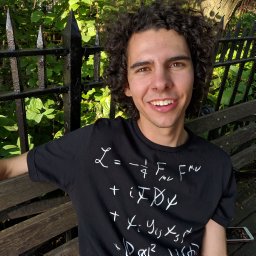
 Eric A. Moreno
· 5 previous affiliations
- Massachusetts Institute of TechnologySince 2021
- Research Fellow · Since 2021
- PhD student · 2021–2026
- Student Researcher · Since 2020
- California Institute of Technology2017–2021
- Research Assistant and Taylor W. Lawrence SURF Fellow · 2018–2021
- Bachelor of Science - BS, Physics · 2017–2021
- LIGO Scientific Collaboration2018
- Research Assistant · 2018
- Senspex, Inc.2015–2017
- IT Specialist · 2016–2017
- IT Assistant · 2015–2016
Research Overview
Eric A. Moreno focuses on the intersection of machine learning, high-energy physics, and gravitational-wave astronomy, developing algorithms for rapid data processing and anomaly detection. Their trajectory spans from optimizing neural networks for edge hardware constraints to deploying recurrent architectures for unmodeled transient detection. Recently, this work has expanded to investigate the use of autonomous AI agents for experimental physics analysis.
Research Trajectory
The trajectory begins with applying deep learning to high-energy physics at the Large Hadron Collider (LHC). Early work explored Interaction networks for jet characterisation at the LHC, demonstrating that these architectures could achieve strong performance without relying on strict assumptions about detector geometry. Moreno subsequently led the development of Interaction networks for the identification of boosted <mml:math xmlns:mml="http://www.w3.org/1998/Math/MathML" display="inline"><mml:mi>H</mml:mi><mml:mo stretchy="false">→</mml:mo><mml:mi>b</mml:mi><mml:mover accent="true"><mml:mi>b</mml:mi><mml:mo stretchy="false">¯</mml:mo></mml:mover></mml:math> decays, which framed jet showers as particle interactions to improve classification on CMS Open Data. This research contributed to the broader area of Parameter Efficiency and Model Size Optimization.
The focus then expanded to gravitational-wave astronomy, specifically targeting the detection of unmodeled signals. Moreno introduced Source-Agnostic Gravitational-Wave Detection with Recurrent Autoencoders, utilizing unsupervised anomaly detection to identify signals beyond pre-computed templates, advancing the research direction of Modeling Temporal Dependencies with Recurrent Neural Networks. To address the latency requirements of interferometers like LIGO, collaborative work in Accelerating Recurrent Neural Networks for Gravitational Wave Experiments optimized LSTM networks for FPGA deployment. This effort intersected with research in Compressing Deep Networks for Edge Hardware Constraints and the area of Sub-Microsecond Neural Inference via Pipelined Hardware Co-Design.
Building on the recurrent autoencoder approach, Moreno contributed to the Gravitational Wave Anomalous Knowledge (GWAK) method in GWAK: gravitational-wave anomalous knowledge with recurrent autoencoders. This semi-supervised strategy constructed a low-dimensional embedded space to isolate physical signatures of distinct signals. The method was later applied to observational data in A Neural Network-Based Search for Unmodeled Transients in LIGO-Virgo-KAGRA's Third Observing Run, successfully recovering compact binary coalescences and detector glitches. Parallel efforts in real-time parameter estimation resulted in Rapid Likelihood Free Inference of Compact Binary Coalescences using Accelerated Hardware, which utilized normalizing flows to process candidates with minimal latency.
Returning to hardware acceleration, research shifted toward deploying attention mechanisms for physics triggers. Moreno guided Low Latency Transformer Inference on FPGAs for Physics Applications with hls4ml, achieving sub-microsecond latency for multi-head attention and softmax layers on FPGA chips. This work engaged with the area of Feature Disentanglement in Parallel Attention Subspaces. Further collaborative development in Ultra Fast Transformers on FPGAs for Particle Physics Experiments applied these techniques to jet flavor tagging, contributing to the direction of Generalizing Machine Learning Frameworks Across Network Architectures.
The most recent phase of the trajectory explores automated scientific workflows. Participation in AutoSciDACT: Automated Scientific Discovery through Contrastive Embedding and Hypothesis Testing helped establish a pipeline for statistically robust novelty detection using contrastive pre-training. Subsequently, Moreno led AI Agents Can Already Autonomously Perform Experimental High Energy Physics, demonstrating that large language model-based agents could execute complex analysis pipelines—from event selection to statistical inference—on open data. To rigorously evaluate these autonomous systems, collaborative work in HEP-Ex-Bench: Evaluating Agentic Performance in High Energy Physics Experiment Data Analyses with Sealed Worlds introduced a benchmark utilizing programmatically generated private datasets with injected signals.
Current Directions
Recent work investigates the integration of autonomous AI agents into experimental physics workflows. The most recent papers address the automation of high-energy physics data analysis, exploring how large language models can execute tasks ranging from background estimation to statistical inference. A key focus within this domain is the development of robust evaluation frameworks, utilizing blind analysis and simulated "sealed worlds" to quantitatively benchmark the accuracy and reliability of agent-driven scientific discovery.
Profile updated
Loading new papers…
Other researchers whose papers cluster into the same research directions — a proxy for overlapping technical interests and shared intellectual neighborhoods.
See something wrong? Report a mistake