

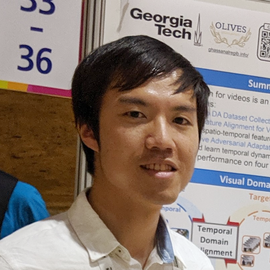
 Min-Hung Chen
· 7 previous affiliations
- Nvidia (United States)Since 2022
- Staff Research Scientist · Since 2026
- Research Scientist · 2022–2026
- Research Engineer · 2022
- MediaTek (Taiwan)2020–2021
- AI Engineer · 2020–2021
- Georgia Institute of Technology2014–2020
- Graduate Research Assistant (Advisor: Prof. Ghassan AlRegib) · 2015–2020
- PhD student · 2014–2020
- Graduate Teaching Assistant · 2014–2019
- Baidu (China)2019
- Research Intern · 2019
- Academia Sinica2013–2014
- Research Assistant · 2013–2014
- National Taiwan University2006–2012
- MS student · 2010–2012
- Undergrad student · 2006–2010
Research Overview
Min-Hung Chen focuses on multimodal artificial intelligence, video understanding, and efficient deep learning. His early work addressed spatiotemporal dynamics and domain adaptation in computer vision, developing methods to align features across shifting environments. Recently, his research has centered on vision-language integration, parameter-efficient model adaptation, and cooperative autonomous driving systems.
Research Trajectory
Chen’s early research explored computational photography and depth estimation. He developed an iterative, correlation-based flow for Depth estimation for hand-held light field cameras under low light conditions (2014), demonstrating how to extract depth information without prior noise characteristics.
Moving into video understanding, he tackled the challenge of domain shift in large-scale video datasets. In Temporal Attentive Alignment for Large-Scale Video Domain Adaptation (2019), he investigated how simultaneously aligning and learning temporal dynamics can improve performance across diverse video domains, contributing to the broader areas of Aligning Temporal Dynamics Across Domain Shifts and Adversarial Training for Domain Invariant Representations. Around the same time, he participated in research on Hierarchical Temporal Modeling for Long Video Understanding, exploring spatiotemporal dynamics for activity recognition in TS-LSTM and temporal-inception: Exploiting spatiotemporal dynamics for activity recognition (2019). He expanded on these themes by addressing spatiotemporal variations in action segmentation. In Action Segmentation With Joint Self-Supervised Temporal Domain Adaptation (2020), he introduced self-supervised auxiliary tasks to align cross-domain feature spaces, advancing the direction of Hierarchical Feature Alignment for Domain Adaptation. He also investigated environmental robustness in static images, demonstrating how severe weather conditions degrade algorithm performance in Traffic Sign Detection Under Challenging Conditions: A Deeper Look into Performance Variations and Spectral Characteristics (2020).
Transitioning toward more efficient and robust learning paradigms, Chen developed frameworks for imbalanced data. In Frequency-Aware Self-Supervised Long-Tailed Learning (2023), he proposed learning frequency-aware prototypes to identify rare samples without labels. A major focus then became parameter-efficient fine-tuning for large models. He led the development of DoRA: Weight-Decomposed Low-Rank Adaptation (2024), a highly influential method in the research direction of Low-Rank Weight Decomposition for Efficient Model Adaptation.
In 2025, his work heavily emphasized vision-language models and multimodal integration. He guided research in the area of Cross-Modal Attention Fusion for Heterogeneous Data Integration, applying multimodal large language models to cooperative autonomous driving in V2V-LLM: Vehicle-to-Vehicle Cooperative Autonomous Driving with Multi-Modal Large Language Models. He also explored prompt learning for dense prediction tasks, introducing a framework to enhance semantic alignment in Semantic Prompt Learning for Weakly-Supervised Semantic Segmentation. To adapt multimodal models to specialized domains with minimal data, he developed LEAML: Label-Efficient Adaptation to Out-of-Distribution Visual Tasks for Multimodal Large Language Models. In video analysis, he rethought referring video object segmentation by decoupling the task and optimizing temporal box prompts in Temporal Prompting Matters: Rethinking Referring Video Object Segmentation. Similarly, he adapted foundation models for zero-shot action detection using interest token spotting in Spatio-Temporal Context Prompting for Zero-Shot Action Detection.
His most recent work continues to balance high-fidelity video generation and model efficiency. He participated in research analyzing physical consistency in video diffusion models, finding that locking motion priors early improves outcomes in Physics in 2-Steps: Locking Motion Priors Before Visual Refinement Erases Them (2026). Returning to model compression, he oversaw the development of EoRA: Fine-tuning-free Compensation for Compressed LLM with Eigenspace Low-Rank Approximation (2026), which uses low-rank matrices to mitigate quantization and pruning errors without retraining. Additionally, he contributed to reinforcement learning frameworks for video analysis, helping design a system that dynamically reallocates visual tokens for fine-grained verification in Zoom-Zero: Reinforced Coarse-to-Fine Video Understanding via Temporal Zoom-in (2026).
Current Directions
Recent work investigates the intersection of large language models, parameter-efficient adaptation, and complex video understanding. A primary focus is on optimizing massive foundation models for deployment, developing techniques like eigenspace low-rank approximation to compensate for compression errors without the need for extensive retraining. In the multimodal domain, the most recent papers in the evidence address label-efficient adaptation for out-of-distribution visual tasks and the integration of multi-modal large language models into cooperative autonomous driving systems. Furthermore, ongoing research in video analysis explores spatio-temporal context prompting for zero-shot action detection, temporal prompting for object segmentation, and reinforcement learning frameworks that dynamically balance global temporal context with fine-grained visual details.
Profile updated
Loading new papers…
Other researchers whose papers cluster into the same research directions — a proxy for overlapping technical interests and shared intellectual neighborhoods.
See something wrong? Report a mistake