

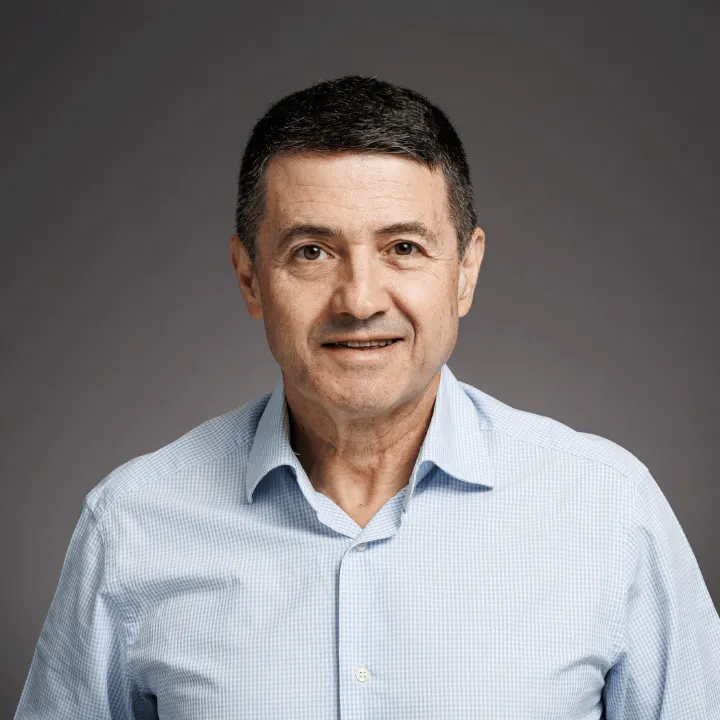
 Leandros Tassiulas
· 5 previous affiliations
- Yale UniversitySince 2014
- Full Professor · Since 2014
- Uninet LLCSince 2022
- co-Founder & Chief Scientist · Since 2022
- University of Thessaly2002–2014
- Professor · 2002–2014
- Associate Director, Informatics and Telematics Institute · 2009–2012
- University of Maryland, College Park1987–1991
- Doctor of Philosophy (Ph.D.), Electrical Engineering · 1989–1991
- Master's Degree, Electrical Engineering · 1987–1989
Research Overview
Leandros Tassiulas focuses on the mathematical modeling, resource allocation, and control of complex communication networks. His foundational work established optimal scheduling and stability policies for wireless systems, evolving to encompass edge caching, quantum network routing, and multi-agent reinforcement learning for cloud-native infrastructures. Recently, his research has expanded to include the evaluation and optimization of large language models and retrieval-augmented generation systems.
Research Trajectory
The trajectory begins in the early 1990s with foundational work on the stability and control of communication networks. He introduced critical scheduling policies for multihop radio networks in Stability properties of constrained queueing systems and scheduling policies for maximum throughput in multihop radio networks, defining stability regions for queueing networks with interdependent servers. This line of inquiry continued with Dynamic server allocation to parallel queues with randomly varying connectivity, which established necessary and sufficient conditions for stabilizability in systems with changing topologies, contributing significantly to the research direction of Queueing and Scheduling Under Bursty Non-Poisson Traffic.
Moving into the 2000s, the focus expanded to include fairness and cross-layer design in ad hoc networks. In Maxmin fair scheduling in wireless networks, he proposed dynamic weight assignment mechanisms to achieve both short- and long-term fairness, advancing the broader area of Balancing Efficiency and Fairness in Wireless Resource Allocation. This era of research was synthesized in the comprehensive overview Resource Allocation and Cross-Layer Control in Wireless Networks.
In the 2010s, his work adapted to new network paradigms, including content distribution and quantum communications. He explored caching strategies in Distributed Cache Management in Information-Centric Networks, aligning with the emerging area of Distributed Edge Caching in Wireless Networks. Concurrently, he participated in research on quantum networking architectures, such as Routing entanglement in the quantum internet, which demonstrated how multi-path 2D networks could exponentially improve entanglement distribution rates over traditional linear repeater chains. This work supports the research direction of Qubit Routing under Hardware Topology Constraints.
Entering the 2020s, his research increasingly integrated advanced optimization and machine learning techniques to manage complex, dynamic systems. He addressed robust optimization in Online Convex Optimization with Perturbed Constraints: Optimal Rates against Stronger Benchmarks, providing primal-dual algorithms capable of handling fluctuating constraints, a contribution to the area of Generalizing Provable Control to Nonlinear Systems.
By 2025, a major theme became the automation and optimization of 5G and 6G cloud-native infrastructures. He investigated capacity gains in mesh networks with beam-steering capabilities in On the Optimization and Stability of Sectorized Wireless Networks. To address the empirical validation gap in modern deployments, his group developed 5GC-Bench: A Framework for Stress-Testing and Benchmarking 5G Core VNFs. A significant breakthrough in this period was the application of multi-agent reinforcement learning (MARL) to network slicing. This is detailed in Accelerating Network Slice Placement with Multi-Agent Reinforcement Learning and the related framework SlicePilot: Demystifying Network Slice Placement in Heterogeneous Cloud Infrastructures, which achieved near-optimal deployment costs with massive speedups over traditional mathematical optimization. This agent-driven approach to network management is further reflected in AGORAN: An agentic open marketplace for 6G RAN automation. The utility of reinforcement learning was also extended back to quantum systems in Compiler for Distributed Quantum Computing: A Reinforcement Learning Approach, which tackles the routing of logical to physical qubits across interconnected processing units.
Most recently, the trajectory has broadened to encompass the evaluation and architectural refinement of generative AI and large language models (LLMs). This includes work on visual generative models in An Item Is Worth a Prompt: Versatile Image Editing with Disentangled Control. In the natural language domain, he collaborated on Benchmark for Assessing Olfactory Perception of Large Language Models, revealing the limitations of LLMs in structural molecular reasoning. Furthermore, HypRAG: Hyperbolic Dense Retrieval for Retrieval Augmented Generation introduced hyperbolic geometry to dense retrieval, improving context relevance by aligning embedding spaces with the hierarchical structure of language. These recent explorations intersect with the broader research area of Decision Making as Autoregressive Sequence Prediction.
Current Directions
Recent work investigates the intersection of autonomous network management and advanced artificial intelligence architectures. A primary focus is the deployment of multi-agent reinforcement learning for "zero-touch" orchestration in 5G and 6G environments, specifically targeting the dynamic placement of virtual network functions and network slices across heterogeneous cloud infrastructures. Concurrently, current research explores the capabilities and structural optimization of large language models and retrieval-augmented generation systems. This includes developing novel benchmarking frameworks to test LLM reasoning limits and leveraging non-Euclidean geometries, such as hyperbolic embeddings, to improve the efficiency and accuracy of hierarchical language representations and information retrieval.
Profile updated
Loading new papers…
Other researchers whose papers cluster into the same research directions — a proxy for overlapping technical interests and shared intellectual neighborhoods.
See something wrong? Report a mistake