

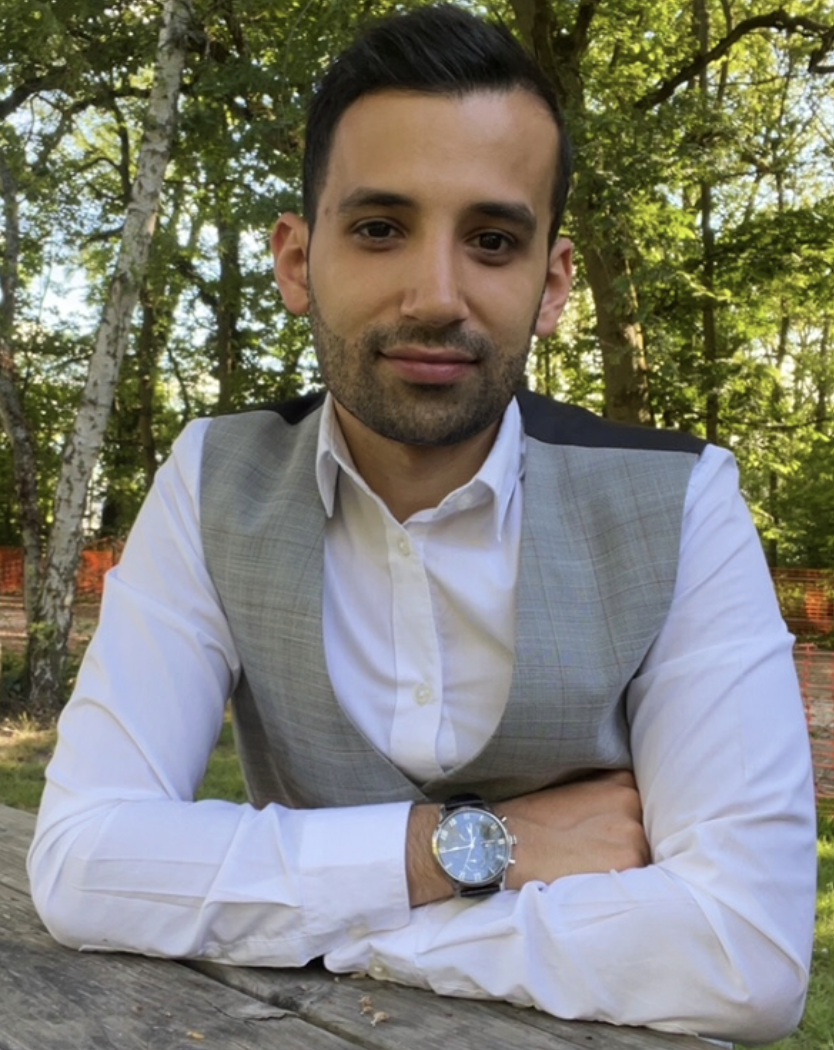
 Ali Maatouk
· 4 previous affiliations
- Yale UniversitySince 2024
- Researcher · Since 2024
- Huawei Technologies (China)2021–2023
- Machine Learning Engineer · 2021–2023
- University of Maryland, College Park2017–2021
- Researcher · 2017–2021
- CentraleSupélec2016–2020
- PhD student · 2017–2020
- MS student · 2016–2017
Research Overview
Ali Maatouk focuses on the development of foundation models for structured data, multimodal learning, and the optimization of large-scale networked systems. His early research addressed information freshness and age of information metrics in wireless communications. Currently, his work explores geometric and graph-based approaches to analyze text, time-series, and graph structures.
Research Trajectory
Maatouk's early research concentrated on optimizing wireless networks and formalizing metrics for information freshness. He investigated scheduling techniques for frequency division duplex systems in On Optimal Scheduling for Joint Spatial Division and Multiplexing Approach in FDD Massive MIMO, contributing to the broader area of Tracking Time-Varying Channels Beyond the Quasi-Static Assumption. A central theme of his doctoral work, detailed in his thesis Optimization of Wireless Networks : Freshness in Communications. (Optimisation des réseaux sans-fil : fraîcheur en communication), was the Age of Information (AoI). He analyzed this metric in carrier sense multiple access environments in On the Age of Information in a CSMA Environment. Recognizing the limitations of standard AoI, he introduced the Age of Incorrect Information (AoII) in The Age of Incorrect Information: A New Performance Metric for Status Updates, extending the concept to capture the freshness of correct, informative updates. This work advanced the research direction of Threshold Based Transmission Policies for Remote Estimation.
Continuing his work on network optimization, Maatouk explored the global optimality of scheduling policies in On the Global Optimality of Whittle's Index Policy for Minimizing the Age of Information. He also examined long-term system performance under periodic demand in A Framework for the Evaluation of Network Reliability Under Periodic Demand. He further refined the AoII metric to support goal-oriented communication strategies in The Age of Incorrect Information: An Enabler of Semantics-Empowered Communication. Around this time, his research began bridging telecommunications and artificial intelligence. He participated in developing TeleQnA: A Benchmark Dataset to Assess Large Language Models Telecommunications Knowledge, a large-scale evaluation of LLMs in specialized technical domains, aligning with broader investigations into The Generative Evaluation Gap in Language Models.
In 2024, Maatouk's focus shifted heavily toward the intersection of large language models and network automation. He proposed a fully differentiable neural surrogate for wireless ray-tracing in SANDWICH: Towards an Offline, Differentiable, Fully-Trainable Wireless Neural Ray-Tracing Surrogate, framing trajectory generation as an offline sequential decision-making problem. He also helped introduce Tele-LLMs: A Series of Specialized Large Language Models for Telecommunications, optimizing models specifically for telecom tasks. To address the challenge of creating network digital twins, he developed Hermes: A Large Language Model Framework on the Journey to Autonomous Networks, a multi-agent architecture that separates design and coding roles. Concurrently, he investigated fundamental LLM behavior, proposing a method to mechanistically increase attention on instruction tokens in Pay Attention to What Matters.
Most recently, Maatouk has advanced the application of foundation models to structured data and non-Euclidean geometries. He contributed to TRACE: Grounding Time Series in Context for Multimodal Embedding and Retrieval, a framework connecting raw time-series data with natural language context. He also helped build TelecomTS: A Multi-Modal Observability Dataset for Time Series and Language Analysis to improve system observability. Addressing the structural relationships in scientific literature, he designed LitFM: A Retrieval Augmented Structure-aware Foundation Model For Citation Graphs, which integrates text and citation graphs to reduce errors, contributing to research on Factual Inaccuracy and Hallucination in Large Language Models. Exploring alternative architectural paradigms, he co-authored HELM: Hyperbolic Large Language Models via Mixture-of-Curvature Experts and HypRAG: Hyperbolic Dense Retrieval for Retrieval Augmented Generation, demonstrating that hyperbolic geometry can better capture the hierarchical structure of language and improve context relevance in the area of Grounding Language Models with External Knowledge Retrieval. His recent work also spans domain-specific evaluations, including public health communication in RephQA: Evaluating Readability of Large Language Models in Public Health Question Answering—relevant to the area of Simplifying Clinical Language for Patient Health Literacy—and 6G network automation in AGORAN: An agentic open marketplace for 6G RAN automation.
Current Directions
Based on his most recent papers, Maatouk's current research investigates the integration of non-Euclidean geometries and multimodal architectures into foundation models. A major theme is the use of hyperbolic geometry to scale large language models and improve dense retrieval, moving beyond standard Euclidean embeddings to better represent hierarchical data structures. Concurrently, he is developing multimodal frameworks that fuse natural language with structured data—such as raw time-series metrics and citation graphs—to enhance system observability and reduce hallucinations in retrieval-augmented generation. His ongoing work also emphasizes the creation of specialized LLM agents and evaluation benchmarks tailored for complex domains like telecommunications and public health.
Profile updated
Loading new papers…
Other researchers whose papers cluster into the same research directions — a proxy for overlapping technical interests and shared intellectual neighborhoods.
See something wrong? Report a mistake