

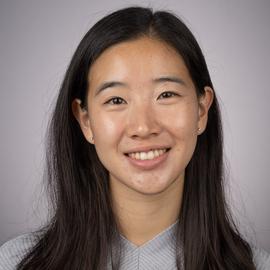
 Katie Z Luo
· 9 previous affiliations
- Stanford UniversitySince 2025
- Postdoc · 2025–2027
- Postdoctoral Researcher · Since 2025
- Cornell University2020–2025
- Doctor of Philosophy - PhD, Artificial Intelligence · 2020–2025
- Cornell Tech2020–2025
- PhD student · 2020–2025
- waymo2024
- PhD Research Intern · 2024
- Research Intern · 2023
- Research Intern · 2020
- Uber AI (United States)2019–2020
- AI Resident at Uber ATG · 2019–2020
- University of California, Berkeley2018–2019
- Master of Science - MS, Electrical Engineering and Computer Sciences · 2018–2019
- MS student · 2018–2019
- Undergrad student · 2015–2018
Research Overview
Katie Z Luo focuses on 3D perception, multi-modal learning, and autonomous driving systems. Her early work explored inverse reinforcement learning and image synthesis for augmented reality before shifting toward unsupervised object discovery from LiDAR data. Currently, she investigates collaborative perception and the integration of large language models to enhance motion forecasting in complex driving environments.
Research Trajectory
During her early research, Luo contributed to the area of Inferring Objectives from Expert Demonstrations. In Learning Robust Rewards with Adverserial Inverse Reinforcement Learning, she collaborated on the development of Adversarial Inverse Reinforcement Learning (AIRL), a framework designed to extract intent from expert demonstrations. This approach aimed to recover disentangled reward functions that remain valid despite changes in environmental physics or obstacles, advancing the broader research directions of Transferable Reward Learning across Varying Dynamics and Disentangling Reward Functions from Environment Dynamics.
Following this work, Luo investigated challenges in optical see-through displays, where systems can only add light to a scene. She developed methods in the area of Non-Negative Image Synthesis for Additive Augmented Reality. In Stay Positive: Non-Negative Image Synthesis for Augmented Reality, she proposed a two-stage approach that leverages human visual perception's tolerance to certain illusions, creating realistic images without physically darkening pixels. She expanded on this in Residual Aligned: Gradient Optimization for Non-Negative Image Synthesis, introducing a gradient-based optimization method. By matching image gradients rather than raw pixel values, this method successfully simulates dark details and high contrast on displays where physically subtracting light is impossible.
Luo's focus subsequently shifted toward 3D perception for autonomous driving, specifically addressing the bottleneck of manual LiDAR annotation. She developed methods for the research direction of Unsupervised Object Discovery from Motion to Appearance. In Learning to Detect Mobile Objects from LiDAR Scans Without Labels, she introduced techniques to train 3D object detectors without relying on expensive human bounding-box annotations, addressing the brittleness of models that struggle when deployed with new sensor setups. To further refine unsupervised discovery, she presented Reward Finetuning for Faster and More Accurate Unsupervised Object Discovery. This work introduced DRIFT (Discovery from Reward-Incentivized Finetuning), which utilizes common-sense heuristics as a reward signal—adapting principles of reinforcement learning from human feedback to train detectors more efficiently. Addressing the challenge of deploying models in novel environments, she also developed Hist-DA (Historically Guided Domain Adaptation) in Unsupervised Domain Adaptation for Self-Driving from Past Traversal Features. This method leverages unlabeled data from repeated drives through the same location, using the persistence of static environmental features to regularize neural network features and filter noisy pseudo-labels.
In 2024, Luo explored the optimization and application of foundation models across both vision and language domains. She investigated persistent, grid-like noise artifacts in feature maps with Denoising Vision Transformers, introducing a two-stage framework (DVT) utilizing neural fields to isolate and remove these artifacts. This approach improved performance in dense prediction tasks like semantic segmentation and depth estimation without requiring retraining of the original backbone. Concurrently, she addressed the alignment of large language models with individual human preferences in Orchestrating LLMs with Different Personalizations. This black-box method merges outputs from specialized expert LLMs on a per-token level, training a lightweight Preference Control Model (PCM) to dynamically translate preference descriptions to adhere to specific user requirements.
Most recently, Luo has integrated these multimodal and collaborative approaches back into autonomous driving systems. In Enhanced Motion Forecasting with Plug-and-Play Multimodal Large Language Models, she introduced "Plug-and-Forecast" (PnF), a method to extract nuanced scene understanding and agent intentions using LLMs, feeding these insights as augmented features to improve motion forecasting in challenging scenarios. Expanding the scope of perception to multi-agent systems, she co-authored Mixed Signals: A Diverse Point Cloud Dataset for Heterogeneous LiDAR V2X Collaboration. This work provides a high-quality, real-world benchmark for Vehicle-to-Everything (V2X) collaborative perception, featuring heterogeneous LiDAR configurations and left-hand traffic scenarios to demonstrate that multi-agent collaboration significantly outperforms single-vehicle systems in complex urban environments.
Current Directions
The most recent papers in the evidence indicate a dual focus on collaborative perception and the integration of large language models into autonomous driving stacks. Luo's current work investigates how multimodal foundation models can be utilized as plug-and-play components to enhance motion forecasting by extracting complex scene semantics and agent intentions. Additionally, she is actively exploring Vehicle-to-Everything (V2X) collaborative perception, addressing the challenges of heterogeneous sensor fusion across multiple connected vehicles and roadside infrastructure to achieve robust 3D perception in unstructured urban environments.
Profile updated
Loading new papers…
Other researchers whose papers cluster into the same research directions — a proxy for overlapping technical interests and shared intellectual neighborhoods.
See something wrong? Report a mistake