

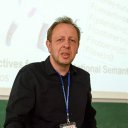
 Johan Bos
· 4 previous affiliations
- University of GroningenSince 2010
- Full Professor · Since 2010
- Sapienza University of Rome2006–2009
- Postdoc · 2006–2009
- University of Edinburgh2001–2005
- Postdoc · 2001–2005
- Saarland University1994–2000
- PhD student · 1994–2000
Research Overview
Johan Bos focuses on computational semantics, formal logic mapping, and the rigorous evaluation of natural language understanding systems. His trajectory spans early work in spoken dialogue interfaces to advanced semantic parsing using Discourse Representation Theory. Most recently, his research investigates neurosymbolic approaches to semantic parsing and critically examines the reasoning capabilities of modern pretrained language models.
Research Trajectory
Johan Bos’s research trajectory is characterized by a sustained focus on extracting, representing, and evaluating semantic meaning in natural language. In the early 2000s, his work explored the intersection of symbolic natural language processing and robotics. As a co-author on Talking to Godot: dialogue with a mobile robot, he contributed to systems where the semantic content of spoken dialogue was used to inform probabilistic robot navigation, demonstrating early applications of grounded language understanding.
By the mid-2000s, Bos's focus sharpened on the precise semantic interpretation of specific linguistic phenomena. As first author of An Empirical Approach to the Interpretation of Superlatives, he developed an automated method for parsing and interpreting superlative adjectives in open-domain text. This work aligned with his broader contributions to the research direction of Compositional Mapping of Natural Language to Formal Logic, which seeks to bridge the gap between ambiguous human speech and executable symbolic predicates. During this period, he also contributed to related research themes such as Semantic Answer Type Classification and Overcoming Syntactic Parsing Fragility in Informal Text.
As neural networks became dominant in the mid-2010s, Bos led efforts to integrate deep learning with formal semantic structures. As senior author on Semantic Tagging with Deep Residual Networks, he introduced a novel semantic tagging task designed specifically to aid multilingual semantic parsing, utilizing residual networks to capture both word and character representations.
In the late 2010s, his lab expanded into evaluating the limitations of neural models, particularly concerning figurative language and complex reasoning. He guided research in the area of Disambiguating Literal and Figurative Language in Context, serving as senior author on The Other Side of the Coin: Unsupervised Disambiguation of Potentially Idiomatic Expressions by Contrasting Senses. Concurrently, he investigated the logical reasoning capacities of modern architectures. In Can Neural Networks Understand Monotonicity Reasoning?, his team demonstrated that state-of-the-art natural language inference models struggled significantly with downward monotonicity, highlighting a critical gap between statistical pattern matching and true logical entailment.
Entering the 2020s, Bos's work heavily emphasized Discourse Representation Theory (DRT) as a framework for crosslingual semantic parsing. As senior author of Universal Discourse Representation Structure Parsing, he helped introduce Universal Discourse Representation Theory, a variant that explicitly anchors semantic representations to input tokens, enabling knowledge transfer from resource-rich languages to others via Transformer-based architectures.
Current Directions
The most recent papers in the evidence indicate a dual focus on advancing neurosymbolic parsing and critically evaluating the claims surrounding large pretrained language models. Recent work investigates the structural complexities of Discourse Representation Theory (DRT). In Scope-enhanced Compositional Semantic Parsing for DRT, Bos and colleagues address the degradation of sequence-to-sequence models on complex sentences by introducing a compositional, neurosymbolic parser that utilizes a novel mechanism for predicting quantifier scope.
Alongside architectural advancements, Bos is actively involved in interrogating the evaluation paradigms of natural language understanding (NLU). Recent collaborative work, such as What's the Meaning of Superhuman Performance in Today's NLU?, critically examines the provocative claims that modern language models have achieved superhuman capabilities. This direction questions what current benchmarks actually measure, advocating for a more rigorous understanding of the distinction between statistical performance and genuine linguistic reasoning.
Profile updated
Loading new papers…
Other researchers whose papers cluster into the same research directions — a proxy for overlapping technical interests and shared intellectual neighborhoods.
See something wrong? Report a mistake