

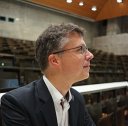
 Sebastian Padó
· 4 previous affiliations
- University of StuttgartSince 2013
- Professor · Since 2013
- Assistant Professor · 2009–2010
- Heidelberg University2010–2013
- Professor · 2010–2013
- Stanford University2007–2009
- Postdoc · 2007–2009
- Saarland University2002–2007
- PhD student · 2002–2007
Research Overview
Sebastian Padó focuses on computational semantics, cross-lingual resource induction, and textual entailment. His early work established methods for building syntax-aware distributional semantic models and projecting role-semantic annotations across languages. More recently, his research investigates unsupervised word sense induction and the application of large language models to qualitative discourse analysis, including the detection of media bias.
Research Trajectory
Padó’s early research addressed the limitations of traditional bag-of-words approaches in lexical semantics, seeking to capture deeper linguistic structures. In 2003, as first author of Constructing Semantic Space Models from Parsed Corpora, he formalized a novel approach to building semantic spaces that explicitly incorporated syntactic relations. By moving beyond simple word co-occurrence counts, this work demonstrated that syntax-aware models could significantly improve performance on semantic priming and lexical relation discrimination tasks. This foundational work aligned with broader efforts in the research direction of Overcoming the Bag of Words Assumption in Text Modeling, which sought to extract more meaningful semantic representations from text.
A major focus of his subsequent work involved overcoming the "lexicographical bottleneck" in natural language processing. Contributing to the area of Automating Lexical Semantic Resource Construction, Padó explored methods to generate high-quality semantic databases without relying on decades of exhaustive manual annotation by expert linguists. In Cross-linguistic Projection of Role-Semantic Information (2005), he introduced a framework for automatically inducing FrameNet-style role-semantic annotations for new languages. By exploiting parallel texts and syntactic projection models, he demonstrated a cost-effective method for transferring semantic knowledge from resource-rich languages like English to languages like German.
By the late 2000s, Padó expanded his focus to machine translation (MT) evaluation and the application of textual entailment. He investigated how logical inferences could be used to assess translation quality more robustly than surface-level string matching metrics. As first author of Robust Machine Translation Evaluation with Entailment Features (2009), he demonstrated that integrating textual entailment features could significantly improve the correlation between automatic MT metrics and human judgments. This work intersected with themes such as Symmetrizing Word Alignments through Bidirectional Agreement, as it required sophisticated alignment and logical inference across differing language structures to verify that a translation preserved the exact meaning of the reference text.
In the 2010s, Padó continued to refine distributional semantic models, particularly addressing the sparsity issues inherent in syntax-based vector spaces. In Derivational Smoothing for Syntactic Distributional Semantics (2013), he proposed using morphological knowledge—specifically, derivationally related words—to smooth semantic similarity estimates in German corpora. This approach proved that even in models built from massive datasets, simple derivational smoothing could considerably improve coverage and reliability.
During this period, he also served as a senior researcher investigating unsupervised lexical disambiguation. In Leveraging Lexical Substitutes for Unsupervised Word Sense Induction (2018), his team tackled the challenge of uninformative and ambiguous contexts in clustering word instances. They demonstrated that representing word instances through meaning-preserving lexical substitutes, rather than traditional bag-of-words contexts, could outperform complex structured probabilistic models in unsupervised word sense induction.
Current Directions
The most recent papers in the evidence indicate an interest in applying large language models (LLMs) to complex societal and discourse-level problems. Padó's recent collaborative work addresses the research direction of Scaling Qualitative Discourse Analysis with Computational Models, moving beyond traditional manual coding to analyze framing and bias at scale.
Specifically, in Media Bias Detection Across Families of Language Models (2024), he and his co-authors investigate the efficacy of prompt-based techniques for recognizing both informational bias (the selective presentation of content) and lexical bias (specific framing through linguistic choices) in news reporting. This research evaluates how well various pre-trained language models can perform nuanced qualitative analysis without the need for extensive tuning or bespoke model design, highlighting an ongoing focus on the intersection of natural language processing and computational social science.
Profile updated
Loading new papers…
Other researchers whose papers cluster into the same research directions — a proxy for overlapping technical interests and shared intellectual neighborhoods.
See something wrong? Report a mistake