

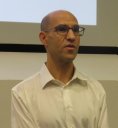
 Jeremy Avigad
· 1 previous affiliation
- Carnegie Mellon UniversitySince 1996
- Full Professor · Since 1996
Research Overview
Jeremy Avigad focuses on formal methods, artificial intelligence for mathematics, and the history and philosophy of mathematical logic. His trajectory spans foundational work in proof assistants to the development of the Lean theorem prover and its massive mathematical libraries. Recently, he investigates the integration of large language models and automated reasoning tools to optimize formal proofs and bridge the gap between informal mathematical intuition and rigorous verification.
Research Trajectory
Jeremy Avigad’s early research established a foundation in mathematical logic and the formalization of complex mathematical arguments. In 1996, he published Formalizing Forcing Arguments in Subsystems of Second-Order Arithmetic, exploring how advanced set-theoretic techniques could be rigorously captured within restricted logical frameworks. This interest in translating deep mathematical concepts into formal systems led to a major milestone in 2007 with A formally verified proof of the prime number theorem. By formalizing Selberg’s elementary proof using the Isabelle proof assistant, this work demonstrated that modern computational tools could handle highly complex mathematical theorems, significantly advancing the broader area of Bridging Informal Mathematical Intuition and Formal Verification. Continuing his investigation into the historical and logical foundations of mathematics, he co-authored A Formal System for Euclid's Elements in 2009. This paper introduced a formal axiomatic system that faithfully modeled Euclid’s proofs, showing that classical diagrammatic reasoning was a rigorous, systematic method that could be fully formalized.
In the mid-2010s, Avigad’s work became closely associated with the development and expansion of the Lean theorem prover. He was part of the core team that introduced the system to the broader community in The Lean Theorem Prover (System Description) in 2015. As Lean evolved, so did the need for extensible automation; in 2017, he contributed to A metaprogramming framework for formal verification, which provided the infrastructure necessary for users to write custom proof automation directly within the Lean environment.
By 2023, Avigad was synthesizing his technical work with broader philosophical reflections on the state of mathematics. In Mathematics and the formal turn, he explored how computational proof assistants are transforming mathematics from a paper-based discipline into one resembling a version-controlled software library, contributing to the research direction of Automated Generation of Formal Specifications and Proofs. That same year, he demonstrated the versatility of automated theorem provers in An Impossible Asylum, using the Vampire solver to debunk a classic Raymond Smullyan logic puzzle by proving its premises logically inconsistent. He also expanded formal verification into applied domains with Verified reductions for optimization, presenting CvxLean, a framework in Lean 4 that guarantees the mathematical soundness of translating high-level optimization problems into solver-ready formats. This work advanced the specific area of Formal Verification of Optimization Reductions.
As artificial intelligence began to intersect more deeply with formal mathematics, Avigad’s research adapted to incorporate these new capabilities. In 2024, he led the development of ImProver: Agent-Based Automated Proof Optimization, introducing an LLM-based agent designed to iteratively refine and optimize human-written proofs in Lean 4. He contextualized these rapid advancements in Automated Reasoning for Mathematics, arguing that the synthesis of symbolic logic, massive libraries like Mathlib, and machine learning marks a turning point for the daily practice of mathematicians.
In 2025, Avigad participated in a community-wide strategic roadmap, The Future of Artificial Intelligence and the Mathematical and Physical Sciences (AI+MPS), which outlined how fundamental scientific principles are necessary to make AI robust and interpretable. He continued to demystify formal methods for the broader mathematical community in Anatomy of a Formal Proof, providing a guided tour of how standard theorems are translated into Lean. Simultaneously, he addressed the existential questions posed by "black box" neural networks in Is Mathematics Obsolete?, defending mathematical rigor as an essential tool for human deliberation and transparency. His applied verification work also continued with A Proof-Producing Compiler for Blockchain Applications, which detailed an augmented compiler that generates formal proofs linking low-level machine code to high-level specifications for scalable blockchain systems.
Most recently, Avigad’s focus has centered on bridging the gap between interactive proof assistants and fully automated solvers. In 2025, he oversaw the development of Lean-Auto: An Interface Between Lean 4 and Automated Theorem Provers, a tool that uses a novel monomorphization algorithm to automate a significant portion of Lean's mathematical library, driving forward the area of Hybrid Automation for Interactive Theorem Proving. This was followed in 2026 by Premise Selection for a Lean Hammer, which introduced an end-to-end "hammer" tool combining neural premise selection with symbolic automated theorem provers. This recent work represents a major contribution to the research directions of Overcoming the Premise Selection Bottleneck in Formal Mathematics and Canonical Normalization for Robust Symbolic Reasoning.
Current Directions
The most recent papers in the evidence indicate a strong focus on building robust, hybrid automation tools for interactive theorem proving. Avigad is actively investigating how to seamlessly integrate external automated theorem provers and neural network-based premise selectors into the Lean 4 ecosystem. This involves developing sophisticated translation mechanisms—such as monomorphization algorithms—that can convert complex dependent type theory into simpler logics that automated solvers can process efficiently.
Alongside the technical development of "hammer" tools and LLM-based proof optimization agents, recent work addresses the philosophical and practical implications of the "formal turn" in mathematics. Avigad is exploring how the integration of massive, version-controlled mathematical libraries (like Mathlib) with artificial intelligence changes the nature of mathematical discovery. A central theme in this current research is ensuring that as AI systems become more capable, the foundational principles of mathematical rigor remain central to maintaining transparency, correctness, and human agency in scientific reasoning.
Profile updated
Loading new papers…
Other researchers whose papers cluster into the same research directions — a proxy for overlapping technical interests and shared intellectual neighborhoods.
See something wrong? Report a mistake