

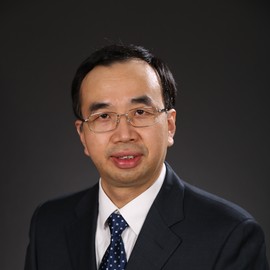
 Hua Xu
· 1 previous affiliation
- Tsinghua UniversitySince 2016
- Associate Professor · Since 2016
2 other authors named Hua Xu: Hua XU (Hong Kong University of Science and Technology · 3 papers), Hua Xu (1 paper)
Research Overview
Hua Xu focuses on multimodal intelligent information processing, open intent discovery for dialogue systems, and evolutionary computing. His trajectory spans early work in signal processing and optimization to extensive contributions in natural language processing, particularly in enabling systems to recognize novel user intents and integrate text, audio, and video modalities. Currently, he investigates large-scale combinatorial optimization and the application of large language models to complex multimodal reasoning.
Research Trajectory
Xu's early research focused on signal processing and optimization algorithms. In 1996, he proposed an iterative algorithm for multichannel filter banks in Efficient iterative design method for cosine-modulated QMF banks, optimizing for high stopband attenuation and low reconstruction delays. This foundational interest in complex optimization problems later extended into evolutionary computing, as seen in his work on Balancing Convergence and Diversity in Decomposition-Based Many-Objective Optimizers, which addressed the challenges of evaluating high-dimensional objective spaces.
By the late 2010s and early 2020s, Xu's focus expanded significantly into natural language processing and dialogue systems, particularly addressing how machines handle unknown or out-of-scope user inputs. He became highly active in the research direction of New Intent Discovery for Open World Dialogue Systems. In Discovering New Intents with Deep Aligned Clustering, he introduced a centroid-based alignment strategy to stabilize pseudo-labels, contributing to the broader area of Autonomous Discovery of Novel Categories in Unlabeled Data. Concurrently, he addressed the challenge of balancing known intent identification with unknown intent detection in Deep Open Intent Classification with Adaptive Decision Boundary, learning adaptive spherical boundaries for known classes. This body of work culminated in the 2023 monograph Intent Recognition for Human-Machine Interactions, which synthesized methodologies in the area of Open Intent Detection for Dialogue Systems. He continued to refine these unsupervised and semi-supervised approaches with the introduction of a robust framework in USNID: A Framework for Unsupervised and Semi-supervised New Intent Discovery.
Parallel to text-based intent discovery, Xu advanced the integration of multiple modalities—text, audio, and video—into sentiment and intent analysis. He participated in developing foundational resources, such as the dataset presented in CH-SIMS: A Chinese Multimodal Sentiment Analysis Dataset with Fine-grained Annotation of Modality. Recognizing the limitations of text-only benchmarks for real-world interactions, he collaborated on MIntRec: A New Dataset for Multimodal Intent Recognition, which provided coarse- and fine-grained taxonomies based on television dialogue. Building on these resources, he developed models to better harmonize non-verbal cues with text, such as the approach detailed in Token-Level Contrastive Learning with Modality-Aware Prompting for Multimodal Intent Recognition. This research supports the broader area of Multimodal Theory of Mind for Socially Intelligent Agents. He also extended intent discovery into multimodal spaces without relying on human labels, as demonstrated in Unsupervised Multimodal Clustering for Semantics Discovery in Multimodal Utterances.
Xu's methodological expertise has also been applied to diverse domains outside of core natural language processing. In clinical informatics, he guided research on extracting structured treatment data from unstructured medical records in Extracting Cancer Chemotherapy and Response Information from Clinical Notes following the RECIST Definition. In the realm of quantum computing architecture, he contributed to evaluating how physical layout and qubit connectivity impact algorithmic performance in Performance of superconducting quantum computing chips under different architecture designs, aligning with the research direction of The Quantum Simulation to Hardware Performance Gap.
In his most recent work, Xu continues to push the boundaries of both intent classification and complex optimization. He contributed to refined boundary-learning techniques in Ellipsoid-Based Decision Boundaries for Open Intent Classification, improving the rejection of out-of-distribution queries. He also explored the integration of foundation models into multimodal systems, participating in the development of a reasoning framework in LLM-Guided Semantic Relational Reasoning for Multimodal Intent Recognition. Returning to his roots in optimization, he collaborated on HyP-ASO: A Hybrid Policy-based Adaptive Search Optimization Framework for Large-Scale Integer Linear Programs, utilizing deep reinforcement learning to enhance large neighborhood search metaheuristics, a contribution to the area of Dynamic Search Radius Adaptation for Global Optimization.
Current Directions
The most recent papers in the evidence indicate a dual focus on advanced human-machine interaction and large-scale mathematical optimization. In the realm of dialogue systems, current work investigates more sophisticated geometric modeling for open intent classification, utilizing ellipsoid-based decision boundaries to better capture class covariance and reject out-of-distribution queries. Concurrently, research in multimodal intent recognition is increasingly leveraging the expansive knowledge of large language models to guide smaller, specialized models. This involves extracting fine-grained semantic cues and modeling logic-inspired relations—such as complementarity and inconsistency—across text, audio, and video modalities.
Beyond natural language processing, recent efforts also address massive combinatorial optimization problems. This work explores hybrid frameworks that integrate deep reinforcement learning with traditional large neighborhood search metaheuristics to adaptively solve large-scale integer linear programs, bridging modern machine learning techniques with classical operations research.
Profile updated
Loading new papers…
Other researchers whose papers cluster into the same research directions — a proxy for overlapping technical interests and shared intellectual neighborhoods.
See something wrong? Report a mistake