

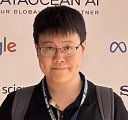
 Guangzhi Sun
· 1 previous affiliation
- University of CambridgeSince 2015
- Junior Research Fellow · 2024–2028
- PhD student · 2019–2023
- Undergrad student · 2015–2019
Research Overview
Guangzhi Sun focuses on multimodal large language models, speech recognition, and the safety and alignment of generative AI systems. His trajectory spans early work in speaker diarization to the development of the SALMONN family of audio-visual models. Currently, he investigates streaming architectures for long-duration video understanding and robust evaluation methods for language models.
Research Trajectory
Guangzhi Sun’s early research focused on foundational speech processing tasks. In 2019, he introduced a novel framework for speaker diarization in Speaker Diarisation Using 2D Self-attentive Combination of Embeddings. This work proposed the c-vector, which utilized a two-dimensional self-attentive structure to average across both time and different types of speaker embeddings, improving clustering performance for audio segments.
By 2024, his focus had expanded to the efficiency and personalization of end-to-end automatic speech recognition (ASR) systems. He developed SAML: Speaker Adaptive Mixture of LoRA Experts for End-to-End ASR, which adapted high-performance models like Whisper for edge devices. By employing lightweight LoRA modules within a Mixture-of-Experts architecture, this approach significantly reduced model size while improving recognition accuracy for specific speakers. This work contributed to the research direction of Compressing Speech Models for On-Device Inference and the broader area of Scaling and Specialization in Mixture of Experts. Concurrently, he explored related quantization and adaptation techniques in Enhancing Quantised End-to-End ASR Models Via Personalisation.
During this period, Sun became heavily involved in the development of multimodal Large Language Models (LLMs), particularly through the SALMONN architecture. With collaborators, he developed SALMONN: Towards Generic Hearing Abilities for Large Language Models, which integrated speech and audio encoders to allow LLMs to perceive and reason across speech, music, and audio events via a novel activation tuning stage. He subsequently led the extension of this paradigm to video, addressing the tendency of visual models to ignore human speech. In video-SALMONN: Speech-Enhanced Audio-Visual Large Language Models, he integrated speech processing into audio-visual LLMs, advancing areas such as Enforcing Temporal Causality with Causal Attention Masking and Eliminating the Textual Bottleneck in Spoken Dialogue.
In 2025, Sun continued to bridge the gap between text-based LLMs and spoken language. He introduced Wav2Prompt: End-to-End Speech Prompt Learning and Task-based Fine-tuning for Text-based LLMs, a framework that maps audio directly into an LLM’s internal token embedding space, preserving zero-shot reasoning abilities while enabling end-to-end fine-tuning. To address the challenge of multilingual speech processing, he developed Low-Rank and Sparse Model Merging for Multi-Lingual Speech Recognition and Translation, a technique that merges specialized single-language models using structural and detail-oriented pruning. He also explored textless multilingual approaches in Cross-Lingual Interleaving for Speech Language Models, demonstrating that shuffling speech segments from different languages during training improves cross-lingual understanding. Further addressing spoken dialogue systems, he contributed to Knowledge-aware audio-grounded generative slot filling for limited annotated data, which grounded slot filling in both raw audio and external knowledge bases to handle rare entities.
The SALMONN family of models saw further expansion in 2025. Sun introduced complex reasoning capabilities to the architecture in video-SALMONN-o1: Reasoning-enhanced Audio-visual Large Language Model. He also participated in the development of SALMONN-omni: A Standalone Speech LLM without Codec Injection for Full-duplex Conversation, which utilized an explicit thinking mechanism to manage dialogue dynamics like turn-taking, contributing to the area of Full-Duplex Interaction via Specialized LLM Control Tokens.
Parallel to his architectural work, Sun has actively investigated the safety, evaluation, and alignment of LLMs. He introduced CASE-Bench: Context-Aware SafEty Benchmark for Large Language Models to evaluate how formal contexts shift safety judgments, revealing widespread over-refusal in commercial models. He also examined the mechanics of knowledge removal in Unlearning vs. Obfuscation: Are We Truly Removing Knowledge?, proposing a method to flatten predictive distributions to genuinely erase facts rather than merely hiding them. For model evaluation, he developed SkillAggregation: Reference-free LLM-Dependent Aggregation, which dynamically weights a panel of LLM judges based on context. Additionally, he collaborated on Bayesian WeakS-to-Strong from Text Classification to Generation, using Bayesian uncertainty estimation to allow weak model ensembles to supervise stronger models, contributing to the broader direction of Aligning Superhuman AI with Weak Supervision.
Moving into 2026, Sun’s research addresses the robustness and scalability of multimodal systems. He contributed to identifying and mitigating vulnerabilities in Speech-Audio Compositional Attacks on Multimodal LLMs and Their Defense with SALMONN-Guard, which introduced a specialized defense model to analyze speech, background audio, and text jointly. He also continued refining automated evaluation methods in Who can we trust? LLM-as-a-jury for Comparative Assessment, accounting for individual judge reliability in multi-LLM assessments. Finally, he tackled the memory constraints of long-form video processing with video-SALMONN S: Memory-Enhanced Streaming Audio-Visual LLM, utilizing Test-Time Training to transform model weights into a dynamic long-term memory capable of processing multi-hour videos.
Current Directions
Sun’s most recent work investigates the scalability and reliability of multimodal foundation models. A primary focus is on streaming architectures that can process long-duration, continuous audio-visual inputs without succumbing to memory bottlenecks, leveraging techniques like test-time training to maintain dynamic context. Alongside architectural improvements, he is actively researching the safety and evaluation of these complex systems. This includes developing robust defense mechanisms against compositional multimodal jailbreak attacks and designing sophisticated, reference-free evaluation frameworks that use ensembles of language models to reliably assess generated outputs.
Profile updated
Loading new papers…
Other researchers whose papers cluster into the same research directions — a proxy for overlapping technical interests and shared intellectual neighborhoods.
See something wrong? Report a mistake