

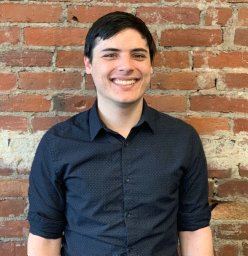
 Eric R. Anschuetz
· 5 previous affiliations
- California Institute of TechnologySince 2023
- Sherman Fairchild Postdoctoral Scholar · Since 2023
- PhD student · 2017–2023
- Intern · 2018
- Harvard University2013–2017
- MS student · 2016–2017
- Undergraduate Research Assistant, Mikhail Lukin Lab · 2015–2017
- Undergrad student · 2013–2017
- Undergraduate Research Assistant, Jonathan Grindlay Lab · 2014–2015
- Naval Air Warfare Center Training Systems Division2013
- Intern · 2013
Research Overview
Eric R. Anschuetz focuses on the theoretical foundations of quantum machine learning, quantum optimization, and the algorithmic implications of spin glass theory. His research investigates the optimization landscapes of quantum neural networks to understand why algorithms fail to train and how to design more robust architectures. Recently, he has explored the boundaries of classical simulability and quantum advantage in learning models.
Research Trajectory
Anschuetz's early research involved the physical realization of controllable quantum systems. He contributed to Atom-by-atom assembly of defect-free one-dimensional cold atom arrays in 2016, which demonstrated a platform for deterministically preparing regular arrays of individually controlled cold atoms. By utilizing real-time feedback and optical tweezers, this work provided a mechanism to eliminate the entropy associated with probabilistic trap occupation, enabling the rapid assembly of defect-free arrays.
Shifting toward quantum algorithms for near-term hardware, Anschuetz began exploring hybrid classical-quantum approaches to complex optimization problems. In Variational Quantum Factoring, he and his collaborators mapped factoring problems to Ising Hamiltonians to significantly reduce qubit requirements, contributing to the area of Logarithmic Encoding for Qubit Efficient Optimization and the broader direction of Scaling Quantum Algorithms with Circuit Cutting and Decomposition. He also investigated the training of quantum generative models, a task traditionally hindered by the computational hardness of sampling from thermal distributions. In Realizing Quantum Boltzmann Machines Through Eigenstate Thermalization, he introduced a method utilizing the Eigenstate Thermalization Hypothesis to approximate thermal states via quantum quenches, advancing work in the area of Ancilla-Assisted Variational Characterization of Quantum States. Continuing to address hardware limitations, he participated in developing Coreset Clustering on Small Quantum Computers, further exploring strategies for scaling quantum algorithms on limited hardware by summarizing large datasets into manageable subsets.
A major theme in Anschuetz's subsequent work is the theoretical analysis of quantum machine learning optimization landscapes and model expressivity. He analyzed the proliferation of poor local minima in Critical Points in Quantum Generative Models, identifying a critical parameter threshold. Below this threshold, local minima are far from the global minimum, but above it, local minima become good approximators of the global minimum, mirroring phenomena seen in classical overparameterized networks. He also investigated how quantum phenomena can natively improve model performance. In Enhancing Generative Models via Quantum Correlations, he demonstrated that non-locality and contextuality can provide a provable advantage in modeling complex probability distributions when extending classical Bayesian networks.
This inquiry into expressivity continued with Interpretable Quantum Advantage in Neural Sequence Learning. Moving beyond arguments reliant purely on complexity theory, this work established explicit analytic comparisons between quantum neural network sequence models and classical recurrent models based on Gaussian operations with non-Gaussian measurements. Alongside these theoretical bounds, Anschuetz continued to explore practical training accelerations, such as evaluating the efficacy of data subsets in Training Quantum Boltzmann Machines with Coresets. While coresets successfully enabled training on custom datasets, the study highlighted that for small-scale simulations, they do not yet consistently outpace full-dataset training.
More recently, Anschuetz has formalized the boundaries of quantum advantage and the structural properties of quantum optimization. He explored the role of quantum contextuality in bounding classical capabilities in Quantifying the Limits of Classical Machine Learning Models Using Contextuality. In the domain of combinatorial optimization, he contributed to Q-CHOP: Quantum constrained Hamiltonian optimization, an algorithm that natively enforces constraints throughout the optimization process rather than relying on traditional, often inefficient, penalty terms. His theoretical synthesis of training dynamics culminated in A Unified Theory of Quantum Neural Network Loss Landscapes, which provides a comprehensive framework for understanding barren plateaus and landscape smoothing. Building on this foundation, he has continued to map the theoretical separations between classical and quantum learning models in Arbitrary Polynomial Separations in Trainable Quantum Machine Learning, addressing the core tension between a model's expressivity and its practical trainability.
Current Directions
The most recent papers in the evidence indicate a continued focus on the theoretical limits and trainability of quantum machine learning models. Anschuetz is investigating the structural properties of quantum neural network loss landscapes to formalize why certain models fail to train and how to mathematically guarantee trainability through overparameterization and landscape smoothing. His recent work also addresses the rigorous mathematical separations between classical and quantum machine learning, exploring how phenomena like quantum contextuality and spin glass theory dictate the average-case complexity of quantum algorithms. Additionally, he is developing novel approaches to constrained Hamiltonian optimization that natively preserve problem constraints on quantum hardware, moving away from heuristic penalty methods toward more robust algorithmic designs.
Profile updated
| Title | Venue | Year |
|---|---|---|
| Quantum Glassiness from Efficient Learning | Communications | 2026 |
| Optimizing Sparse SYK | Quantum | 2026 |
| Arbitrary Polynomial Separations in Trainable Quantum Machine Learning | Quantum | 2026 |
| Does provable absence of barren plateaus imply classical simulability? | Nature Communications | 2025 |
| Average-case quantum complexity from glassiness | arXiv | 2025 |
| A Unified Theory of Quantum Neural Network Loss Landscapes | ICLR | 2025 |
| k-Contextuality as a Heuristic for Memory Separations in Learning | arXiv | 2025 |
| Strongly interacting fermions are non-trivial yet non-glassy | arXiv | 2024 |
| Q-CHOP: Quantum constrained Hamiltonian optimization | ACM Transactions on Quantum Computing | 2024 |
| Combinatorial NLTS From the Overlap Gap Property | Quantum | 2024 |
Loading new papers…
Other researchers whose papers cluster into the same research directions — a proxy for overlapping technical interests and shared intellectual neighborhoods.
See something wrong? Report a mistake