

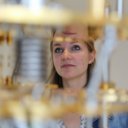
 Christa Zoufal
· 6 previous affiliations
- Researcher · Since 2021
- IBMSince 2018
- Staff Research Scientist · Since 2026
- Manager UK Quantum Research, Quantum Applications · 2025–2026
- Quantum Applications Researcher · 2018–2025
- Unitary Fund2020–2025
- Advisor · 2020–2025
- ETH Zurich2012–2021
- Graduate Student · 2018–2021
- Bachelor’s Degree, Physik · 2012–2015
- University of Hong Kong2017–2018
- Master Thesis, Physics - Quantum Information Theory · 2017–2018
- Horváth & Partners Management Consultants2015–2016
- Praktikantin · 2015–2016
Research Overview
Christa Zoufal focuses on quantum machine learning, quantum optimization, and the theoretical characterization of parameterized quantum circuits. Her trajectory spans the development of quantum generative models and amplitude estimation algorithms to rigorous analyses of trainability in quantum neural networks. Most recently, she investigates standardized benchmarking for quantum utility and practical diagnostics for quantum model initialization.
Research Trajectory
Early work focused on making quantum machine learning and optimization algorithms viable for near-term hardware. In 2019, she introduced a hybrid approach in Quantum Generative Adversarial Networks for learning and loading random distributions, which utilizes quantum generative adversarial networks (qGANs) to efficiently load classical data distributions into quantum states. This method addressed the exponential gate complexity of traditional data encoding, opening pathways for practical applications in finance and beyond. Expanding on variational methods, she subsequently developed a novel realization for Variational Quantum Boltzmann Machines (2020). By employing Variational Quantum Imaginary Time Evolution, this work enabled the preparation of Gibbs states and the evaluation of analytic gradients for arbitrary parameterized Hamiltonians, facilitating training on near-term devices.
Concurrently, her research explored quantum amplitude estimation (QAE) for optimization and finance. With collaborators, she contributed to Quantum-Enhanced Simulation-Based Optimization (2020), presenting the QSBO algorithm to accelerate simulation-based optimization with a quadratic speedup for expensive function evaluations. This theoretical advantage was further applied in Option Pricing using Quantum Computers (2020), which demonstrated how to implement quantum circuits for various financial options and utilized error mitigation on real quantum hardware. To make amplitude estimation more practical, she later introduced Iterative quantum amplitude estimation (2021). This algorithm bypasses the computationally demanding Quantum Phase Estimation subroutine, relying instead solely on Grover's algorithm to achieve the same quadratic speedup with significantly fewer samples.
In parallel with algorithmic design, her trajectory includes rigorous theoretical work on the simulation and trainability of quantum circuits. She established global phase-agnostic bounds in Error Bounds for Variational Quantum Time Evolution (2021), utilizing the Bures metric to provide tighter, physically accurate estimates of simulation quality with minimal computational overhead. This focus on theoretical guarantees naturally extended into the study of gradient concentration in quantum machine learning. In Tight and Efficient Gradient Bounds for Parameterized Quantum Circuits (2023), she derived new bounds that avoid restrictive t-design assumptions. By proving that mixed observables can circumvent gradient vanishing, this work advanced several critical research areas, including Algebraic and Classical Characterization of Quantum Barren Plateaus, Barren Plateaus in Variational Quantum Optimization, and the design of Local Observables for Trainable Quantum Neural Networks.
More recently, her work has bridged quantum computing with classical machine learning frameworks. In 2024, she participated in developing QontOT, detailed in Quantum Theory and Application of Contextual Optimal Transport. This research exploited algebraic links between unitary operators and doubly stochastic matrices to predict distribution shifts, contributing to the broader area of Stabilizing Continuous Neural Optimal Transport. Alongside these specific algorithmic contributions, she provided a comprehensive perspective on the field's trajectory in Challenges and opportunities in quantum optimization (2024), emphasizing the necessity of practical benchmarks to transition from theoretical proposals to tangible quantum advantage.
This emphasis on rigorous evaluation culminated in her 2025 work on benchmarking and diagnostics. She led the development of the Quantum Optimization Benchmarking Library (QOBLIB), introduced in Quantum Optimization Benchmarking Library - The Intractable Decathlon. This curated suite of ten difficult combinatorial optimization problems is designed to track progress in the research direction of Standardized Benchmarking for Quantum Utility and Advantage. Simultaneously, she addressed the resource-intensive nature of training quantum models in Towards Practical Quantum Neural Network Diagnostics with Neural Tangent Kernels (2025). By analyzing the eigenvalue spectrum of the Quantum Neural Tangent Kernel (QNTK) at initialization, this diagnostic framework allows researchers to predict training speed, optimal learning rates, and generalization capabilities before expending computational resources.
Current Directions
The most recent papers in the evidence address the critical need for rigorous evaluation and resource-efficient training in quantum computing. Current work investigates standardized benchmarking frameworks to systematically measure progress toward quantum advantage in combinatorial optimization. Additionally, recent research focuses on practical diagnostics for quantum neural networks, utilizing tools like the Quantum Neural Tangent Kernel to predict model trainability and generalization at initialization. This emphasis on pre-training diagnostics and standardized evaluation reflects a broader effort to make quantum machine learning and optimization algorithms more reliable, scalable, and practically viable on near-term hardware.
Profile updated
Loading new papers…
Other researchers whose papers cluster into the same research directions — a proxy for overlapping technical interests and shared intellectual neighborhoods.
See something wrong? Report a mistake