

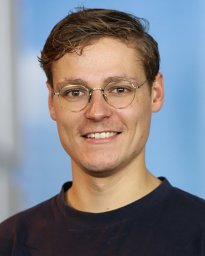
 Casper Gyurik
· 4 previous affiliations
- Mathrix GroupSince 2025
- Quant Analyst/Developer · Since 2025
- Pasqal (France)2024–2025
- Senior Quantum Algorithm Developer · 2024–2025
- Leiden University2019–2024
- Postdoctoraal onderzoeker · 2023–2024
- PhD student · 2019–2023
- University of Amsterdam2012–2018
- Teacher Assistant · 2013–2018
- MS student · 2016–2018
- Undergrad student · 2012–2015
Research Overview
Casper Gyurik focuses on the theoretical foundations of quantum machine learning (QML), computational complexity, and the development of algorithms for noisy intermediate-scale quantum (NISQ) devices. His work explores the boundaries between classical and quantum computation, specifically identifying tasks where quantum learners provide provable exponential advantages over classical counterparts. His research integrates concepts from algebraic topology, randomized measurement protocols, and quantum pseudorandomness to address the practical and theoretical bottlenecks of current quantum hardware.
Research Trajectory
Gyurik’s research trajectory reflects a transition from the application of hybrid quantum-classical systems to the rigorous complexity-theoretic analysis of quantum advantage. In the early 2020s, his work was situated within the emerging field of variational quantum circuits, exploring their utility as hypothesis families in machine learning. This period was characterized by an interest in expanding the reach of quantum-classical systems into challenging domains such as reinforcement learning, as seen in Parametrized Quantum Policies for Reinforcement Learning. This early work identified the difficulties in achieving learning boosts over classical benchmarks, setting the stage for a more fundamental investigation into the nature of quantum speedups.
By 2023, Gyurik’s focus shifted toward establishing a more rigorous mathematical basis for quantum learning. He began addressing the "simulation to hardware gap," investigating how quantum computers could be utilized effectively despite limited qubit counts. As a senior author on work regarding High Dimensional Quantum Machine Learning with Small Quantum Computers, he explored circuit-cutting and recombination techniques to evaluate large-scale quantum models on restricted hardware. During this time, he also contributed to the development of "shadow models," which aim to alleviate the deployment bottleneck of QML by using quantum resources only during the training phase, as detailed in Shadows of quantum machine learning.
In 2024 and 2025, Gyurik’s work became increasingly focused on the intersection of quantum computing and algebraic topology, as well as the fundamental limitations of hybrid protocols. He provided formal proofs for quantum advantage in Topological Data Analysis (TDA), moving beyond heuristic applications to establish BQP-completeness for specific topological problems. His most recent work investigates the "measure-first" paradigm, proving that converting quantum data into classical information too early in a protocol can impose exponential limitations on learning efficiency. This evolution demonstrates a move toward identifying the "gold standard" of quantum advantage—where coherent quantum processing is not just beneficial, but necessary.
Current Directions
Gyurik’s current research is organized around several key themes that address the viability of quantum advantage in the NISQ era and beyond. A primary area of focus is Algorithmic Noise Resilience in Near Term Quantum Computing. This involves determining whether the inherent structural properties of quantum machine learning models can mitigate the errors introduced by decoherence and gate imperfections. This theme is closely linked to The Quantum Simulation to Hardware Performance Gap, where the goal is to ensure that algorithms designed in ideal classical simulations remain performant when deployed on physical qubits.
Another significant direction involves Bypassing the Optimization Bottleneck in Variational Quantum Algorithms. Gyurik investigates the relationship between the trainability of a quantum model and its "dequantization"—the possibility of simulating it classically. This research seeks to identify the "sweet spot" where a model is complex enough to resist classical simulation but structured enough to allow for efficient gradient-based optimization.
Furthermore, Gyurik is exploring the role of Cryptography from Quantum Pseudorandomness in the context of learning theory. By utilizing quantum pseudorandom functions, he has been able to construct rigorous proofs regarding the limitations of certain measurement strategies. This work intersects with Adaptive Measurement Strategies for Quantum State Tomography, where the objective is to reduce the "quantum tax" of information extraction. His recent contributions to differential equation solvers utilize these strategies to achieve significant reductions in the number of circuit evaluations required for training.
Representative Work
Quantum Advantage in Learning Theory
In Exponential separations between classical and quantum learners, Gyurik provides a rigorous theoretical foundation for identifying when quantum computers can outperform classical ones in machine learning. This work is significant for moving the discourse away from artificial, cryptography-based examples toward more natural quantum physical systems. By refining the mathematical definitions of "learning," the paper establishes clear boundaries for quantum advantage, providing a framework for evaluating the potential of future QML models.
Scaling QML on Restricted Hardware
As the senior author of High Dimensional Quantum Machine Learning with Small Quantum Computers, Gyurik addressed the practical limitation of low qubit counts. The research investigates techniques for evaluating a large quantum circuit by decomposing it into smaller subcircuits that can be run on available hardware. The core contribution of this work is the identification of specific applications where many of these subcircuits are superfluous, allowing for a more efficient reconstruction of the original circuit's output than general-purpose circuit-cutting methods would suggest.
Classical Shadows and Model Deployment
In Shadows of quantum machine learning, Gyurik and his collaborators introduced a class of models where quantum resources are required only during the training phase. By generating a "classical shadow" of the trained quantum model—a classically computable approximation of the learned function—the researchers demonstrated that the deployment of the model can be entirely classical. This approach addresses a major obstacle to the practical use of QML, as it removes the need for a quantum computer during the inference or evaluation stage.
Topological Data Analysis and BQP-Completeness
Gyurik’s work on Quantum computing and persistence in topological data analysis identifies a specific task in TDA—determining the persistence of "holes" in a dataset across scales—and proves it can be solved exponentially faster on a quantum computer. By defining the "Harmonic Persistence" problem and proving it is BQP-complete, Gyurik established a rigorous complexity-theoretic foundation for quantum speedups in TDA, a field previously dominated by heuristic approaches.
Limitations of Incoherent Processing
In Limitations of measure-first protocols in quantum machine learning, Gyurik proves that "measure-first" protocols face fundamental, exponential limitations. These protocols, which convert quantum data into classical information before processing, are often preferred for their simplicity. However, by using the "Hidden Matching" problem and quantum pseudorandom functions, Gyurik demonstrates that certain learning tasks require fully coherent quantum processing to remain efficient. This work highlights the necessity of maintaining quantum coherence throughout the learning pipeline to achieve true quantum advantage.
Trainability and Dequantization
In On the Relation between Trainability and Dequantization of Variational Quantum Learning Models, Gyurik explores the tension between a model's ease of training and its classical simulability. The paper investigates whether models that are easy to train (avoiding "barren plateaus") are also more susceptible to being "dequantized" or simulated by classical algorithms. This research is critical for the design of Variational Quantum Algorithms, as it seeks to define the parameters under which a quantum model can be both practical to optimize and theoretically superior to classical alternatives.
Profile updated
Loading new papers…
Other researchers whose papers cluster into the same research directions — a proxy for overlapping technical interests and shared intellectual neighborhoods.
See something wrong? Report a mistake