

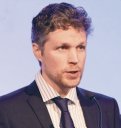
 Daniel Truhn
· 2 previous affiliations
- Universitätsklinikum AachenSince 2012
- Full Professor · Since 2024
- Current
- Researcher · 2012–2024
- RWTH Aachen UniversitySince 2002
- Professorship for AI in Radiology · Since 2024
- Senior Radiologist · 2020–2024
- Research Fellowship AI · 2018–2020
- Residency Radiology · 2013–2018
- Medizin · 2006–2012
- Diplom, Physik · 2002–2007
Research Overview
Daniel Truhn focuses on the application of deep learning and generative artificial intelligence to medical imaging and clinical diagnostics. His trajectory spans early work in computer vision to the development of advanced diffusion models, vision transformers, and secure federated learning frameworks for healthcare data. Most recently, his research investigates the integration of large language models into radiology workflows and the robustness of medical foundation models.
Research Trajectory
His early work involved applied computer vision, participating in research on environmental image analysis such as Measuring Plant Root Growth in 2008.
By 2022, his focus had firmly shifted to advanced machine learning for medical diagnostics and disease modeling. He directed research into generative adversarial networks (GANs) for longitudinal clinical forecasting, developing a latent extrapolation approach to forecast morphological changes in Image prediction of disease progression for osteoarthritis by style-based manifold extrapolation. During this period, he also began exploring the capabilities of emerging diffusion models in healthcare. His group evaluated the inherent medical representations within general-purpose text-to-image systems in Medical domain knowledge in domain-agnostic generative AI. Building on this foundation, he introduced Medfusion, a conditional latent denoising diffusion probabilistic model, demonstrating its advantages over established GAN architectures for generating high-fidelity medical data in Diffusion Probabilistic Models beat GANs on Medical Images.
In 2023, his research expanded to address the architectural challenges of applying vision transformers to high-resolution clinical data. To handle gigapixel-scale histological specimens, he developed Cascaded Cross-Attention Networks for Data-Efficient Whole-Slide Image Classification Using Transformers, which mitigates the quadratic computational scaling of standard transformers. He similarly adapted transformer architectures for three-dimensional, multi-planar imaging, creating a network for Multi-View Abnormality Detection in Clinical Knee MRI Studies Using Transformers. Alongside these classification efforts, he continued advancing generative techniques, combining vector-quantized autoencoders with normalizing flows to simultaneously generate knee radiographs and perform quality control via out-of-distribution detection in Vector-Quantized Latent Flows for Medical Image Synthesis and Out-Of-Distribution Detection.
As large language models and foundation models became increasingly prominent, his work began to scrutinize their reliability and security in clinical settings. He led an investigation into the vulnerabilities of these systems, revealing how minor weight manipulations could inject incorrect biomedical facts in Medical Foundation Models are Susceptible to Targeted Misinformation Attacks. Returning to the computational bottlenecks of vision models in 2024, he proposed Compute-Efficient Medical Image Classification with Softmax-Free Transformers and Sequence Normalization, further optimizing transformer architectures for large-scale medical image analysis.
In 2024, he also addressed the critical need for privacy in multi-institutional healthcare research. He designed a framework for Encrypted federated learning for secure decentralized collaboration in cancer image analysis. This work contributes to broader research areas such as accelerating privacy-preserving inference for large models and secure aggregation for privacy-preserving federated learning, demonstrating that homomorphic encryption can protect weight updates without significant computational overhead and mitigating risks associated with gradient inversion.
His recent investigations highlight the limitations of unsupervised generative methods in clinical practice. He analyzed the robustness of MRI reconstruction techniques, showing how worst-case perturbations can cause models to hallucinate false tissue structures in On Instabilities of Unsupervised Denoising Diffusion Models in Magnetic Resonance Imaging Reconstruction. Concurrently, to improve the factuality of clinical language models, he introduced RadioRAG: Factual Large Language Models for Enhanced Diagnostics in Radiology Using Dynamic Retrieval Augmented Generation, a real-time framework that grounds generative models in live external knowledge while reducing computational overhead in retrieval-augmented systems.
In 2026, Truhn's research has centered on auditing, calibrating, and safety-monitoring medical language models and clinical decision systems. Truhn participated in developing Decision2Care in Auditable Clinical Support with Decision Agents, which produces stepwise probability distributions to enable rapid, auditable emergency care decisions. Addressing the rigid decision thresholds of multimodal foundation models, Truhn guided Single-Pass Decision Scores Enable Rapid Classification with Adjustable Thresholds in Medical Multimodal Large Language Models, introducing a single-pass probability normalization technique to turn medical MLLMs into fast classifiers with tuneable operating points. Further advancing safety oversight without model retraining, Truhn also directed What the model knows but does not say: monitoring medical LLMs through verbalized thoughts, demonstrating that translating internal activations into natural language allows an input-blind judge to detect adversarial manipulations and unsafe requests that the model's final outputs conceal.
Current Directions
The most recent papers in the evidence indicate a dual focus on the secure, robust deployment of foundation models in healthcare and the optimization of retrieval-augmented generation (RAG) for clinical diagnostics. Recent work investigates the vulnerabilities of unsupervised diffusion models in MRI reconstruction, emphasizing the need to mitigate hallucinated artifacts and adversarial instabilities before clinical deployment. Simultaneously, ongoing research addresses the integration of dynamic, up-to-date medical knowledge into large language models to ensure factual accuracy in radiology question answering. Additionally, there is a continued emphasis on privacy-preserving methodologies, specifically leveraging encrypted federated learning to enable decentralized, multi-institutional collaboration on sensitive oncology imaging without compromising patient data.
Profile updated
Loading new papers…
Other researchers whose papers cluster into the same research directions — a proxy for overlapping technical interests and shared intellectual neighborhoods.
See something wrong? Report a mistake