

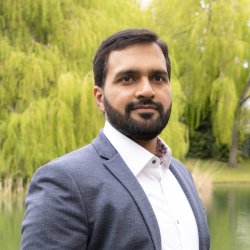
 Muhammad Awais
· 3 previous affiliations
- University of SurreySince 2016
- Associate Professor · Since 2021
- Senior research fellow · 2016–2021
- PhD student · 2008–2011
- Imperial College London2012–2016
- Senior machine learning researcher · 2012–2016
- Cortexica (United Kingdom)2012–2016
- Senior machine learning researcher · 2012–2016
1 other author named Muhammad Awais: Muhammad Awais (2 papers)
Research Overview
Muhammad Awais focuses on self-supervised learning, computer vision, and the adaptation of foundation models for specialized domains. His trajectory spans early work in object recognition and medical image retrieval to recent advancements in masked image modeling and parameter-efficient fine-tuning. Currently, his research addresses object-centric representation learning, multimodal adaptation, and the safe deployment of generative models.
Research Trajectory
The early phase of his research centered on foundational computer vision tasks, beginning with object recognition methodologies. He introduced techniques for combining kernel matrices and classifier fusion in Augmented Kernel Matrix vs Classifier Fusion for Object Recognition. Expanding into clinical applications, he participated in the development of deep learning frameworks for content-based retrieval in Medical image retrieval using deep convolutional neural network. By training convolutional neural networks to classify multimodal images, this work helped extract discriminative features that connect low-level image data to high-level medical concepts, contributing to the broader area of Bridging the Gap Between Pixels and Semantic Meaning. Around the same time, he contributed to spatial transformation techniques, helping demonstrate how statistical models of 3D shapes could be integrated as spatial transformer modules within neural networks in 3D Morphable Models as Spatial Transformer Networks.
Moving into the 2020s, his focus shifted toward optimization, loss functions, and generalization. He collaborated on facial landmark localization, analyzing the impact of loss functions on small-to-medium errors in Rectified Wing Loss for Efficient and Robust Facial Landmark Localisation with Convolutional Neural Networks. This interest in optimization extended to theoretical bounds on generalization, where he helped introduce the Generalized Jeffries-Matusita loss for age estimation in How Does Loss Function Affect Generalization Performance of Deep Learning? Application to Human Age Estimation. A major pivot toward self-supervised learning occurred with SiT: Self-supervised vIsion Transformer, which demonstrated that self-supervised pretraining could outperform supervised methods for Vision Transformers even on smaller datasets, advancing the research direction of Masked Patch Reconstruction for Vision Transformers.
He subsequently applied these self-supervised paradigms to clinical settings, participating in the design of SB-SSL: Slice-Based Self-supervised Transformers for Knee Abnormality Classification from MRI, which achieved strong performance on limited datasets without external pretraining, addressing challenges in the area of Learning from Limited Data in Specialized Medical Domains. His focus on self-supervised learning deepened with GMML is All you Need, exploring how transformers can extract concise representations invariant to nuisance factors. To rigorously evaluate these representations, he led efforts to introduce a large-scale benchmark built upon ImageNet-21K and WordNet in Beyond Accuracy: Statistical Measures and Benchmark for Evaluation of Representation from Self-Supervised Learning. He also directed research into low-shot capabilities across various pretext tasks, including contrastive learning and clustering, in Investigating Self-Supervised Methods for Label-Efficient Learning.
Further expanding self-supervised methodologies, his lab challenged traditional assumptions about positive pairs in Rethinking Positive Pairs in Contrastive Learning, proposing a framework to learn from semantically distant samples by creating requisite subspaces. To address the computational bottlenecks of masked image modeling, he guided the development of efficient training recipes in DailyMAE: Towards Pretraining Masked Autoencoders in One Day. He also explored zero-shot segmentation without vision-language supervision, evaluating the ability of self-supervised models to derive concepts from observational data in Masked Momentum Contrastive Learning for Semantic Understanding by Observation.
Most recently, his work has emphasized object-centric learning, multimodal adaptation, and generative AI safety. He led the development of CG-SSL: Concept-Guided Self-Supervised Learning, a curriculum-based framework for discovering visual concepts, and Object-Centric Refinement for Enhanced Zero-Shot Segmentation, which improves zero-shot segmentation by making vision features more object-aware. Both works contribute to the broader area of Dynamic Slot Allocation for Object Centric Learning. In the multimodal space, he collaborated on CoLA: Cross-Modal Low-rank Adaptation for Multimodal Downstream Tasks, introducing an inter-modal adaptation pathway for parameter-efficient fine-tuning. He also returned to medical imaging, co-developing an efficient framework combining parameter-efficient fine-tuning with multiple instance learning for whole slide image analysis in Domain Adaptation Without the Compute Burden for Efficient Whole Slide Image Analysis, aligning with research in the area of Specialized Visual Grounding for Medical Foundation Models. Finally, addressing generative AI safety, he participated in designing a dual-module transformation to steer text-to-image models toward responsible concepts in RespoDiff: Dual-Module Bottleneck Transformation for Responsible & Faithful T2I Generation, contributing to efforts mitigating Why Text to Image Models Amplify Societal Stereotypes.
Awais's recent investigations also explore internal representation dynamics and reasoning mechanisms in multimodal foundation models. In From Senses to Decisions: The Information Flow of Auditory and Visual Perception in Multimodal LLMs, they co-investigated how audio and visual signals traverse through audio-visual LLMs, showing that sensory tokens can be pruned after routing information to the language model. Shifting toward video reasoning, Awais supervised the development of Cog-VADU: A Training-Free Cognitive Reasoning Framework for Video Anomaly Detection and Understanding, which formulates video anomaly detection as a sequential reasoning task using chain-of-thought prompting and cross-modal re-ranking to yield interpretable predictions without task-specific training.
Current Directions
The most recent papers in the evidence address three primary themes: object-centric representation learning, parameter-efficient adaptation for multimodal systems, and the safety of generative models. Recent work investigates how self-supervised clustering and concept-guided curricula can improve zero-shot segmentation by making vision features explicitly aware of object boundaries and regions. In parallel, research explores cross-modal adaptation and the internal information routing of multimodal LLMs, as well as training-free cognitive reasoning frameworks for video anomaly detection and understanding. Finally, ongoing efforts address the alignment of text-to-image generation, focusing on architectural interventions that steer models toward responsible outputs without degrading image quality or prompt fidelity.
Profile updated
Loading new papers…
Other researchers whose papers cluster into the same research directions — a proxy for overlapping technical interests and shared intellectual neighborhoods.
See something wrong? Report a mistake