

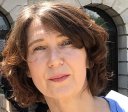
 Cornelia Fermuller
· 6 previous affiliations
- University of Maryland, College ParkSince 1994
- Research Scientist · Since 1994
- Visiting research scientist · 1994
- TU Wien1990–1993
- PhD student · 1990–1993
- Visiting research scientist · 1993
- Joanneum Research1989–1990
- Assistant research scientist · 1989–1990
- Graz University of Technology1983–1989
- M.S., Applied Mathematics · 1983–1989
1 other author named Cornelia Fermuller: Cornelia Fermüller (63 papers)
Research Overview
Cornelia Fermuller focuses on computer vision, motion estimation, and embodied robotics, investigating how artificial agents perceive and interact with dynamic environments. Her trajectory spans early foundational work in three-dimensional motion perception to recent advances in neuromorphic vision and multimodal human-robot interaction. Currently, she is exploring event-based flow estimation and the integration of physical dynamics into video-text models.
Research Trajectory
Fermuller's early research established foundational geometric principles for understanding how moving systems perceive their environment. In 1993, she addressed Global 3D motion estimation, laying the groundwork for separating three-dimensional motion from scene structure. This led to an influential 1995 publication, Direct Perception of Three-Dimensional Motion from Patterns of Visual Motion, which demonstrated that self-motion can be estimated by locating global patterns of retinal motion without requiring complete optical flow. During this period, she also formalized approaches to Qualitative egomotion. Her subsequent investigations into the geometric constraints of vision resulted in On the Geometry of Visual Correspondence and Structure from Motion: Beyond the Epipolar Constraint. Collectively, these contributions advanced the broader area of Resolving Local Ambiguity in Visual Motion Integration and established robust methods for the research direction of Direct Motion Estimation from Spatiotemporal Image Gradients.
Moving into the 2010s, Fermuller's focus expanded to encompass robotic perception and active vision. She participated in developing systems that translate raw visual data into actionable robotic plans, such as in Robot Learning Manipulation Action Plans by "Watching" Unconstrained Videos from the World Wide Web. This work contributed to robust motion understanding in unconstrained video and functional grasping for task-oriented manipulation. She also explored active vision for resource-constrained platforms, contributing to GapFlyt: Active Vision Based Minimalist Structure-Less Gap Detection For Quadrotor Flight, which advanced techniques in the area of Autonomy for SWaP Constrained Nano Aerial Vehicles. Recognizing the limitations of traditional frame-based cameras for high-speed robotic tasks, she began investigating alternative sensing paradigms, culminating in Learning sensorimotor control with neuromorphic sensors: Toward hyperdimensional active perception. This marked a significant entry into the research direction of Sharp 3D Reconstruction from Motion Blurred Imagery.
By 2024, Fermuller's research trajectory demonstrated a deep integration of perception, action, and learning in embodied agents. She introduced Maelstrom Networks, a modular neural architecture that decouples temporal memory from active learning, contributing to efficient temporal learning with fixed recurrent reservoirs. In parallel, her lab developed NatSGD: A Dataset with Speech, Gestures, and Demonstrations for Robot Learning in Natural Human-Robot Interaction. This project mapped spontaneous human inputs to formal logic, demonstrating that simultaneous multimodal processing significantly improves task comprehension and advancing the field of simulating autonomy to elicit natural human-robot interaction.
Further bridging perception and physical action, she proposed Embodied Visuomotor Representation, a framework allowing robots to perceive distance and scale intrinsically through their own motor acceleration and visual flow. Her research group also addressed complex navigation challenges in Search-Based Path Planning among Movable Obstacles, optimizing collision-free routing by allowing robots to actively push objects. These efforts intersect with her broader work in the area of Overcoming Visual Self Occlusion in Robotic Manipulation. Beyond physical robotics, she addressed fundamental flaws in foundation models with Diving Deep into the Motion Representation of Video-Text Models, introducing methods to force models to focus on physical dynamics rather than static objects, thereby overcoming static bias in video understanding.
In her most recent work, Fermuller continues to push the boundaries of neuromorphic vision and generative modeling. She collaborated on From Inpainting to Layer Decomposition: Repurposing Generative Inpainting Models for Image Layer Decomposition, exploring efficient adaptation via low-rank parameter updates to split images into foregrounds and backgrounds without training massive models from scratch. Returning to her foundational interest in motion, she introduced a novel supervised point-based method in Learning Normal Flow Directly From Events, addressing the high error rates of existing model-based normal flow estimators. Looking toward 2026, she participated in developing A Bayesian Nonparametric Framework For Learning Disentangled Representations, which adaptively scales latent capacity to discover underlying data structures. Concurrently, she led research on Motion Segmentation and Egomotion Estimation from Event-Based Normal Flow, creating an optimization-based pipeline that exploits the high temporal resolution of neuromorphic sensors to isolate independently moving objects. Her 2026 work further expanded into efficient edge navigation, generative compositing, and unified spatial representations: she co-developed RingNav: Task-Shaped Circular Memory for Visual Heading, which constrains memory to a circular manifold for lightweight heading estimation on tiny robots, contributed to FreeCHROMA: Generative Chroma Keying from Unaligned Background References for video compositing and harmonization via diffusion models, and collaborated on WorldLatent: A Unified 4D Latent Space for World Perception and Generation to establish a joint multimodal representation for 4D vision and generation.
Current Directions
The most recent papers in the evidence indicate a strong ongoing focus on event-based vision and advanced representation learning. Fermuller is actively investigating how to extract reliable motion signals, such as normal flow and egomotion, directly from the sparse, high-temporal-resolution data provided by neuromorphic sensors. This involves developing optimization pipelines that incorporate geometric constraints and inertial measurements to segment independently moving objects in dynamic scenes. Additionally, her recent collaborative work explores the structure of latent spaces in generative models, focusing on Bayesian nonparametric frameworks for disentangled representations and the efficient repurposing of large-scale inpainting models for complex vision tasks like layer decomposition.
Profile updated
Loading new papers…
Other researchers whose papers cluster into the same research directions — a proxy for overlapping technical interests and shared intellectual neighborhoods.
See something wrong? Report a mistake