

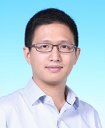
 Shaojie Shen
· 1 previous affiliation
- Associate Professor · Since 2020
- Assistant Professor · 2014–2020
Research Overview
Shaojie Shen focuses on visual-inertial state estimation, autonomous navigation, and interactive motion planning for robotic systems. His trajectory spans foundational work in monocular odometry and sensor calibration to advanced trajectory generation for agile quadrotors and automated vehicles. Recently, his research emphasizes multi-agent traffic simulation, inverse reinforcement learning for trajectory prediction, and multi-sensor fusion with 3D Gaussian Splatting.
Research Trajectory
The trajectory begins with foundational contributions to aerial robotics and visual-inertial state estimation. In 2013, he developed Vision-Based State Estimation and Trajectory Control Towards High-Speed Flight with a Quadrotor, establishing core methods for agile aerial navigation. This focus on robust estimation led to the development of VINS-Mono: A Robust and Versatile Monocular Visual-Inertial State Estimator (2018). By tightly coupling preintegrated IMU measurements with feature observations, this work provided a highly accurate, low-SWaP (size, weight, and power) solution for metric six degrees-of-freedom state estimation, significantly advancing the area of Mitigating Cumulative Drift in Visual and Inertial Navigation.
Building on these estimation frameworks, he addressed the practical challenges of multi-sensor fusion. With Real-Time Temporal and Rotational Calibration of Heterogeneous Sensors Using Motion Correlation Analysis (2021), his group tackled the often-overlooked problem of temporal synchronization alongside spatial calibration, contributing to the broader area of Continuous Online Extrinsic Calibration for Autonomous Systems. Concurrently, his research expanded into decision-making for ground vehicles. He designed EPSILON: An Efficient Planning System for Automated Vehicles in Highly Interactive Environments (2022), which utilized a hierarchical structure with guided branching to solve partially observable Markov decision processes efficiently. This work was a key development in the research direction of Interactive Motion Planning for Autonomous Vehicles.
In recent years, his work has increasingly integrated advanced perception models with agile planning. In the research direction Monocular Metric Depth Estimation for Uncalibrated Images, his group developed Metric3D v2: A Versatile Monocular Geometric Foundation Model for Zero-Shot Metric Depth and Surface Normal Estimation (2024), which resolves focal length ambiguity to recover real-world 3D metrics directly from in-the-wild images. This deep integration of perception and planning is also evident in his continued work on quadrotors. His team formulated APACE: Agile and Perception-Aware Trajectory Generation for Quadrotor Flights (2025), a framework that explicitly maximizes feature matchability to reduce estimator error during aggressive maneuvers. Pushing the physical limits of aerial navigation, his group achieved Autonomous Flights Inside Narrow Tunnels (2025) by accounting for aerodynamic proximity effects in confined 3D pipe networks. To further enhance exploration efficiency, he presented FALCON: Fast Autonomous Aerial Exploration Using Coverage Path Guidance (2025), which utilizes incremental connectivity-aware space decomposition to minimize the revisitation of previously explored regions.
His research in motion planning also extends to complex ground environments. Addressing the research direction Topological Path Diversity in Motion Planning, he developed Fast 3D Sparse Topological Skeleton Graph Generation for Mobile Robot Global Planning (2025), offering a trajectory-independent method for efficiently capturing the spatial structure of free space. Expanding the capabilities of mobile robots in cluttered spaces, he proposed Contact-Aware Motion Planning Among Movable Objects (2025), an optimization-based framework that treats contact as a complementarity constraint, allowing robots to actively and predictably push obstacles rather than merely avoiding them. In the mapping domain, his lab introduced CSMapping: Scalable Crowdsourced Semantic Mapping and Topology Inference for Autonomous Driving (2025), leveraging latent diffusion models as structural priors to construct high-definition maps from noisy production vehicle data. Furthermore, he advanced multi-sensor odometry with GS-LIVO: Real-Time LiDAR, Inertial, and Visual Multi-sensor Fused Odometry with Gaussian Mapping (2025), tightly coupling these modalities with 3D Gaussian Splatting for photorealistic mapping on resource-constrained embedded platforms.
A major recent focus has been on intent reasoning and trajectory prediction for autonomous driving. He developed Foresight in Motion: Reinforcing Trajectory Prediction with Reward Heuristics (2025), utilizing inverse reinforcement learning (IRL) to generate interpretable reward maps before forecasting paths. This approach was further refined in GoIRL: Graph-Oriented Inverse Reinforcement Learning for Multimodal Trajectory Prediction (2025), which applies IRL to high-fidelity graph-based prediction to improve resilience against unexpected environmental changes. He also participated in research on Trajectory-Conditioned World Models for Interactive Driving, contributing to ReCamDriving: LiDAR-Free Camera-Controlled Novel Trajectory Video Generation (2025), a framework that generates high-fidelity videos from novel camera trajectories using 3D Gaussian Splatting as a structural guide. Most recently, he presented Advancing Multi-agent Traffic Simulation via R1-Style Reinforcement Fine-Tuning (2026), adapting iterative reinforcement learning techniques to achieve highly realistic multi-agent traffic simulations.
Current Directions
The most recent papers in the evidence indicate a strong focus on integrating advanced machine learning paradigms—such as inverse reinforcement learning (IRL) and 3D Gaussian Splatting (3DGS)—into autonomous navigation and simulation pipelines. Current work investigates intent-driven trajectory prediction, utilizing IRL to recover latent reward structures that explain human driving behavior in complex, graph-based environments. Additionally, recent efforts address the generation of high-fidelity, multi-agent traffic simulations by applying iterative reinforcement fine-tuning techniques to autonomous driving models. Another active direction involves tightly coupling multi-sensor odometry with 3DGS to achieve real-time, photorealistic mapping on embedded systems, alongside the development of scalable, crowdsourced semantic mapping frameworks using latent diffusion models as structural priors.
Profile updated
Loading new papers…
Other researchers whose papers cluster into the same research directions — a proxy for overlapping technical interests and shared intellectual neighborhoods.
See something wrong? Report a mistake