

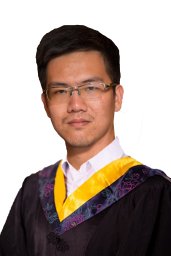
 Chenran Li
· 6 previous affiliations
- Nvidia (United States)Since 2024
- Researcher · Since 2025
- Intern · 2024
- 英伟达公司Since 2024
- Robotics @ ISAAC / Research @ GEAR · Since 2025
- Intern - Robotics & ML · 2024
- University of California, Berkeley2019–2025
- Graduate Student Researcher · 2020–2025
- Undergraduate Research Assistant · 2019–2020
- PhD student · 2020–2025
- Summer Research Intern (ADAS) · 2023
- Harbin Institute of Technology2016–2020
- Undergrad student · 2016–2020
Research Overview
Chenran Li focuses on autonomous driving systems, reinforcement learning, and policy customization for continuous control. His early work addressed state estimation and multi-agent trajectory prediction for socially compliant navigation. More recently, his research investigates test-time preference alignment for language models and the use of large language models to diagnose and repair robotic motion planners.
Research Trajectory
He initially addressed foundational control challenges in autonomous vehicles, developing methods to handle non-linear tire behavior and changing environments. This included Dual Extended Kalman Filter Based State and Parameter Estimator for Model-Based Control in Autonomous Vehicles, which proposed a state and parameter estimation approach to obtain accurate, time-varying parameters for model-based control. Expanding into interactive driving, he introduced an iterative imitation learning framework in Iterative Imitation Policy Improvement for Interactive Autonomous Driving. By treating static datasets as weak simulators and utilizing an A* planner for pseudo-expert labels, this work bridged behavioral cloning and robust navigation, contributing to the broader research direction of Modeling Reciprocal Dynamics in Multi-Agent Trajectory Prediction. To further handle social interactions, he developed Efficient Game-Theoretic Planning With Prediction Heuristic for Socially-Compliant Autonomous Driving, which applied Monte Carlo Tree Search to overcome the computational demands and non-convexity of generalized Nash equilibrium problems in traffic scenarios.
In 2023, his focus expanded to policy customization in reinforcement learning. He introduced Residual Q-Learning: Offline and Online Policy Customization without Value, a method to adapt pre-trained agents to new constraints without requiring access to the original reward functions or internal value tables.
Concurrently, he began exploring the intersection of large language models and robotic planning. In 2024, he developed DrPlanner: Diagnosis and Repair of Motion Planners Using Large Language Models, a framework that uses structured code descriptions and iterative feedback to identify and repair logic flaws in automated vehicle planners. This work intersects with several research areas, including Autonomous Code Refinement via Execution Feedback Loops, Multimodal Fusion for Source Code Representation, and Repository Scale Context Constraints in Code Language Models.
The residual learning paradigm introduced in 2023 became a central theme in his 2025 work. He collaborated on Residual-MPPI: Online Policy Customization for Continuous Control, which combined Model Predictive Path Integral control with residual Q-learning for zero-shot adaptation. He later formalized these concepts in Residual Policy Gradient: A Reward View of KL-regularized Objective, demonstrating that standard KL-regularization functions as reward-level multi-task balancing and showing that decoupling the KL penalty improves fine-tuning performance. Applying these insights to inverse reinforcement learning, he participated in MEReQ: Max-Ent Residual-Q Inverse RL for Sample-Efficient Alignment from Intervention, an algorithm that learns a residual reward function from human interventions to improve the sample efficiency of aligning robot behavior with human preferences.
Also in 2025, continuing his work in autonomous driving interactions, he co-authored WOMD-Reasoning: A Large-Scale Dataset for Interaction Reasoning in Driving, which introduced a massive multi-modal dataset to train LLMs to reason about complex traffic rules and agent intentions, further advancing the area of Modeling Reciprocal Dynamics in Multi-Agent Trajectory Prediction. In the domain of physical robotics, he contributed to DexCtrl: Towards Sim-to-Real Dexterity with Adaptive Controller Learning, a framework that bridges the reality gap in dexterous manipulation by jointly predicting robot actions and low-level controller parameters like stiffness and damping.
Most recently, in 2026, his research has extended residual and reward-decomposition techniques to language model alignment. He collaborated on REAR: Test-time Preference Realignment through Reward Decomposition, a training-free method that dynamically adjusts the balance between question-answering and preference components within an LLM's internal reward to generate more aligned outputs at inference time.
Current Directions
The most recent papers in the evidence address the alignment of complex models—ranging from robotic controllers to large language models—with human preferences and real-world constraints. This includes developing training-free, test-time methods for language model realignment and creating sample-efficient inverse reinforcement learning algorithms for robotics. Additionally, current work investigates the use of multi-modal reasoning to bridge the gap between simulated environments and physical execution, particularly in dexterous manipulation and interactive autonomous driving.
Profile updated
Loading new papers…
Other researchers whose papers cluster into the same research directions — a proxy for overlapping technical interests and shared intellectual neighborhoods.
See something wrong? Report a mistake