

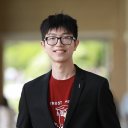
 Wenli Xiao
· 8 previous affiliations
- Nvidia (United States)Since 2024
- Research Engineer · Since 2024
- physical intelligenceSince 2026
- Researcher · Since 2026
- Carnegie Mellon UniversityCurrent
- Current
- Master of Science - MS, Mechatronics, Robotics, and Automation Engineering · 2023–2025
- Research Assistant · 2022
- Undergrad student · 2019–2023
- Bachelor's degree, Computer Engineering · 2019–2023
- Research Assistant · 2021–2022
- Visiting Student · 2022
- Webank2021
- Software Engineer · 2021
Research Overview
Wenli Xiao focuses on dexterous manipulation, humanoid robotics, and foundation models for embodied artificial intelligence. His research develops scalable methods for whole-body control, safe reinforcement learning, and autonomous policy improvement in real-world environments. Currently, he investigates vision-language-action models and post-training techniques that enable generalist robots to adapt and self-improve.
Research Trajectory
As a doctoral student at Carnegie Mellon University, Xiao’s early research trajectory began with foundational work in reinforcement learning (RL) and multi-agent systems, with an emphasis on safety and handling partial observability. In 2023, he participated in developing the Energy-based Predictive Representation for Reinforcement Learning, a unified framework designed to manage exploration and planning in partially observable Markov decision processes. Concurrently, he introduced Model-based Dynamic Shielding for Safe and Efficient Multi-agent Reinforcement Learning, establishing mechanisms to guarantee safety in complex multi-agent environments. He expanded on these safety guarantees the following year by proposing methods for Safe Deep Policy Adaptation.
Moving into 2024, Xiao’s focus shifted toward agile mobility and whole-body humanoid control. He developed AnyCar to Anywhere: Learning Universal Dynamics Model for Agile and Adaptive Mobility, a transformer-based dynamics model that enables wheeled robots to achieve specialist-level agility across diverse environments by leveraging minimax optimization and adaptive safety margins. In the humanoid domain, he co-developed WoCoCo: Learning Whole-Body Humanoid Control with Sequential Contacts, a unified framework that overcomes the long-horizon exploration challenges typical of tasks requiring complex contact sequences. He also collaborated on OmniH2O: Universal and Dexterous Human-to-Humanoid Whole-Body Teleoperation and Learning, a system utilizing kinematic pose as a universal interface to allow humans to control full-sized humanoids via virtual reality and verbal instructions.
In 2025, Xiao continued to advance humanoid robotics by bridging the gap between specialized skills and generalist policies. He introduced HOVER: Versatile Neural Whole-Body Controller for Humanoid Robots, a unified neural controller capable of seamlessly transitioning between locomotion and manipulation. By distilling human motion imitation skills, this work demonstrated efficient knowledge transfer without relying on massive teacher models. Building on these sim-to-real capabilities, he participated in the development of Opening the Sim-to-Real Door for Humanoid Pixel-to-Action Policy Transfer, which demonstrated a humanoid loco-manipulation policy capable of opening diverse real-world doors using only RGB camera input. This project intersected with several key research areas, including photorealistic simulation via neural rendering and the broader area of Dynamics Randomization for Robust Robotic Control. Alongside his humanoid research, he also contributed to Agile Mobility with Rapid Online Adaptation via Meta-Learning and Uncertainty-Aware MPPI, further refining control strategies for dynamic environments.
Most recently, in 2026, alongside his role as a Research Scientist Intern at NVIDIA GEAR Lab, Xiao’s work has integrated foundation models and autonomous self-improvement into embodied AI. He developed Self-Improving Vision-Language-Action Models with Data Generation via Residual RL, introducing the Probe, Learn, Distill (PLD) framework. This approach allows Vision-Language-Action (VLA) models to autonomously correct their own execution failures without requiring additional human demonstrations. This significant contribution advances the research direction of Residual Reinforcement Learning for Policy Refinement, while also addressing the capability threshold for autonomous self-improvement and overcoming sparse rewards in robotic manipulation. Additionally, he collaborated on CaP-X: A Framework for Benchmarking and Improving Coding Agents for Robot Manipulation, which evaluates and enhances AI models that control robots by writing code, contributing to execution-guided reinforcement learning for code generation.
Current Directions
Xiao’s most recent work investigates the intersection of foundation models and embodied artificial intelligence, with a specific focus on autonomous self-improvement and code-generation agents. Recent papers in the evidence address the limitations of static Vision-Language-Action (VLA) models by developing post-training frameworks that allow robots to autonomously probe their environments, recover from execution errors using residual reinforcement learning, and distill these corrections back into a generalist policy. Additionally, his current research explores "Code-as-Policy" paradigms, benchmarking and improving the ability of large language models to control robotic manipulation through multi-turn reasoning and execution-guided textual feedback.
Profile updated
Loading new papers…
Other researchers whose papers cluster into the same research directions — a proxy for overlapping technical interests and shared intellectual neighborhoods.
See something wrong? Report a mistake