

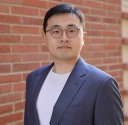
 Chen Tang
· 6 previous affiliations
- The University of Texas at AustinSince 2023
- Postdoc · Since 2023
- Postdoctoral Fellow in Computer Science · 2023–2025
- University of California, Los AngelesSince 2025
- Assistant Professor · Since 2025
- Current
- University of California, Berkeley2016–2023
- Postdoctoral Scholar in Mechanical Engineering · 2022–2023
- Graduate Student Researcher · 2016–2022
- PhD student · 2022–2023
- waymo2021
- Intern, Planner Prediction Router ML & Deep Learning · 2021
- Bachelor of Engineering - BE, Mechanical Engineering · 2012–2016
4 other authors named Chen Tang: Chen Tang (Chinese University of Hong Kong · 46 papers), Chen Tang (The University of Tokyo · 39 papers), Chen Tang (University of Science and Technology of China · 12 papers), Chen Tang (TikTok · 1 paper)
Research Overview
Chen Tang focuses on the intersection of control theory, robotics, and machine learning to develop embodied AI agents for human-centered environments. His trajectory spans from probabilistic trajectory prediction and autonomous racing at the physical limits of handling to hierarchical reinforcement learning. Most recently, his work addresses natural language communication for cooperative autonomous driving and vision-language-action models for dynamic robot navigation.
Research Trajectory
The early phase of this research trajectory centered on ensuring the safety and physical feasibility of autonomous driving systems. This work began with Adaptive Probabilistic Vehicle Trajectory Prediction Through Physically Feasible Bayesian Recurrent Neural Network (2019), which combined Bayesian neural networks with known physical models to guarantee that predicted vehicle trajectories remained physically viable while adapting to human driving policies. Building on the need for interpretable models in complex traffic scenarios, Domain Knowledge Driven Pseudo Labels for Interpretable Goal-Conditioned Interactive Trajectory Prediction (2022) utilized pseudo labels to guide a Conditional Variational Autoencoder. By creating an interpretable latent space for interaction behaviors, this approach contributed to the broader area of Self-Explainable Neural Networks without Performance Loss.
Around the same time, the focus expanded to high-speed vehicle control and autonomous racing. Outracing Human Racers with Model-based Autonomous Racing (2022) demonstrated that interpretable, model-based control methods—specifically a coupled online Model Predictive Control tracker—could achieve human-expert performance in high-fidelity simulators. This advanced the research direction of Autonomous Control at the Physical Limits of Handling. To further refine these high-speed systems, Double-Iterative Gaussian Process Regression for Modeling Error Compensation in Autonomous Racing (2023) introduced a framework to compensate for modeling errors in both offline planning and online tracking, supporting the area of High Fidelity Vehicle Dynamics for Safe Autonomous Control.
In 2023 and 2024, the trajectory incorporated reinforcement learning techniques for policy refinement and hierarchical control. Residual Q-Learning: Offline and Online Policy Customization without Value (2023) provided a method to customize pre-trained agents without requiring access to their original reward functions, aligning with the direction of Residual Reinforcement Learning for Policy Refinement. This was complemented by Skill-Critic: Refining Learned Skills for Hierarchical Reinforcement Learning (2024), which focused on improving the underlying structures of hierarchical reinforcement learning models.
Scaling and optimizing trajectory models became a prominent theme in 2024. Pre-training on Synthetic Driving Data for Trajectory Prediction (2024) leveraged rule-based planners and augmented HD maps to generate synthetic scenes, improving performance on real-world benchmarks without additional human annotation. This scaling effort touched upon challenges in areas like Mitigating Positional Leakage in Masked Point Cloud Pretraining. Simultaneously, Grounded Relational Inference: Domain Knowledge Driven Explainable Autonomous Driving (2024) provided semantically meaningful explanations for multi-agent interactions by grounding the model's relational inference in human domain knowledge. To address the computational bottlenecks of generative models in self-driving, Optimizing Diffusion Models for Joint Trajectory Prediction and Controllable Generation (2024) introduced techniques that drastically reduced inference times while maintaining high-quality trajectory generation.
By 2025, the research broadened to evaluate the state of robot learning and integrate large foundation models into robotic control. Deep Reinforcement Learning for Robotics: A Survey of Real-World Successes (2025) proposed a taxonomy and a maturity scale to quantify the real-world readiness of DRL applications. The integration of vision-language models (VLMs) was critically examined in SocialNav-SUB: Benchmarking VLMs for Scene Understanding in Social Robot Navigation (2025), which introduced a visual question-answering benchmark revealing significant gaps in the spatial and temporal reasoning of state-of-the-art VLMs, contributing to the field of Integrating Social Norms into Robot Motion Planning.
Recent work emphasizes complex instruction following and multi-agent communication. ComposableNav: Instruction-Following Navigation in Dynamic Environments via Composable Diffusion (2025) enabled robots to blend motion primitives at runtime to satisfy novel combinations of commands. For multi-agent systems, Towards Natural Language Communication for Cooperative Autonomous Driving via Self-Play (2025) developed a framework for autonomous vehicles to coordinate using natural language, refining their strategies through post-episode debriefing. Finally, addressing the temporal mismatch in real-time systems, TIC-VLA: A Think-in-Control Vision-Language-Action Model for Robot Navigation in Dynamic Environments (2026) decoupled high-level reasoning from reactive control to handle the inference latency inherent in large vision-language-action models.
Current Directions
Based on the most recent papers in the evidence, current work focuses heavily on bridging the gap between large-scale foundation models (such as LLMs and VLMs) and real-time, embodied robotic control. A major theme is overcoming the latency inherent in large vision-language-action models. By decoupling slow, high-level semantic reasoning from fast, reactive low-level control, recent architectures address the practical challenges of deploying complex generative models in dynamic, real-world environments.
Additionally, current research investigates how autonomous agents can use natural language not just for receiving human instructions, but as a functional protocol for multi-agent cooperation. This involves leveraging self-play and iterative debriefing to allow autonomous vehicles to negotiate and coordinate complex maneuvers, ultimately distilling these language-driven strategies into efficient models capable of near-real-time inference.
Profile updated
Loading new papers…
Other researchers whose papers cluster into the same research directions — a proxy for overlapping technical interests and shared intellectual neighborhoods.
See something wrong? Report a mistake