

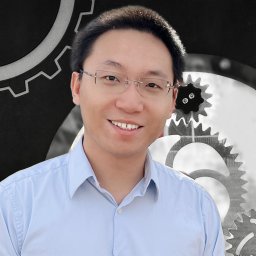
 Boyuan Chen
· 4 previous affiliations
- Duke UniversitySince 2022
- Dickinson Faculty Assistant Professor · Since 2025
- Assistant Professor · 2022–2024
- Columbia University2016–2022
- Doctor of Philosophy - PhD, Computer Science · 2018–2022
- Master of Science (M.S.), Computer Science · 2016–2017
- Undergrad student · 2016
- Jilin University2012–2016
- Undergrad student · 2012–2016
4 other authors named Boyuan Chen: Boyuan Chen (OpenAI (United States) · 15 papers), Boyuan Chen (Peking University · 15 papers), Boyuan Chen (2 papers), Boyuan Chen (New York University · 2 papers)
Research Overview
Boyuan Chen focuses on autonomous robotics, automated scientific discovery, and representation learning for complex dynamical systems. His trajectory spans from early work in evolutionary learning and video action prediction to developing frameworks that automatically extract fundamental state variables from experimental data. Currently, he investigates scalable robot learning, bipedal locomotion, and automated morphology design to bridge the gap between high-level specifications and physical deployment.
Research Trajectory
Chen’s early research explored foundational machine learning and computer vision problems. He contributed to the development of Autostacker: a compositional evolutionary learning system (2018), which automated the generation of machine learning pipelines. Expanding into video analysis, he participated in creating Oops! Predicting Unintentional Action in Video (2020), investigating how self-supervised representations and temporal order prediction can help models recognize the onset of unintentional human actions from in-the-wild video data.
In 2021, his focus on representation learning deepened with Beyond Categorical Label Representations for Image Classification. This work demonstrated that high-dimensional, high-entropy label representations—such as audio spectrograms—can provide stronger error signals than traditional categorical probabilities during model training. This interest in extracting fundamental representations from complex data naturally extended to the physical sciences. He introduced a framework for the Automated discovery of fundamental variables hidden in experimental data (2022), proposing a principle to determine the number of state variables required to describe a physical system directly from high-dimensional observations. Concurrently, he applied these concepts to robotics, developing methods for Fully body visual self-modeling of robot morphologies to enable machines to computationally model their own physical bodies for planning and control.
A major theme in Chen’s subsequent work is improving the adaptability and generalization of robotic systems. To address the difficulty of transferring reinforcement learning policies across different environments and robot kinematics, his group developed Policy Stitching: Learning Transferable Robot Policies (2023). This approach aligns latent representations to facilitate transfer learning for novel robot-task combinations, contributing to the broader research direction of Relative Representations for Latent Space Alignment. He further extended this modularity to vision-based imitation learning with Perception Stitching: Zero-Shot Perception Encoder Transfer for Visuomotor Robot Policies (2024), which disentangles perceptual knowledge from downstream motion skills to allow zero-shot adaptation to drastic visual changes.
Parallel to his robotics research, Chen continued to advance automated scientific discovery. He led work on the Automated Global Analysis of Experimental Dynamics through Low-Dimensional Linear Embeddings (2024), which discovers low-dimensional linear models for nonlinear dynamical systems, advancing the area of Phase Space Reconstruction from Time Series Data. This was complemented by Automated Discovery of Continuous Dynamics from Videos (2024), a framework that extracts operable state variables and differentiable vector fields directly from visual data without prior domain knowledge. He also participated in applying deep learning to materials science, contributing to Towards end-to-end structure determination from x-ray diffraction data using deep learning (2024). This work seeks to computationally automate structural inference, intersecting with the research directions of Resolving Peak Overlap in Powder Diffraction and Automating Crystal Structure Identification from Diffraction Data.
Chen has also investigated how humans and AI agents interact and collaborate. He guided the development of CREW: Facilitating Human-AI Teaming Research (2024), a platform designed to support multidisciplinary studies of human-agent collaboration across complex scenarios. Building on this, he introduced GUIDE: Real-Time Human-Shaped Agents (2024), a framework that accelerates reinforcement learning by grounding continuous human feedback into dense rewards. In the domain of robotic perception, he collaborated on SonicSense: Object Perception from In-Hand Acoustic Vibration (2024), a hardware-software system that enables robots to differentiate materials, reconstruct 3D shapes, and re-identify objects through acoustic sensing.
In his most recent trajectory, Chen’s research has focused on scaling robot learning and design. He oversaw the creation of LAPP: Large Language Model Feedback for Preference-Driven Reinforcement Learning (2025), which uses large language models to automatically generate preference labels from raw trajectories, minimizing the need for manual reward engineering. His work in physical robotics includes The duke humanoid: Design and control for energy efficient bipedal locomotion using passive dynamics (2025), presenting an open-source bipedal platform and an end-to-end reinforcement learning algorithm that leverages passive dynamics to significantly reduce energy transport costs. Addressing the bottleneck of hardware design, he developed Text2Robot: Evolutionary Robot Design from Text Descriptions (2025), a framework that rapidly converts text specifications into physically manufacturable quadrupedal robots through geometric processing and body-control co-optimization. Finally, his research extends to expressive humanoid robotics, as seen in his work on Learning realistic lip motions for humanoid face robots (2026).
Current Directions
Recent work investigates the intersection of generative AI and physical robot design to accelerate both the learning and manufacturing of autonomous systems. A primary focus is on automating the robot design process itself, exploring how high-level text specifications can be rapidly translated into physically manufacturable morphologies through body-control co-optimization. In parallel, ongoing research addresses the scalability of robot learning by utilizing large language models to provide automated preference feedback, reducing the reliance on manual reward engineering. Additionally, current efforts in physical robotics emphasize energy-efficient bipedal locomotion—leveraging passive dynamics to improve the cost of transport in humanoid platforms—and enhancing the expressive capabilities of humanoid faces for more natural human-robot interaction.
Profile updated
Loading new papers…
Other researchers whose papers cluster into the same research directions — a proxy for overlapping technical interests and shared intellectual neighborhoods.
See something wrong? Report a mistake