

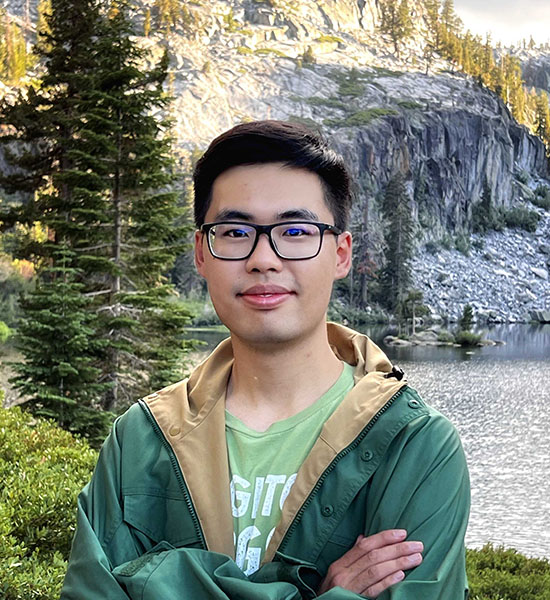
 Boyuan Chen
· 7 previous affiliations
- OpenAI (United States)Since 2025
- Researcher · Since 2025
- 博士生, 电子工程与计算机(EECS) · 2021–2025
- 研究科学家 · 2023
- AI Resident, Google X · 2022
- 研究员 · 2019–2021
- University of California, Berkeley2017–2021
- 学士, 计算机科学,数学 · 2017–2021
- Undergrad student · 2017–2021
4 other authors named Boyuan Chen: Boyuan Chen (Duke University · 46 papers), Boyuan Chen (Peking University · 15 papers), Boyuan Chen (2 papers), Boyuan Chen (New York University · 2 papers)
Research Overview
Boyuan Chen focuses on the intersection of world models, reinforcement learning, and embodied AI to develop autonomous systems capable of sophisticated reasoning and interaction in physical environments. His research explores how generative modeling, particularly diffusion-based architectures, can be leveraged for robotic planning, spatial reasoning, and long-horizon decision-making. Currently a research scientist at OpenAI, Chen’s work has transitioned from studying zero-shot generalization in reinforcement learning to building large-scale vision-language-action models that bridge the gap between high-level semantic understanding and low-level motor control.
Research Trajectory
Chen’s early research, beginning around 2019, addressed the fundamental challenge of zero-shot generalization in intelligent agents. This work sought to enable agents to learn in one environment and perform tasks in unseen environments without additional data collection or fine-tuning. In Scoring-Aggregating-Planning: Learning task-agnostic priors from interactions and sparse rewards for zero-shot generalization, he investigated how task-agnostic priors could be derived from sparse rewards to facilitate this transfer. This period also involved exploring Linear Scaling for Multi Agent Communication and Reasoning, where he contributed to methods for discovering diverse strategic behaviors in complex games. By utilizing reward randomization, this research aimed to overcome the tendency of standard policy gradient algorithms to converge on sub-optimal, fixed equilibria in multi-agent trust dilemmas.
As his work progressed into the early 2020s, Chen shifted toward the problem of grounding high-level reasoning in physical reality. While Large Language Models (LLMs) demonstrated significant planning capabilities, they often lacked the necessary spatial context to execute tasks in the real world. To address this, he developed Open-vocabulary Queryable Scene Representations for Real World Planning, introducing a framework that allows LLM planners to query available objects within a scene before generating plans. This research contributed to the development of Textual Cognitive Maps for 3D Reasoning, enabling models to process geometric data and spatial relationships more effectively.
During this mid-career phase, Chen also investigated the trade-offs between model-free and model-based reinforcement learning. In Self-Supervised Reinforcement Learning that Transfers using Random Features, he proposed methods to mitigate the "compounding errors" typical of model-based approaches while maintaining the adaptability that model-free methods often lack. His work in this period also touched upon Closing the Sim-to-Real Gap in Robotics, participating in empirical analyses of how co-training with simulated and real-world data can scale imitation learning, particularly when physical demonstrations are limited.
Chen’s most recent work represents a significant pivot toward generative world models and diffusion-based planning. This trajectory is characterized by the development of "Diffusion Forcing," a paradigm that combines the stability of autoregressive next-token prediction with the generative power of full-sequence diffusion. This approach has been applied to infinite video generation and complex robotic trajectory guidance. Furthermore, he has focused on endowing vision-language models with quantitative 3D spatial knowledge, such as distances and size differences, which are often absent from standard internet-scale training data. His current efforts at OpenAI involve training large-scale generative models for image and video synthesis, specifically aimed at enabling robots to "imagine" and execute complex tasks in-the-wild.
Current Directions
Chen’s current research is concentrated on three primary pillars: world models for robotics, spatial reasoning in multimodal models, and stable long-sequence generation. A central theme is the use of video as a universal interface for planning. By training models to generate full video sequences of task completion, Chen aims to bypass the limitations of discrete action prediction, allowing robots to generalize to novel environments through visual imagination.
He is also actively refining the architectural foundations of diffusion models to handle variable-length histories and long-range consistency. This includes developing "noising-as-masking" frameworks that allow models to condition on flexible past frames, ensuring that generated trajectories remain stable over hundreds of steps without diverging. Additionally, he continues to explore Visuo-Tactile Integration for Contact-Rich Manipulation, investigating how multi-modal inputs can improve a robot's ability to handle delicate or complex physical interactions.
Representative Work
In Diffusion Forcing: Next-token Prediction Meets Full-Sequence Diffusion, Chen introduced a training paradigm that assigns independent noise levels to each token in a sequence. This method bridges the gap between autoregressive models and diffusion models, allowing for the stable generation of variable-length sequences. The approach is particularly effective for robotic planning, as it enables the model to roll out continuous video or state trajectories infinitely without the common pitfall of sequence divergence.
Addressing the spatial limitations of multimodal models, SpatialVLM: Endowing Vision-Language Models with Spatial Reasoning Capabilities presents a system for training VLMs on internet-scale spatial reasoning data. Chen developed a pipeline to generate synthetic but physically accurate spatial data, allowing models to reason about quantitative relationships like the distance between objects or their relative sizes. This work significantly enhances the utility of VLMs for robotics and complex visual question-answering tasks.
In Large Video Planner Enables Generalizable Robot Control, Chen proposed a shift in the robot foundation model paradigm. Rather than predicting actions directly, the Large Video Planner (LVP) generates a video of the task being completed. By training on a curated dataset of 1.4 million clips, the model can "imagine" a successful outcome and then extract the necessary motor commands to achieve it, facilitating zero-shot generalization to "in-the-wild" robotic challenges.
Chen’s work on Open-vocabulary Queryable Scene Representations for Real World Planning established the NLMap framework. This research addressed the lack of grounding in LLM-based planners by creating a natural language queryable representation of the physical scene. By integrating Visual Language Models (VLMs) with LLM planners, the system allows an agent to perceive and query its surroundings, leading to more context-aware and executable plans in real-world environments.
In the domain of reinforcement learning, Self-Supervised Reinforcement Learning that Transfers using Random Features explores the use of random features to improve the transferability of learned policies. Chen addressed the trade-off between the power of model-free methods and the adaptability of model-based methods. By using random features to learn world dynamics, the proposed method reduces the impact of compounding errors, making self-supervised RL more robust for complex, long-horizon tasks.
Finally, History-Guided Video Diffusion introduces the Diffusion Forcing Transformer (DFoT), which utilizes a flexible conditioning mechanism for video generation. This work enables stable, high-quality video synthesis for over 800 frames and provides robustness to out-of-distribution camera movements. The "History Guidance" technique developed here allows the model to maintain long-term temporal consistency, a critical requirement for using generative models as reliable world simulators for robotics.
Profile updated
Loading new papers…
Other researchers whose papers cluster into the same research directions — a proxy for overlapping technical interests and shared intellectual neighborhoods.
See something wrong? Report a mistake