

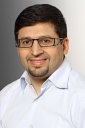
 Ali Jannesari
· 6 previous affiliations
- Idaho State UniversitySince 2024
- Associate Professor · Since 2024
- Iowa State UniversitySince 2018
- Associate Professor · Since 2024
- Assistant Professor · 2018–2024
- University of California, Berkeley2016–2018
- Senior Research Fellow · 2016–2018
- Technische Universität Darmstadt2015–2016
- Junior Research Group Leader · 2015–2016
- RWTH Aachen University2012–2015
- Junior Research Group Leader · 2012–2015
- Karlsruhe Institute of Technology2005–2010
- Postdoctoral Researcher · 2005–2010
Research Overview
Ali Jannesari focuses on the intersection of high-performance computing, artificial intelligence, and software analytics. His early work developed dynamic analysis tools for detecting synchronization defects and profiling data dependencies in parallel programs. Currently, his research investigates machine learning for automated code parallelization, the interpretability of code language models, and hardware-aware optimization for deep learning architectures.
Research Trajectory
Jannesari's early research addressed the fundamental challenges of software reliability and performance in concurrent systems. He developed Helgrind+: An efficient dynamic race detector, which combined lockset algorithms and happens-before relations with correct condition variable handling to reduce false alarms and missed synchronization defects. Continuing in the domain of program analysis, he contributed to An Efficient Data-Dependence Profiler for Sequential and Parallel Programs, which sought to lower the runtime and space overhead of tracking dynamically allocated memory and array indices.
As machine learning began to intersect with systems research, his focus expanded to include distributed and data-driven optimization. This included work in the area of Public Data Dependency in Federated Distillation, such as SPATL: Salient Parameter Aggregation and Transfer Learning for Heterogeneous Federated Learning. Recognizing the limitations of standard machine learning models in understanding complex program structures, his lab introduced PERFOGRAPH: A Numerical Aware Program Graph Representation for Performance Optimization and Program Analysis. This representation captures the numerical realities of code, advancing work in the broader area of Structural Logic in Code Language Models.
A major theme in Jannesari's recent trajectory is the application of large language models (LLMs) and transformers to high-performance computing, specifically targeting the area of Scaling Sequential Logic to Manycore Architectures. He led the development of CodeRosetta: Pushing the Boundaries of Unsupervised Code Translation for Parallel Programming, an unsupervised transformer model that translates standard programming languages into HPC extensions like CUDA. This work directly addresses challenges in the research direction of Bridging the Parallel Data Gap in Program Translation. Building on this, his group introduced OMPILOT: Harnessing Transformer Models for Auto Parallelization to Shared Memory Computing Paradigms, a lightweight model that automates C++ parallelization using OpenMP and introduces a metric to verify functional correctness. To further enhance zero-shot parallelization, he developed AutoParLLM: GNN-guided Context Generation for Zero-Shot Code Parallelization using LLMs, which integrates Graph Neural Networks to provide precise architectural context to LLMs.
He has also contributed to broader code translation pipelines, participating in the design of a dual-LLM framework in Beyond Code Pairs: Dialogue-Based Data Generation for LLM Code Translation to generate multi-turn training data for low-resource languages. Extending domain-specific translation to machine learning frameworks, his recent work includes Learning Bug Context for PyTorch-to-JAX Translation with LLMs, which leverages in-context learning from real-world bugs to improve the reliability of framework-to-framework code conversion.
Parallel to code generation, Jannesari investigates the internal mechanisms and efficiency of neural models. He contributed to neuron-level analyses in Interpreting Pretrained Source-code Models using Neuron Redundancy Analyses, identifying task-irrelevant neurons to facilitate model compression, which aligns with the broader area of Extracting Interpretable Features from Neural Superposition. He subsequently formalized this interpretability effort with Analyzing Latent Concepts in Code Language Models, introducing a framework that clusters internal representations to uncover the latent concepts models use to understand programs.
To address the computational bottlenecks of deploying large models, his research explores hardware-aware pruning and compression. He introduced PerfMamba: Performance Analysis and Pruning of Selective State Space Models, which uses internal gating signals to remove redundant states in Mamba architectures. Similarly, SuperSAM: Crafting a SAM Supernetwork via Structured Pruning and Unstructured Parameter Prioritization applies layer-wise structured pruning to the Segment Anything Model, creating highly efficient subnetworks for edge inference. He also automated this optimization process with ProfilingAgent: Profiling-Guided Agentic Reasoning for Adaptive Model Optimization, a multi-agent system that generates custom pruning and quantization strategies based on hardware profiling data. Further expanding efficient architecture design to continual learning, Jannesari guided Sparse Subspace-to-Expert Sharing for Task-Agnostic Continual Learning, introducing a sparse mixture-of-experts approach that shares parameter subspaces across tasks without explicit task boundaries.
Jannesari's expertise in performance modeling extends to real-time scheduling and cyber-physical navigation. He developed GraphPerf-RT: A Graph-Driven Performance Model for Hardware-Aware Scheduling of OpenMP Codes, a surrogate model that predicts OpenMP task performance on heterogeneous embedded systems to enable risk-aware, energy-efficient scheduling. In the domain of autonomous navigation, he applied reinforcement learning to drone path planning in Maximizing aerial detection of organic objects in non-exhaustively searchable survey area. This framework adapts to real-time wind conditions and object distributions, contributing to the research direction of Exploiting Environmental Flow for Energy-Efficient Navigation.
Current Directions
Recent work investigates the intersection of large language models and high-performance computing, with a strong emphasis on automating complex software engineering tasks. The most recent papers in the evidence address zero-shot code parallelization and domain-specific translation, utilizing graph neural networks and in-context learning to help LLMs generate functionally correct parallel code and translate between machine learning frameworks like PyTorch and JAX.
Concurrently, Jannesari is focused on hardware-aware model optimization and interpretability. This includes developing multi-agent systems and structured pruning techniques to compress state space models and large vision transformers for efficient edge inference. Alongside these optimization efforts, his current research seeks to demystify code language models by clustering internal representations to extract human-readable latent concepts, ensuring that AI-driven software tools remain both efficient and interpretable.
Profile updated
Loading new papers…
Other researchers whose papers cluster into the same research directions — a proxy for overlapping technical interests and shared intellectual neighborhoods.
See something wrong? Report a mistake