

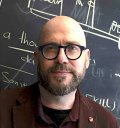
 Alan Aspuru-Guzik
· 2 previous affiliations
- University of TorontoSince 2018
- Director · Since 2021
- Full Professor · Since 2018
- Harvard University2006–2018
- Professor · 2006–2018
1 other author named Alan Aspuru-Guzik: Alán Aspuru-Guzik (2 papers)
Research Overview
Alan Aspuru-Guzik focuses on the intersection of machine learning, quantum chemistry, and materials discovery, developing data-driven representations to accelerate molecular design. His trajectory spans the creation of continuous chemical spaces, generative models for materials, and deep learning frameworks for electronic structure calculations. Most recently, his work investigates scalable autoregressive generation, deep equilibrium models for molecular dynamics, and neural wavefunctions for high-fidelity quantum chemistry.
Research Trajectory
Early in the observed period, Aspuru-Guzik focused on foundational methods for mapping discrete molecular structures into continuous latent spaces. In 2023, he introduced Automatic chemical design using a data-driven continuous representation of molecules. By utilizing deep neural networks to create a continuous representation, this work enabled the use of gradient-based optimization to generate novel molecules with targeted properties. This approach provided a new mechanism for exploring chemical space, contributing to the research direction of Navigating the Combinatorial Complexity of Chemical Space and addressing the broader challenge of Overcoming Syntactic Fragility in Molecular Language Models.
Building on this generative foundation, his research expanded into applied inverse design workflows. In 2024, he and his collaborators published Artificial design of organic emitters via a genetic algorithm enhanced by a deep neural network. By combining genetic algorithms with deep neural network filters, the team successfully identified over 10,000 new organic molecules for next-generation OLEDs. This AI-accelerated workflow navigated massive chemical spaces to find rare emitters that defy standard photophysical rules, advancing work in the area of Robust Grammar Constrained Molecular Strings.
In 2025, his work broadened significantly to encompass scalable 3D generation, the interpretability of materials models, and the acceleration of fundamental computational chemistry tasks. He contributed to the development of Quetzal, detailed in Scalable Autoregressive 3D Molecule Generation. This autoregressive model generates 3D molecular structures atom-by-atom by combining a causal transformer with a lightweight diffusion multi-layer perceptron, matching the quality of state-of-the-art diffusion models while offering substantial speedups and natively handling tasks like scaffold completion. Concurrently, he explored the theoretical underpinnings of materials discovery in A tomographic interpretation of structure-property relations for materials discovery. This paper introduced a framework treating material properties as projections of a hidden material essence, using information theory to quantify how different properties encode complementary or redundant information. His group also investigated cognitive-inspired frameworks for large language models, introducing Schema-Activated In-Context Learning in Schema for In-Context Learning to force models to build abstract mental templates, thereby improving reasoning efficiency on complex scientific questions.
A major theme that emerged in 2025 was the bypass of computationally expensive operations in molecular simulations. He led the development of Hessian Interatomic Potentials (HIP), a deep learning approach that predicts molecular Hessians directly from atomic structures without relying on automatic differentiation or finite differences. This methodology was detailed across multiple publications, including a conference presentation, Shoot from the HIP: Hessian Interatomic Potentials without derivatives, and a comprehensive preprint, Shoot from the HIP: Hessian Interatomic Potentials without derivatives. By constructing SE(3)-equivariant Hessians from irreducible representations during message passing, the HIP model achieves significant speedups for critical tasks like reaction pathway discovery and vibrational analysis. Similarly, he sought to optimize molecular simulations by transforming equivariant neural networks into deep equilibrium models in DEQuify your force field: More efficient simulations using deep equilibrium models. The resulting DEQuiformer architecture reuses computational features from previous time steps to exploit temporal continuity, improving inference speed and parameter efficiency.
Moving into 2026, the trajectory shifted toward high-fidelity quantum chemistry and the control of generative models. He introduced the MoLe (Molecular Orbital Learning) framework in Coupled Cluster con MoLe: Molecular Orbital Learning for Neural Wavefunctions. This equivariant machine learning model predicts high-accuracy Coupled Cluster wavefunctions directly from simple Hartree-Fock inputs by learning the underlying mathematical amplitudes rather than just total energy. This line of research, which contributes to the area of Neural Initializations for Electronic Structure Solvers, was further expanded in MōLe-Λ: Learning the Coupled-Cluster Response State for Energies, Gradients, and Properties. Here, the model learns the full coupled-cluster response state—both right-hand and left-hand amplitudes—from localized Hartree-Fock molecular orbitals, enabling faster computation of energies, forces, and a wide range of molecular properties.
Alongside these quantum chemistry advancements, he developed new techniques for generative modeling and autonomous workflows. In Discrete Feynman-Kac Correctors, he introduced a framework that allows for flexible control over the generation process of discrete diffusion models without retraining, enabling users to fine-tune sampling distributions for tasks like annealing or incorporating external rewards. Finally, he explored the orchestration of complex scientific tasks through structured execution graphs in El Agente Gráfico: Structured Execution Graph for Scientific Agents.
Current Directions
The most recent papers in the evidence address the integration of machine learning with rigorous quantum mechanical calculations and the development of controllable scientific agents. Current work heavily investigates neural network representations of the quantum Hamiltonian, specifically focusing on predicting Coupled Cluster wavefunctions and response states to bypass traditional, computationally expensive solvers. By learning mathematical amplitudes directly from Hartree-Fock inputs, these models aim to scale high-fidelity quantum chemistry to larger, unseen molecules. Additionally, ongoing research explores the control of discrete generative models through training-free guidance and the design of structured execution graphs to facilitate complex, multi-step reasoning in automated scientific discovery workflows.
Profile updated
Loading new papers…
Other researchers whose papers cluster into the same research directions — a proxy for overlapping technical interests and shared intellectual neighborhoods.
See something wrong? Report a mistake