


- Certification for Machine Learning Methods through the Care Label Framework
Abstract
As machine learning (ML) transitions from research to deployment, a "trust gap" has emerged between developers and end-users. This paper proposes the Care Label Framework, a standardized certification system designed to bridge this gap. By integrating theoretical ratings with empirical hardware benchmarks, the framework generates a visual certificate—similar to energy ratings on household appliances—that evaluates a model's reliability, usability, and environmental impact. This approach ensures that software implementations strictly adhere to their underlying mathematical guarantees, providing a transparent evaluation tool for both experts and non-experts.
Introduction: The Trust Gap in Machine Learning
The rapid integration of machine learning into everyday products has outpaced the development of standardized evaluation metrics accessible to non-specialists. While Explainable AI (XAI) provides tools for researchers, the average consumer or business deployer lacks a clear way to assess a model's reliability, resource consumption, or carbon footprint. Furthermore, a significant disconnect often exists between a method's theoretical properties and its specific software implementation. A model might be theoretically sound but practically inefficient or buggy. To address this, we need a certification process that validates both the abstract method and its real-world deployment.
The Care Label Framework
The proposed framework consists of three core pillars designed to provide a comprehensive view of an ML method's performance and requirements.
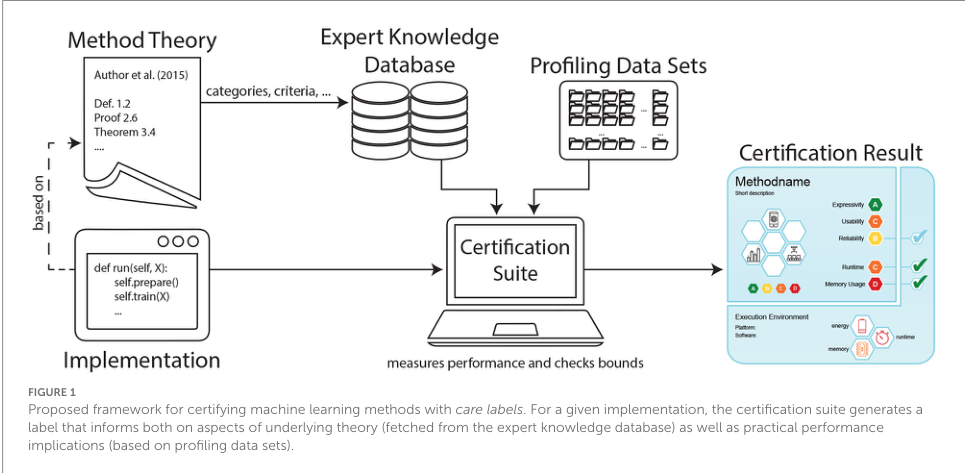 *[Yes We Care!
- Certification for Machine Learning Methods through the Care Label Framework, page 4](/pdf/art_00df23bd658e4e7caf2ce67b9487ed9e#page=4)*
1. The Care Label Design
The visual certificate is divided into two segments:
- Theory Segment: This part displays static ratings (A through D) across five critical categories: Expressivity, Usability, Reliability, Runtime, and Memory. These ratings are derived from established theoretical properties.
- Implementation Segment: This part provides dynamic measurements taken on specific hardware. It includes real-world data on energy consumption (measured in Watt-seconds), actual runtime, and memory usage.
2. Expert Knowledge Database
This community-driven repository stores the theoretical properties of various ML methods. Ratings are determined through objective "yes/no" criteria, such as whether a model is hyperparameter-free or if it provides exact inference.
3. Certification Suite
The Certification Suite is a software tool that bridges theory and practice. It performs bound checks—automated tests using synthetic data—to verify that a specific software implementation obeys its theoretical guarantees (e.g., convergence rates or error bounds). Simultaneously, it measures the implementation's resource consumption on the target hardware.
Experimental Validation: Markov Random Fields
To demonstrate the framework's utility, the authors evaluated two variants of Markov Random Fields (MRFs): Junction Tree (JT) inference (an exact method) and Loopy Belief Propagation (LBP) (an approximate heuristic). The evaluation utilized synthetic datasets, including grid graphs (up to $15 \times 15$ vertices) and Erdos-Renyi random graphs, to profile scaling and reliability.
Reliability vs. Efficiency Trade-offs
The framework clearly highlighted the inherent trade-offs between these methods:
- Junction Tree (JT): Received an 'A' for Reliability due to its mathematical exactness but a 'D' for Runtime and Memory because of its exponential scaling.
- Loopy Belief Propagation (LBP): Received a 'B' for Runtime but a 'D' for Reliability, reflecting its nature as a heuristic without formal guarantees.
Quantitative Energy Insights
The care label revealed a massive disparity in energy consumption. On a $14 \times 14$ grid graph, the JT implementation consumed 416.88 Watt-seconds, whereas the LBP implementation required only 20.63 milli-Watt-seconds. This 20,000x difference, often obscured in standard research papers, is made immediately apparent to the user through the label.
Key Insights and Implementation Rules
A critical component of the framework is the "Infimum" Rating Rule. To maintain the integrity of the certification, the framework uses a pessimistic combination strategy: the overall rating for a category like "Reliability" is determined by the lowest-rated component in the pipeline. If a reliable method is paired with an unreliable inference algorithm, the final label reflects the weaker link.
Furthermore, the framework treats energy consumption as a first-class metric. Inspired by EU energy labels for appliances, this feature addresses the growing environmental concerns surrounding large-scale machine learning models.
Limitations and Future Directions
While the Care Label Framework provides a robust starting point, several challenges remain:
- Curation: The expert knowledge database currently requires manual entry by specialists. Future iterations could leverage automated extraction from scientific literature.
- Scope Expansion: The current proof-of-concept focuses on probabilistic graphical models. Extending this to Deep Learning architectures (like Transformers) is challenging due to the lack of tight theoretical bounds for many neural networks.
- Complexity Management: As ML pipelines become more modular, the logic for combining ratings will need to evolve to handle increasingly complex dependencies.
Conclusion
The Care Label Framework offers a path toward standardized, transparent, and trustworthy machine learning. By translating complex asymptotic complexities into simple, visual ratings and verifying code against theory, it empowers users to make informed decisions about the models they deploy.
Summary updated