


TL;DR
WoRD (Waypoint Recognition with Diffusion) treats online goal recognition as a posterior inference problem using a learned diffusion-based trajectory prior. By maintaining independent denoising chains for each candidate goal and guiding them with analytic observation gradients, it preserves well-calibrated, multimodal beliefs during highly ambiguous trajectory prefixes where traditional filters and classifiers often fail.
What Problem Does This Paper Address?
Goal recognition—inferring where an agent is headed based on partial observations—is a fundamental challenge in autonomous systems and human-robot interaction. The problem is hardest during the "ambiguous prefix": the early part of a path that could reasonably lead to multiple different goals.
Existing methods suffer from three main issues:
- Unimodal Collapse: Probabilistic filters (like Kalman filters) often "lock on" to a single goal too early, becoming unable to recover if that guess was wrong.
- Overconfidence: Discriminative classifiers (like GRUs) are trained to pick the right label, often pushing all probability mass onto one candidate even when the evidence is still ambiguous.
- Model Dependency: Many methods require hand-crafted dynamics models that are difficult to specify for complex, obstacle-filled environments.
As illustrated in Figure 1, a pedestrian in the middle of an intersection might be heading toward several different exits. A faithful recognition system must maintain a multimodal belief until the agent's behavior becomes truly distinctive.
Methods
WoRD introduces a framework that uses Diffusion Models not for generation, but for online posterior inference.
- Learned Trajectory Prior: Instead of a physics-based motion model, WoRD uses a Temporal U-Net trained on trajectory data to learn a score field $\nabla_\tau \log p(\tau | w^j)$. This allows the model to naturally account for obstacles and goal-directed behavior without explicit manual modeling.
- Per-Goal Denoising Chains: For every candidate goal in a set $W$, WoRD runs an independent denoising process. This ensures that hypotheses don't compete or "collapse" into one another prematurely.
- Analytic Observation Guidance: To keep the generated trajectories consistent with what has actually been observed, the authors derive a closed-form log-likelihood gradient from the measurement model. This gradient "steers" the diffusion process toward the observed path at every step.
- Warm-Starting for Real-Time Use: Standard diffusion is slow. WoRD achieves online speeds by "warm-starting": rather than starting from pure noise for every new observation, it re-noises the previous estimate slightly and refines it, cutting computational costs significantly.
- Bayesian Reweighting: Finally, the likelihoods from each per-goal chain are combined via Bayes' rule to produce a calibrated posterior distribution over the goal set.
Datasets
The authors evaluated WoRD across both simulated and real-world environments:
- Simulated Domains (Sim 3WP, 4WP, 4WP-c): Procedurally generated 2D worlds with obstacles and varying numbers of waypoints. The "complex" (4WP-c) variant specifically features long ambiguous prefixes.
- rounD (Vehicles): A real-world dataset of vehicle trajectories at German roundabouts.
- inD (Pedestrians): A real-world dataset of pedestrian trajectories at busy intersections.
For the real-world data, candidate goals were extracted using DBSCAN clustering on the terminal positions of agents in the training set.
Key Insights and Ideas
- Diffusion as a Process Model: The core "aha moment" is replacing the analytical transition model of a Kalman filter with the score function of a diffusion model. This allows the system to handle complex, non-Gaussian trajectory distributions.
- Guidance without Classifiers: Unlike many conditional diffusion models that require a separately trained classifier for guidance, WoRD uses the physical geometry of the observations to guide the chains analytically.
- Calibration is Safety: The paper emphasizes that for safety-critical applications (like autonomous driving), being "calibrated" (knowing when you don't know) is more important than simple argmax accuracy. WoRD is specifically designed to avoid the "Confident-and-Wrong" (CaW) failure mode.
Key Results
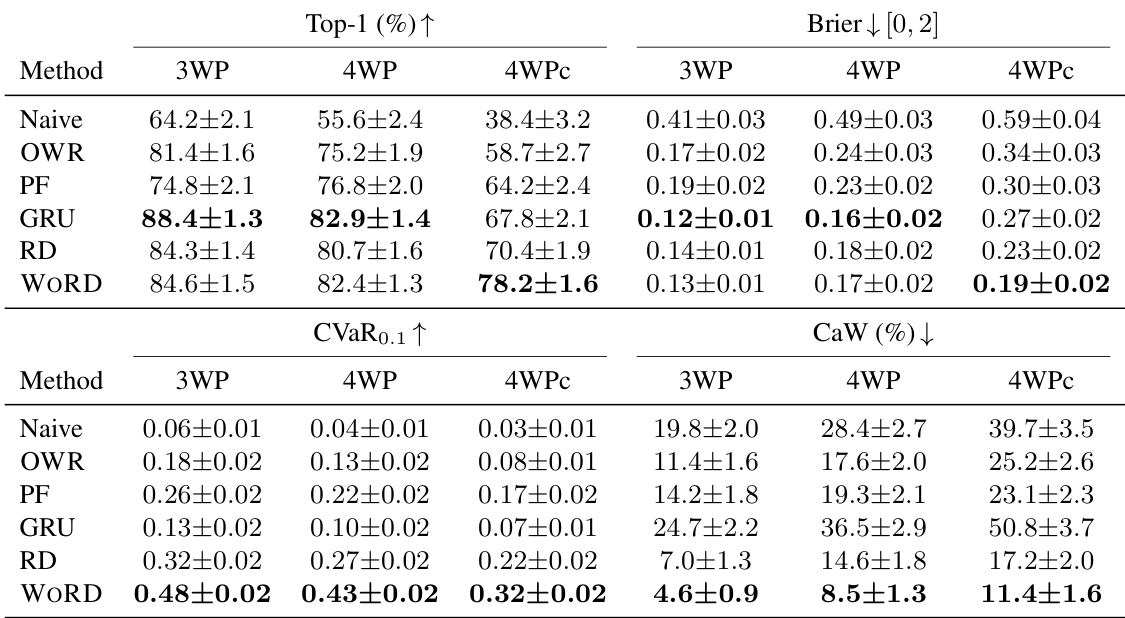
WoRD consistently outperformed baselines (including GRU classifiers and Particle Filters) on metrics targeting calibration and tail-end performance.
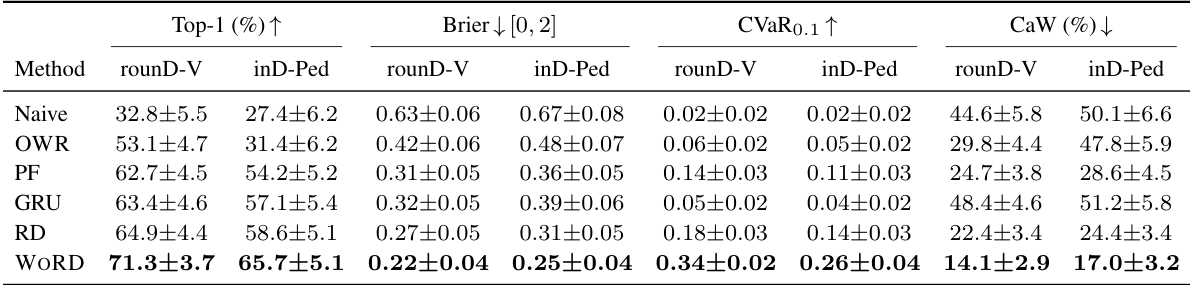
- Complex Scenarios: In the most ambiguous settings, WoRD maintained a significant lead. For example, on the rounD vehicle dataset, it achieved a Top-1 accuracy of 71.3%, compared to 63.4% for a GRU classifier.
- Safety Metrics: WoRD drastically reduced the "Confident-and-Wrong" (CaW) rate. On the inD pedestrian dataset, WoRD's CaW was 17.0%, while the GRU classifier was overconfident and wrong 51.2% of the time.
- Efficiency: The warm-start mechanism made WoRD 16x faster than standard diffusion inference (Reverse Diffuser), bringing per-update latency down to ~10ms, which is suitable for real-time sensor rates.
Limitations and Future Work
- Closed-Set Assumption: WoRD currently requires the set of candidate goals to be known in advance. It cannot yet "discover" a brand-new goal location during inference.
- Computational Overhead: While warm-starting helps, running multiple diffusion chains is still more computationally expensive than a simple Kalman filter.
- State Representation: The current work focuses on 2D planar trajectories. Extending this to 3D states (e.g., for drones) or incorporating latent diffusion for video-based recognition are noted as promising future directions.
Summary updated