


TL;DR
This paper deconstructs complex visual tracking systems into five core components to perform a rigorous ablative analysis. The authors reveal that the feature extractor—not the heavily studied observation model—is the primary driver of tracking performance, showing that a basic tracker built from simple textbook components can compete with the state-of-the-art when properly configured.
What Problem Does This Paper Address?
Visual tracking algorithms are typically evaluated as monolithic systems on standard benchmarks. If Tracker A beats Tracker B, it is incredibly difficult to isolate why—is it due to a superior machine learning classifier, better image features, or a more robust motion model?
This holistic evaluation approach creates a significant blind spot, often leading the research community to over-emphasize complex observation models (classifiers) while treating other vital components as mere engineering afterthoughts. The authors address this gap by proposing a diagnostic framework to break down trackers into individual components, allowing them to systematically identify what actually drives tracking success and failure.
Methods
The authors propose a framework that disassembles a short-term, single-object, model-free tracker into five constituent parts:
- Motion Model: Generates a set of candidate bounding boxes in the current frame based on the target's state in the previous frame (e.g., Particle Filter vs. Sliding Window).
- Feature Extractor: Transforms raw pixel data within candidate regions into informative mathematical representations (e.g., Raw Grayscale, Raw Color, Haar-like features, HOG).
- Observation Model: A classifier that evaluates the candidates and predicts the probability that a candidate is indeed the target (e.g., Logistic Regression, Ridge Regression, SVM, Structured Output SVM).
- Model Updater: Controls the strategy and frequency of updating the observation model to adapt to appearance changes while avoiding drift.
- Ensemble Post-processor: An optional component that merges bounding box predictions from multiple distinct trackers to form a more accurate final prediction.
By holding four of these components constant and systematically swapping out the fifth, the authors conduct a clean, controlled ablative study across different tracking configurations.
Datasets
The primary benchmark used for evaluation is VTB1.0 (Visual Tracking Benchmark), which consists of 50 fully annotated video sequences. The paper also references and tabulates other major benchmarks for context (including PTB, ALOV++, VOT2014, VTB2.0, and NUS-PRO) to show the landscape of tracking evaluation, though no new datasets are introduced.
Key Insights and Ideas
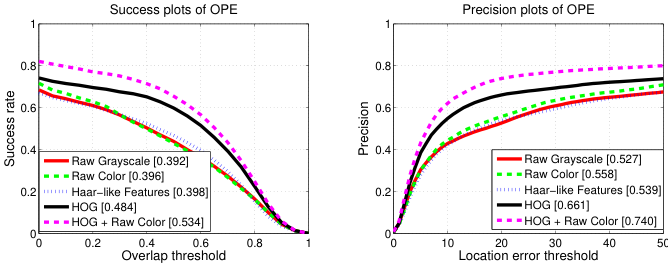
- Features Matter Most: The feature extractor is the single most critical component of a tracker. Upgrading from raw grayscale pixels to a combination of HOG and raw color features boosted tracking success rates by over 20%.
- The Classifier Myth: The tracking community heavily focuses on designing sophisticated classifiers (like Structured Output SVMs). However, the authors found that when strong features (HOG + Color) are used, the choice of classifier barely matters—simple linear logistic regression performs just as well as, or better than, complex alternatives.
- Resolution-Adaptive Motion: Standard motion models often fail during fast object motion because search parameters are set in absolute pixels. Resizing input videos to a fixed scale makes the motion model adaptive to video resolution, significantly improving robustness.
- Updaters are Underrated: Tuning the threshold for when to update the tracking model can alter final performance by more than 10%, yet this component is rarely studied formally.
- Diversity Drives Ensembles: An ensemble post-processor yields massive gains, but only if the underlying trackers are highly diverse (e.g., combining entirely different tracking algorithms rather than just varying the classifiers within the same framework).
Key Results
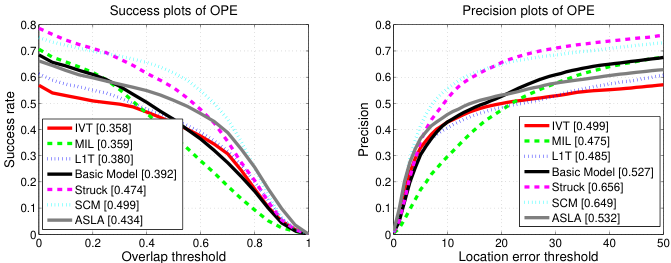
By combining basic textbook components—a Particle Filter motion model (with video resizing), HOG + Raw Color features, and a simple Logistic Regression classifier—the authors built a "Basic Model" that achieved an Area Under Curve (AUC) score of 0.392 on the VTB1.0 success plot, outperforming several highly complex trackers of its time like IVT and MIL.
When fully optimized with HOG + Raw Color features, this basic setup reached a success plot AUC of 0.534 and a precision score of 0.740, surpassing the best overall monolithic performance reported in the original VTB1.0 benchmark paper.
Limitations and Future Work
- Component Coupling: The framework assumes components can be cleanly separated. However, some tracking paradigms are tightly coupled and cannot be easily disassembled—such as mean-shift trackers, part-based methods, or modern deep learning architectures that optimize features and classification end-to-end.
- Speed vs. Accuracy: The study focuses purely on tracking accuracy and robustness, ignoring computational speed. The authors' best-performing MATLAB combination runs at only around 10 frames per second (fps), whereas real-world applications often require much faster processing.
- Future Directions: The authors call for more research into lightweight yet effective feature representations, principled mathematical frameworks for model updating, and advanced ensemble methods.
Summary updated