


TL;DR
Standard Mean Teacher (MT) frameworks struggle with cross-domain object detection because they inherently drift toward a heavy bias favoring the source domain. This paper introduces the Unbiased Mean Teacher (UMT) framework, which corrects this bias using pixel-level domain translation and a dynamic out-of-distribution sample selection strategy, setting new state-of-the-art results across multiple domain adaptation benchmarks.
What Problem Does This Paper Address?
Deep learning models excel when test data matches their training data, but their performance plummets when deployed in new environments—a challenge known as domain shift. In object detection, this shift can be caused by changes in weather, lighting, or artistic style. Because annotating bounding boxes in every possible environment is prohibitively expensive, researchers rely on unsupervised domain adaptation (UDA).
A popular starting point for UDA is the Mean Teacher (MT) framework, where a "student" model learns from the pseudo-labels generated by a "teacher" model (which is an exponential moving average of the student). However, the authors reveal a fundamental flaw: because the primary supervision still originates from the labeled source domain, the teacher model becomes heavily biased toward the source domain. As a result, its predictions on target domain images are highly unreliable, leading to poor distillation.
Methods
To counteract this model bias, the authors propose Unbiased Mean Teacher (UMT), which introduces three core strategies to "heal" the training process:
- Healing Teacher Bias (Cross-Domain Distillation): The authors use CycleGAN to translate unlabeled target images into "source-like" images. Because the teacher model is biased toward the source domain, it generates much more accurate pseudo-labels on these source-like images. The teacher processes the source-like image to generate bounding boxes, while the student is optimized using the original target image, forcing the student to adapt to the true target domain.
- Healing Student Bias (Target-like Augmentation): Conversely, source images are translated into "target-like" images. The student is trained on these target-like images using the original source annotations, making its feature representations more favorable to the target domain from the start.
- Healing the Teaching Process (Out-of-Distribution Estimation): Domain adaptation is dynamic; as the model trains, its familiarity with different samples changes. UMT introduces a side-branch to predict a sample's "confidence"—specifically, how likely it is to be an in-distribution sample. This confidence score is used to dynamically select the best sample pairs for distillation and to interpolate soft labels during training.
Datasets
The UMT framework was evaluated across three distinct types of domain shifts using standard benchmarks:
- Real to Artistic: Training on PASCAL VOC (2007 and 2012) and adapting to Clipart1k and Watercolor2k.
- Normal to Adverse Weather: Training on Cityscapes (clear weather) and adapting to Foggy Cityscapes.
- Synthetic to Real: Training on SIM10K (synthetic driving scenes from GTA V) and adapting to Cityscapes.
Key Insights and Ideas
- The "Source-Like" Trick: The most striking insight is that the teacher model's domain bias can be weaponized. Instead of trying to force the teacher to understand the target domain perfectly, feeding it target images styled to look like the source domain yields significantly cleaner, more accurate pseudo-labels.
- Dynamic vs. Static Adaptation: Relying solely on offline image translation (like CycleGAN) isn't enough because it doesn't account for how the model evolves during training. The addition of the dynamic out-of-distribution confidence branch ensures the teaching process adapts alongside the model.
- Surpassing the Oracle: In the weather adaptation experiment (Cityscapes $\rightarrow$ Foggy Cityscapes), UMT actually outperformed the "Oracle" baseline (a model trained directly on clean target data). This suggests that leveraging clear-weather source data provides structural priors that can actually boost performance in low-visibility target settings.
Key Results
UMT achieved significant performance gains over previous state-of-the-art (SOTA) methods across all datasets:
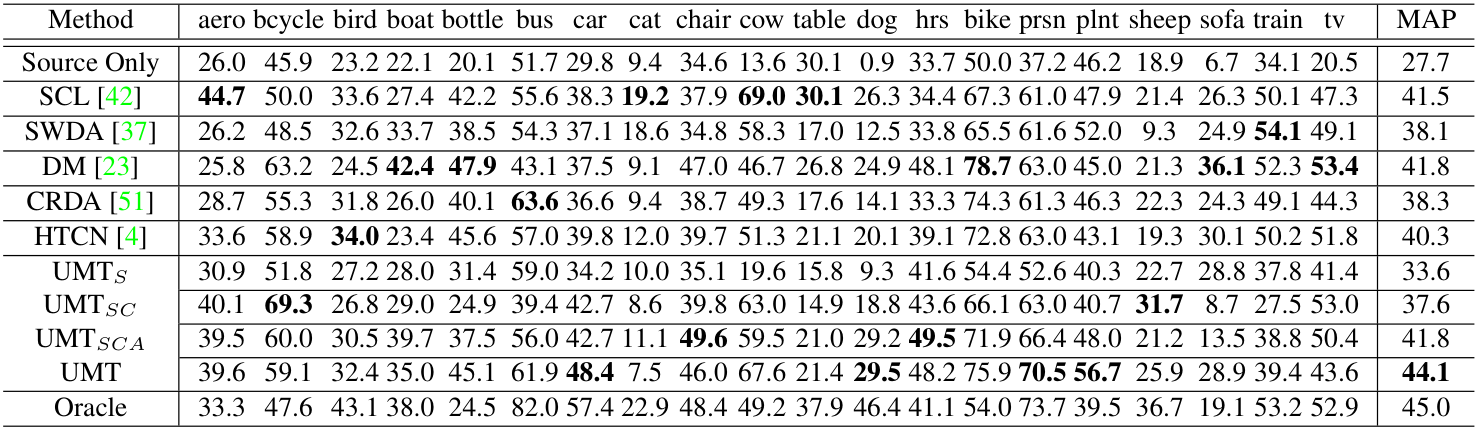
- PASCAL VOC $\rightarrow$ Clipart1k: Achieved 44.1% mAP, a notable increase over previous methods like DM (41.8%) and standard Mean Teacher (33.6%).
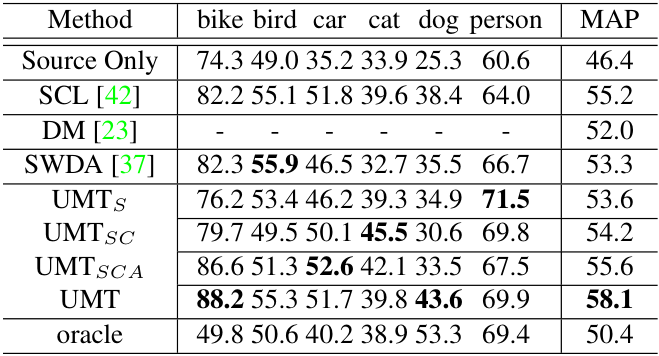
- PASCAL VOC $\rightarrow$ Watercolor2k: Reached 58.1% mAP, outperforming the baseline standard Mean Teacher model (53.6%).
- Cityscapes $\rightarrow$ Foggy Cityscapes: Achieved 41.7% mAP, outperforming the SOTA method HTCN (39.8%) and even beating the Oracle baseline (40.3%).
- SIM10K $\rightarrow$ Cityscapes: Reached 43.1% mAP on car detection, outperforming standard MT (40.8%) and other adversarial methods.
Limitations and Future Work
While UMT delivers impressive results, it relies on an offline image-to-image translation step (CycleGAN) to generate the source-like and target-like images before the main training loop begins. This introduces a two-stage dependency, increasing preprocessing time and relying heavily on the quality of the generative model.
Future work could explore integrating the pixel-level domain translation directly into the end-to-end training framework or extending this unbiased teacher strategy to other complex vision tasks like instance segmentation.
Summary updated